
India’s ‘new normal’ collapses as Pakistan reinforces deterrence: ISA–IRS dialogue
India’s ‘new normal’ collapses as Pakistan reinforces deterrence: ISA–IRS dialogue
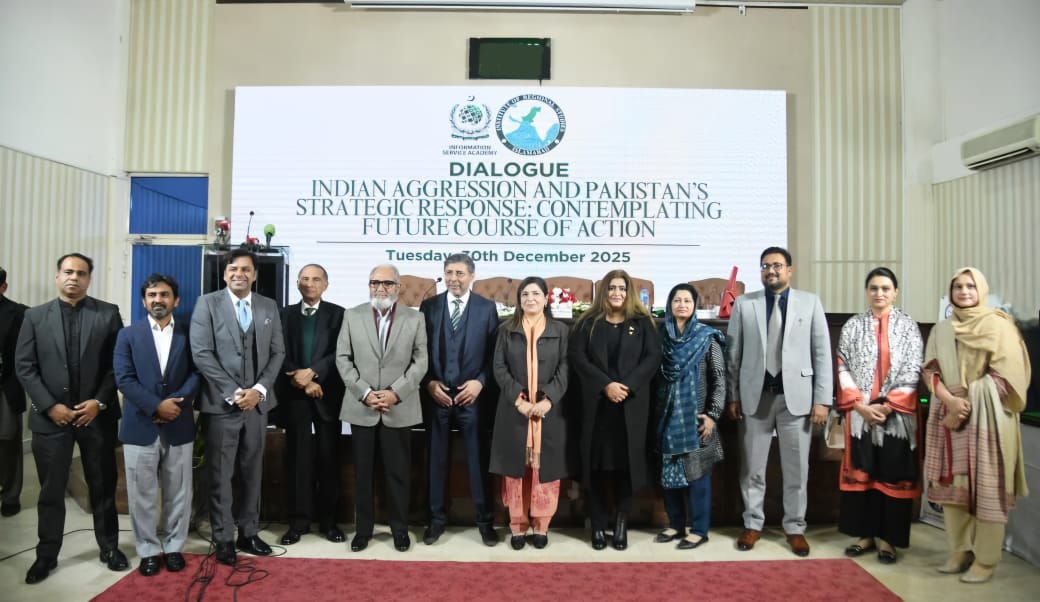
ISLAMABAD, Dec 30 (APP): Pakistan’s strategic resolve and calibrated response have decisively reset the regional balance, senior security analysts, diplomats and scholars observed on Tuesday as the Information Service Academy (ISA), in collaboration with the Institute of Regional Studies (IRS), hosted a high-level dialogue on “Indian Aggression and Pakistan’s Strategic Response.”
Speakers said South Asia was passing through a defining moment marked not by routine tension but by the failure of India’s coercive strategy to impose a so-called “new normal” on Pakistan.
The event commenced with the national anthem, followed by national songs to pay tribute to the armed forces of Pakistan in recognition of their professionalism and sacrifices, particularly after the successful operation Bunyan-ul-Marsoos.
In her welcome remarks, Executive Director General of the Information Service Academy (ISA) Ms Imrana Wazir welcomed the distinguished participants and underscored the importance of informed and objective discourse amid heightened tensions in South Asia. She highlighted Pakistan’s strategic potential and emphasized the need for collective intellectual engagement to effectively address emerging regional and global challenges.
The dialogue featured a keynote address by former Chairman Joint Chiefs of Staff Committee, General (R) Zubair Mehmood Hayat, who attended as the Guest of Honour.
He said South Asia was passing through a decisive phase marked by the collapse of India’s attempt to impose a so-called “new normal” on Pakistan. He said India’s strategy of coercion had failed across strategic, political, military and diplomatic domains, exposing serious flaws in its strategic thinking.
Pakistan’s measured yet resolute response, he noted, had redrafted the military equation, imposed tangible costs and punctured myths surrounding escalation dominance, dealing a significant blow to India’s credibility. He added that India had misread Pakistan’s strategic culture by mistaking restraint for weakness and unity for division, while nationalism and media hype could not substitute for sound strategy.
Outlining the way forward, General Hayat said the onus now lay on India to accept the new strategic reality by abandoning coercive fantasies and returning to diplomacy, realism and restraint, though he saw little evidence of such a shift.
He stressed that Pakistan must continue to act as a net stability provider by maintaining credible deterrence, strengthening economic resilience and institutional cohesion, and preparing for hybrid and narrative threats. Emphasising that preparedness was not provocation, he said peace without deterrence was an illusion and stability without readiness amounted to surrender, adding that Pakistan must remain vigilant, prepared and resolute until wisdom prevailed across the border.
Ambassador Jauhar Saleem, President of the Institute of Regional Studies, said South Asia was entering a more volatile phase in which prudence must guide policy as much as boldness, warning that the margin for error in regional crises was rapidly shrinking. He said the May 2025 conflict reaffirmed that the Jammu and Kashmir dispute remained the region’s central tinderbox and that failure to address its political, humanitarian and legal dimensions would leave South Asia vulnerable to recurring crises.
He noted that India’s shift from a calibrated posture to a more assertive, escalation-seeking doctrine had altered regional dynamics, citing measures such as the suspension of the Indus Waters Treaty and economic coercion as indicators of future threshold testing.
Saleem said future conflicts were likely to be short, intense and geographically expansive, with urban centres, cyberspace and outer space now integral to the battlespace, while the rise of Hindutva-driven extremism posed a structural challenge by shrinking space for moderation in India. He said Pakistan’s deterrence had held firm and public resolve had strengthened, but stressed the need to reinforce full-spectrum deterrence, particularly at lower levels of conflict.
Lieutenant General (retd) Khalid Rabbani, former Corps Commander Peshawar said Pakistan must remain fully prepared for future regional challenges, warning that tensions with India are likely to persist. He said past crises had shown Pakistan’s resolve and capability, adding that Islamabad’s responses to Indian actions had been “calibrated but effective.” He noted that India, following recent confrontations, had increased its defence spending and accelerated arms purchases from countries including Russia, France, the United States and Israel.
Rabbani said India’s current political leadership was driven by an ideology of regional dominance and frequently used anti-Pakistan rhetoric for domestic political gains. He cautioned that such an approach could lead to further provocations, including the possibility of more false-flag incidents.
Former Foreign Secretary Ambassador Aizaz Ahmad Chaudhry said the May 2025 conflict had fundamentally altered regional perceptions, exposing India’s overestimation of its military power while reinforcing Pakistan’s confidence, credibility and global standing. He said India failed to demonstrate the military dominance it had assumed and also discovered it could not serve as a counterweight to China.
Chaudhry assessed that New Delhi was unlikely to initiate another conflict in the near future.
Dr Maria Sultan, President of SASSI University, said Pakistan’s air operations during the May conflict marked a turning point in modern warfare, arguing that the use of an integrated “kill chain” methodology by the Pakistan Air Force fundamentally changed how air power could be employed for strategic deterrence.
An interactive question-and-answer session followed, during which students from various universities posed thoughtful and pertinent questions to the panel, enriching the discussion and reflecting strong academic engagement with the subject.
The dialogue concluded with closing remarks by the Executive Director General, who summarized the key takeaways and reaffirmed confidence in Pakistan’s ability to navigate future security challenges through strategic foresight and prudent decision-making.
She noted that this was the first dialogue in a planned series and that similar engagements would be held over the next six months on other relevant and timely topics. She also expressed appreciation for the collaboration and support of the Institute of Regional Studies (IRS) in making the event successful.
The dialogue was well attended by senior government officials, diplomats, representatives from civil society, think tanks, and the media. The active participation of students from diverse universities added depth and vitality to the session, making it both engaging and productive.
APP/tsw/usz