ISLAMABAD, Jun 8 (APP):Supreme Court Judge Justice Miangul Hassan Aurangzeb on Monday called for a “mediation before litigation” approach to dispute resolution as he joined former Supreme Court judge Justice (retd.) Arif Hussain Khilji and Minister of State for Law and Justice Barrister Aqeel Malik in backing a major reform package aimed at making mediation the preferred route for resolving labour and commercial disputes. The reform package, launched by the …
Govt, judiciary back mediation reforms to tackle growing case backlog
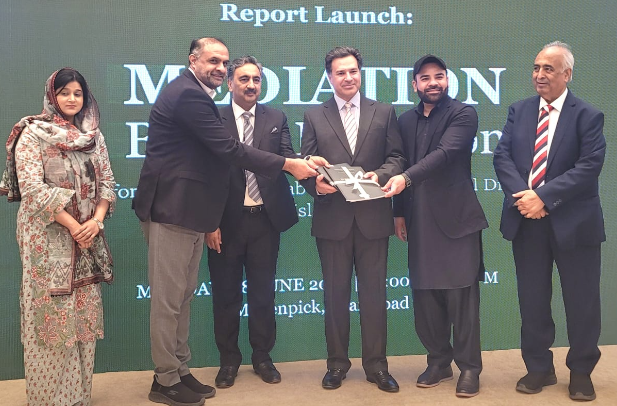
ISLAMABAD, Jun 8 (APP):Supreme Court Judge Justice Miangul Hassan Aurangzeb on Monday called for a “mediation before litigation” approach to dispute resolution as he joined former Supreme Court judge Justice (retd.) Arif Hussain Khilji and Minister of State for Law and Justice Barrister Aqeel Malik in backing a major reform package aimed at making mediation the preferred route for resolving labour and commercial disputes.
The reform package, launched by the Research Society of International Law (RSIL) and the Legal Aid Society (LAS), is accompanied by a report proposing legal and institutional reforms to strengthen implementation of the Alternative Dispute Resolution Act, 2017 and reduce pressure on Pakistan’s overburdened courts.
Delivering the keynote address as chief guest, Supreme Court Judge Justice Miangul Hassan Aurangzeb called for a fundamental shift in legal culture and proposed a new motto for Pakistan’s justice system: “mediate, don’t litigate.”
Drawing on his recent study visit to Turkey, he observed that Pakistan already possessed many of the institutional foundations required to replicate successful mediation models.
Justice Aurangzeb also highlighted institutional weaknesses that could undermine reform efforts, including prolonged periods during which the NIRC operated without a chairman and situations in which commission members remained vulnerable to executive discretion.
Minister of State for Law and Justice Barrister Aqeel Malik described Pakistan’s justice system as standing at a critical juncture. Referring to the more than 2.26 million pending cases across the country, he said the backlog represented not only a legal challenge but also a human crisis affecting livelihoods, rights and economic activity.
He expressed strong support for the concept of “mediation before litigation,” arguing that rising litigation costs had made reform an urgent necessity. The minister said Pakistan’s signing of the Singapore Convention on Mediation reflected the government’s commitment to modern dispute-resolution mechanisms and disclosed that legislation to implement the convention domestically was already being prepared.
Former Supreme Court judge Justice (retd.) Arif Hussain Khilji strongly endorsed mediation as an effective dispute-resolution tool, citing the Legal Aid Society’s experience of resolving two to three cases daily with a settlement rate of approximately 74 per cent. He pointed to Turkey’s investment in mediation infrastructure as a model worthy of consideration in Pakistan and said empathy for litigants should remain the guiding principle behind any justice-sector reform.
Presenting the report’s findings, RSIL Executive Director Jamal Aziz said that despite legislative and institutional progress, the transformative impact envisaged under the ADR framework had yet to materialise. He noted that disputes were still not being referred to mediation on a significant scale, while case backlogs continued to increase.
He attributed the situation to conceptual, systemic and institutional shortcomings within the existing framework and proposed a phased reform package involving targeted amendments to four statutes and two sets of rules. The reforms would begin with labour disputes before the National Industrial Relations Commission (NIRC), expand to wage-related claims and later extend to commercial disputes involving claims exceeding Rs5 million.
Mr Aziz said a substantial portion of the report focused on creating an implementation architecture capable of ensuring that mediation reforms are effectively translated into practice rather than remaining confined to legislation.
Federal Secretary for Law and Justice Raja Naeem Akbar welcomed the report and reiterated the government’s commitment to strengthening alternative dispute resolution mechanisms. He said the Ministry of Law and Justice had already undertaken training initiatives, was working on amendments to the ADR Act and was actively considering measures to make arbitration mandatory in appropriate cases.
Highlighting the specific challenges surrounding labour disputes, Senior Deputy Registrar of the NIRC Saleha Bashir said mediation could provide workers and employers with a quicker and less adversarial means of resolving conflicts. Referring to the Industrial Relations Act, she noted that legal protections extended to all persons in employment and not merely those formally classified as workmen. She stressed the need for greater public awareness of these protections and emphasised the judiciary’s role in ensuring their effective enforcement.
Earlier, Legal Aid Society Board Member Furqan Ali welcomed participants and acknowledged the legal profession’s role in addressing the growing case backlog.
Concluding the event, RSIL President Ahmer Bilal Soofi thanked the speakers and participants and said mediation required not only procedural reform but also reflection and dialogue before conflict escalation. He observed that the principle of honouring agreements occupied a central place in Islamic teachings and provided a natural foundation for mediation. He reaffirmed RSIL’s commitment to pursuing evidence-based legal reforms and supporting their implementation.