Federal Minister for Information Technology and Telecommunication Shaza Fatima Khawaja on Thursday informed the National Assembly that Pakistan’s IT exports were witnessing consistent growth due to government-led reforms, digital skills programmes and policy support aimed at strengthening the country’s technology sector.
Govt committed to boosting IT exports through reforms, digital skills initiatives: Shaza Fatima
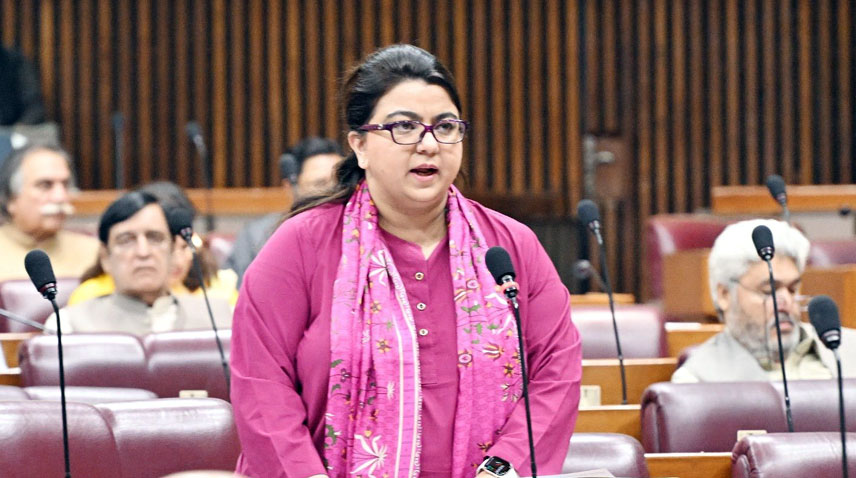
ISLAMABAD, May 14 (APP): Federal Minister for Information Technology and Telecommunication Shaza Fatima Khawaja on Thursday informed the National Assembly that Pakistan’s IT exports were witnessing consistent growth due to government-led reforms, digital skills programmes and policy support aimed at strengthening the country’s technology sector.
Responding to questions during the Question Hour, the minister said Pakistan’s IT exports had been growing by around 20 percent annually over the last several years.
She informed the House that when the incumbent government assumed office, IT exports stood at around $2.4 billion, adding that the figure was expected to cross $4.5 billion during the current fiscal year.
Shaza Fatima credited the growth to the government’s “whole-of-government approach” under the leadership of Prime Minister Shehbaz Sharif, which prioritized the IT sector and facilitated exporters through policy incentives.
The minister said the IT sector remained the only export-oriented industry operating under a final tax regime, adding that companies registered with the Pakistan Software Export Board (PSEB) were subject to only 0.5 percent tax on exports, while non-registered entities paid one percent tax.
She said the government was annually imparting digital and high-tech skills training to more than 500,000 youth, emphasizing that the country’s growing human resource capacity was the key driver behind rising IT exports.
The minister said reforms had also been introduced in training programmes, under which employability had been made a key performance indicator for the release of public funds.
She added that international certifications and third-party evaluations had also been made mandatory for training initiatives, resulting in improved outcomes.
According to the minister, a third-party evaluation of advanced training programmes showed an employability rate of 82 percent, which she termed higher than international benchmarks.
Highlighting facilitation measures for the IT industry, she said the government had established a 24/7 facilitation centre through PSEB and simplified business registration procedures.
She said the time required for PSEB registration had been reduced from 90 days to just nine minutes.
The minister further informed the House that IT companies were being allowed 50 percent dollar retention in special foreign currency accounts, while the State Bank of Pakistan had removed several regulatory hurdles, including restrictions related to Form-E.
Shaza Fatima said companies had also been permitted to invest through Roshan Digital Accounts at the directions of the prime minister.
She said over 250 IT companies had participated in international roadshows over the last two years, while 10 Special Technology Parks and 50 e-Rozgar Centres had been established across the country.
She added that women-specific technology parks had also been set up in Azad Jammu and Kashmir to promote female participation in the digital economy.
Responding to supplementary questions regarding internet services, the minister said Pakistan’s international connectivity had improved with the landing of three submarine cables in recent years.
She said fibre-optic connectivity across the country had expanded significantly, adding that fibre-based household connections had increased from 1.9 million in 2024 to 5.1 million within two years.
The minister said the government was implementing a National Fiberization Policy and had abolished right-of-way charges to accelerate broadband infrastructure development.
She further informed the House that 5G services had entered the rollout phase and pilot services were already available in major areas of Islamabad.
Shaza Fatima said separate monitoring systems for urban and rural internet quality were also being introduced to bridge the digital divide.
The minister said the government had set a target of achieving $15 billion in IT exports along with an additional $10 billion contribution through digital transformation initiatives.
She said efforts were underway to accelerate the sector’s annual growth rate from 20 percent to 30 percent through extraordinary interventions, including artificial intelligence acceleration and implementation of a national AI policy.