Maryam Shah ISLAMABAD, Sep 20 (APP):Residents of Sector G-13 continue to face inadequate water supply despite heavy rains and water accumulation in several parts of the federal capital, calling for a stronger water supply system capable of meeting the sector’s growing domestic requirements. Residents said while talking to APP that the existing arrangement, under which water is supplied twice a week, often falls short of their essential needs. They suggested …
G-13 residents seek relief from persistent water shortage, tanker burden
Maryam Shah
ISLAMABAD, Sep 20 (APP):Residents of Sector G-13 continue to face inadequate water supply despite heavy rains and water accumulation in several parts of the federal capital, calling for a stronger water supply system capable of meeting the sector’s growing domestic requirements.
Residents said while talking to APP that the existing arrangement, under which water is supplied twice a week, often falls short of their essential needs.
They suggested increasing the frequency to at least three times a week or enhancing the quantity and duration of each supply cycle so that households could receive sufficient water without having to depend on tankers.
They said families had already adopted stringent water conservation practices, carefully rationing available supplies and avoiding non-essential consumption. Despite these efforts, however, the available quantity frequently ran out before their daily requirements could be met.
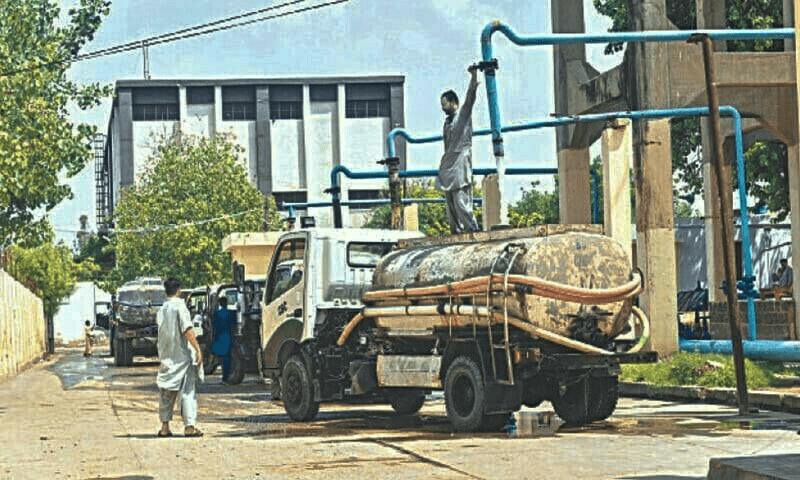
For many households, the shortfall means arranging water tankers two or three times a month. Residents said the recurring expenditure had become increasingly difficult to bear amid rising fuel prices and broader inflationary pressures.
Hafiz Ghulam Ali, Imam of a mosque in G-13, told APP that the limited availability of water is creating considerable difficulties for residents in managing routine domestic affairs.
“We receive water supply, but the quantity is not sufficient for our basic requirements. We use it very carefully and avoid unnecessary consumption, but even then, we have to arrange a water tanker two or three times a month. With fuel prices and overall inflation rising, this additional expense is becoming increasingly difficult for families,” he said.
Munaza Ahmed, a school teacher and resident of G-13, said the situation had become particularly challenging for working women, who had to balance professional commitments with household responsibilities.
“Getting ready for school and taking care of household responsibilities becomes extremely difficult when there is not enough water at home. As a working woman, I have to leave early for my job, but the shortage forces me to spend additional time arranging water before going to school,” she told APP.
She said uncertainty over water availability had complicated even the most basic morning routines.
“We try to make every drop count, but sometimes the available water simply does not last. I have to organise my morning around whether there will be enough water at home.
Waiting for a tanker or arranging water from another source can cause delays and make it difficult to reach work on time,” she added.
Shopkeeper Atif Khan, a resident and trader in G-13, while talking to APP suggested that the authority could use tanker water to supplement the regular distribution network rather than relying on tankers merely as an emergency measure.
“If tankers are already being used to meet the shortfall, why not add that water to the regular supply and increase the quantity reaching households? If residents receive sufficient water through the main system, they would no longer need tankers so frequently,” he told APP.
He said such an approach could simultaneously ease the difficulties faced by residents and reduce the financial burden associated with tanker subsidies.
“The priority should be to strengthen the regular supply instead of continually compensating for its shortage through tanker services. If available resources are used to augment the main distribution system, residents will benefit while the authority’s expenditure on tanker subsidies could also be reduced,” Atif added.
Another resident, Murtaza Turi, acknowledged that the situation had improved considerably compared with previous years, when G-13 faced more severe shortages.
“Compared with a few years ago, the situation is far better now. We appreciate the efforts being made by FGEHA to improve the supply system.
However, further reforms and infrastructure improvements are still needed to ensure that the available water keeps pace with the needs of the growing population,” he told APP.
He urged the authority to continue modernising the distribution network and ensure that infrastructure improvements translated into a dependable supply for residents.
The shortage has become particularly frustrating during periods of heavy rainfall. Residents said it is difficult to reconcile persistent household shortages with the visible accumulation of rainwater across different parts of Islamabad.
They questioned why families should continue purchasing tanker water despite substantial rainfall, saying the situation underscored the need for more effective water management, storage and distribution mechanisms.
They also cautioned that reliance on tankers should remain a temporary contingency arrangement rather than becoming a permanent feature of the sector’s water management system.
Responding to the concerns, an FGEHA spokesperson, in an exclusive interview with APP, said the authority is moving towards a permanent solution through a dedicated pipeline project for G-13 and G-14.
“By December, InshaAllah, the dedicated pipeline will be fully operational, bringing a lasting solution to the water supply challenges faced by residents of G-13 and G-14,” the spokesperson said.
He added that the concerned Deputy Director, Mr. Rafaqat Bhatti, is overseeing the work and that the Housing Authority had directed the relevant teams to ensure its expeditious completion and operationalisation.
The spokesperson said the project, expected to become functional within the next two to three months, would enable the authority to substantially reduce reliance on tanker services and shift towards a more sustainable water supply arrangement.
“InshaAllah, once the pipeline becomes operational, we will overcome the existing difficulties and gradually eliminate dependence on tankers. Residents will be provided water through the permanent supply system drawing on natural reservoirs,” he said.
He described the project as a major step towards securing a stable and dependable water source for the two sectors, replacing short term arrangements with a permanent infrastructure based solution.
The official said recent rainfall had helped replenish local natural water reserves, while FGEHA is simultaneously upgrading the existing distribution infrastructure and subsidising official tanker rates to ease the immediate financial pressure on households.
The dedicated pipeline from Khanpur Dam to Sectors G-13 and G-14 is expected to provide a stable and uninterrupted bulk water supply to the two sectors upon completion.
Residents welcomed the planned infrastructure improvements but called for interim measures to bridge the supply gap until the pipeline becomes fully operational.
They urged the authority to increase the frequency of supply from twice to three times a week, or alternatively enhance the volume and duration of each supply cycle.
They further called for transparent and equitable tanker distribution, stressing that families already coping with rising living costs should not be compelled to repeatedly purchase water simply to fulfil their basic domestic needs.