Deputy Prime Minister and Foreign Minister (DPM/FM), Senator Mohammad Ishaq Dar on Wednesday called for strengthening multilateralism, upholding international law and placing diplomacy at the centre of international relations to address emerging geopolitical and global challenges.
DPM Dar, UN chief call for stronger multilateralism to address global challenges
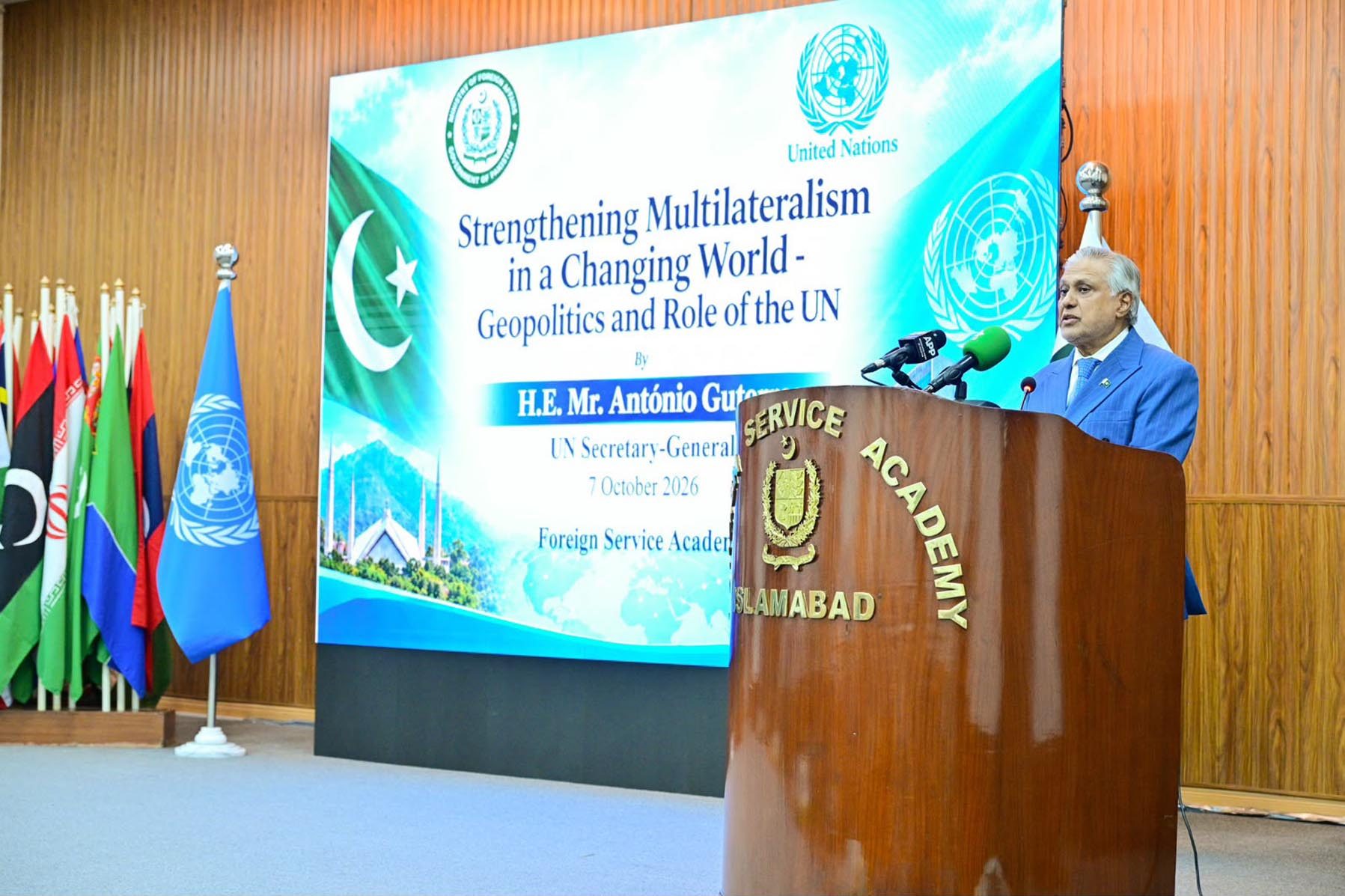
ISLAMABAD, Oct 7 (APP):Deputy Prime Minister and Foreign Minister (DPM/FM), Senator Mohammad Ishaq Dar on Wednesday called for strengthening multilateralism, upholding international law and placing diplomacy at the centre of international relations to address emerging geopolitical and global challenges.
Addressing an interaction with United Nations Secretary-General Antonio Guterres at the Foreign Service Academy, the deputy prime minister said the international order was undergoing profound change, with shifting balances of power, geopolitical competition and technological advances reshaping relations among states.
He said that despite growing interdependence, the willingness of countries to act collectively was weakening, while armed conflicts, selective application of international law, widening inequalities and climate emergencies were compounding instability.
DPM Senator Dar said a more multipolar world would not automatically become more peaceful or equitable and required effective institutions through which power could be exercised responsibly, differences managed peacefully and common challenges addressed collectively.
He described the United Nations as central to this endeavour, citing its universal membership, legitimacy and Charter-based mandate. He said the UN Charter remained a common foundation for an international order based on international law, sovereign equality and collective responsibility.
The deputy prime minister highlighted the UN’s role in supporting diplomatic initiatives, peace agreements, political processes and ceasefires. He also appreciated the contribution of UN peacekeepers and humanitarian personnel, noting Pakistan’s longstanding role as a major troop-contributing country to UN peacekeeping missions.
He said Pakistan had been an active partner in international counterterrorism efforts and remained committed to combating terrorism in all its forms and manifestations.
DPM Dar commended Secretary-General Antonio Guterres for his efforts to defend the UN Charter, advance peace, mobilise climate action and support vulnerable communities, describing him as a great friend of Pakistan.
He said Pakistan’s commitment to multilateralism was a pillar of its foreign policy and outlined priorities including consistent adherence to the UN Charter and international law, placing diplomacy at the centre of international relations, strengthening the legitimacy and capacity of the UN, and addressing the security implications of emerging technologies.
He stressed that treaty obligations and Security Council resolutions must be implemented, while calling for a just and peaceful settlement of the Palestinian issue and the Jammu and Kashmir dispute.
The Deputy Prime Minister also called for reform of the UN Security Council to expand elected representation and accountability, saying that privilege and permanence should not come at the expense of broader representation. He further stressed the need for predictable financing for development, humanitarian action, peacekeeping and peacebuilding.
On emerging technologies, he called for inclusive international frameworks to prevent the misuse of artificial intelligence and other technologies, reduce risks of arms races and escalation, and uphold international law.
Speaking on the occasion, UN Secretary-General Antonio Guterres said he had a special place in his heart for the people of Pakistan, recalling his experience with the country first as UN High Commissioner for Refugees and later as Secretary-General.
He highlighted Pakistan’s generosity in hosting millions of refugees, its resilience in confronting terrorism and its contribution to UN peacekeeping. He said Pakistani peacekeepers had served in some of the world’s most dangerous places, protecting civilians and supporting fragile peace processes.
The UN chief also commended Pakistan’s efforts to facilitate dialogue and de-escalation, including its role in helping forge peace between the United States and Iran.
Turning to climate change, he recalled his visit to Pakistan during the 2022 floods and described the disaster as demonstrating a profound injustice. He noted that Pakistan contributed around one percent of global emissions but remained among the countries most vulnerable to climate disasters.
He praised the resilience and solidarity demonstrated by Pakistani communities during the floods, saying their response reflected the interconnected nature of global security and the need for countries to help one another during crises.
Secretary-General Guterres said humanity was facing challenges that no country could address alone, including climate disruption, conflict, inequality and transformative technologies such as artificial intelligence.
He said the world was moving towards a multipolar system but multipolarity alone could not guarantee stability. He called for a networked world with multiple centres of power sustained by stronger economic, political, social and technological connections, supported by a multilateral system centred on the United Nations.
He identified four major tests for multilateralism: peace and security, inequalities, the climate crisis and the technological revolution.
On inequality, he said developing countries were increasingly being left behind despite global economic growth, with rising debt burdens and declining development finance. He called for reform of the international financial architecture and said developing countries should not have to choose between servicing debt and investing in their future. He also appreciated Pakistan’s efforts to keep these issues on the global agenda.
On climate change, the UN Secretary-General said its impacts were accelerating and intensifying, with developing countries bearing disproportionate costs. He described climate change as a threat multiplier that was driving displacement, increasing resource pressures, undermining food security and contributing to instability.
He said Pakistan was particularly familiar with these impacts but also recognised that the response to climate change represented a major economic opportunity.
The UN Secretary-General also highlighted the potential of renewable energy, modern infrastructure and innovation, while stressing the need for international support to accelerate the renewable energy transition and help vulnerable countries develop adaptation and resilience plans.
He recalled Pakistan’s leadership of the G77 in efforts that contributed to the establishment of the Loss and Damage Fund, stressing that the fund needed to be urgently operationalised and capitalised.
He noted that less than $500 million had been transferred to the Trust Fund against an annual global climate disaster bill of around $200 billion and rising, underscoring the gap between the scale of climate-related losses and available financing.
On artificial intelligence, Secretary-General Guterres said the technology could accelerate development, improve healthcare, expand educational opportunities, transform agriculture and strengthen disaster preparedness. However, he cautioned that it could also deepen inequalities, concentrate power, spread disinformation and disrupt labour markets.
He called for AI governance to reflect the interests of all humanity, with its benefits broadly shared and risks managed collectively, and stressed that developing countries such as Pakistan should participate actively in shaping the frameworks and institutions governing its use.
Both the Deputy Prime Minister and the UN Secretary-General emphasised the importance of dialogue, international cooperation and effective multilateral institutions in addressing geopolitical, economic, climate and technological challenges.
Later, the UN Secretary General also recorded his impressions in the visitors diary of the Foreign Service Academy.