
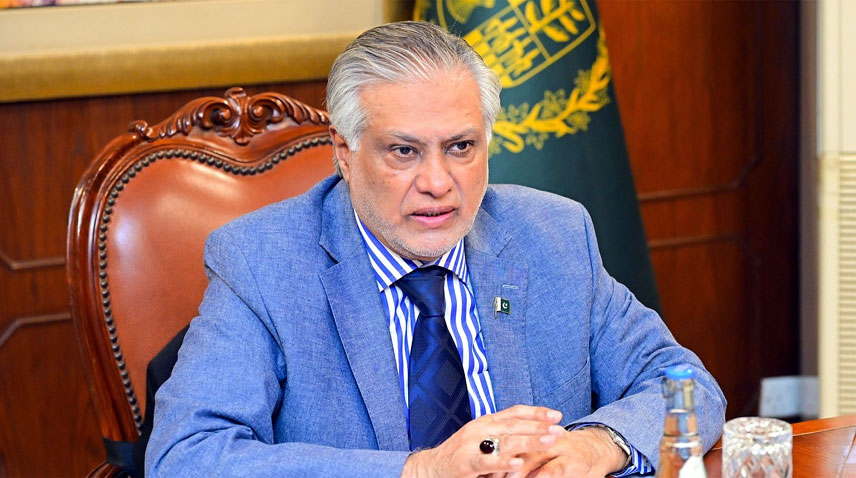

ISLAMABAD, Feb 25 (APP): Deputy Prime Minister and Foreign Minister, Senator Mohammad Ishaq Dar on Wednesday said Islamabad was fully prepared to navigate a rapidly transforming international order, while reaffirming its positions on Jammu and Kashmir, Gaza and regional security.
Addressing the inaugural session of the Pakistan Governance Forum 2026, Dar said the global system established after the Second World War was “in flux”, with norms, institutions and alliances undergoing rapid change.
“The emerging trends are multi-polarity, mini-lateralism and mounting geopolitical contestation,” he said, adding that Pakistan’s foreign policy was equipped to respond to the new realities. He said Pakistan’s foremost priority remained the security of its people and the protection of its sovereignty and territorial integrity.
DPM Dar said persistent provocations from Pakistan’s eastern neighbour, referring to tensions with India, and terrorism emanating from across its western border had not diminished Islamabad’s commitment to peace and dialogue. He described the unresolved dispute over Jammu and Kashmir as being at the heart of regional instability.
Pakistan, he said, continued to call for a just and peaceful resolution of the dispute in accordance with United Nations Security Council resolutions and the Kashmiri people’s right to self-determination. He reiterated Islamabad’s demand for the reversal of India’s measures of August 5, 2019, regarding Indian Illegally Occupied Jammu and Kashmir.
At the same time, Dar underscored that Pakistan possessed both the will and capability to defend itself against aggression, citing what he termed a measured military and diplomatic response to Indian actions in May 2025.
Turning to major power relations, Dar said Pakistan’s “all-weather” partnership with China was deepening through the China-Pakistan Economic Corridor (CPEC) 2.0 and sustained strategic dialogue. He noted that during his meeting in Beijing in January with Chinese Foreign Minister Wang Yi, both sides reaffirmed convergence on Afghanistan, Jammu and Kashmir, water security and counter-terrorism.
He added that Pakistan had also reinvigorated ties with the United States, expanding cooperation beyond traditional security to trade, technology and investment. He referred to recent engagements involving Prime Minister Shehbaz Sharif and senior U.S. officials, including Secretary of State Marco Rubio.
Dar said Pakistan had strengthened partnerships across South Asia, including what he described as a substantive renewal of ties with Bangladesh after a 12-year hiatus in high-level exchanges. A trilateral mechanism involving China, Pakistan and Bangladesh had also been launched to promote regional cooperation, he added.
In the Middle East, he cited a Strategic Mutual Defence Agreement signed with Saudi Arabia in September last year, alongside expanded economic cooperation with the United Arab Emirates, Qatar and other Gulf states.
Dar said Pakistan’s election as a non-permanent member of the United Nations Security Council for the 2025–26 term, with what he described as an overwhelming majority, reflected international confidence in its diplomacy. Since assuming its seat, Pakistan had advocated peaceful conflict resolution, adherence to international law and protection of civilians, he said.
On Gaza, Dar said Pakistan had used multilateral platforms to press for an immediate ceasefire, unhindered humanitarian access and a durable two-state solution. He reiterated support for the establishment of a sovereign Palestinian state based on pre-1967 borders, with Al-Quds Al-Sharif as its capital.
Addressing developments concerning Iran, he said Pakistan was engaging all parties to help defuse tensions and promote dialogue, including through direct contacts with U.S. and Iranian counterparts.
Economic diplomacy, Dar said, was central to the government’s foreign policy, with emphasis on investment, information technology, minerals, agriculture and halal food sectors. The Foreign Office, he added, was pursuing a whole-of-government approach in coordination with economic ministries.
On climate change, Dar described Pakistan as among the countries most vulnerable to its impacts despite minimal contribution to global emissions. He said Islamabad would continue to advocate climate finance, loss and damage funding and adaptation support in multilateral forums, including during its tenure on the Security Council.
“Pakistan’s approach will remain anchored in protecting our core national interests through peaceful means, meaningful dialogue and engagement,” he said, adding that leadership-level diplomacy would remain a key instrument in advancing the country’s objectives.