ISLAMABAD, Nov 24 (APP):Federal Minister for Information Technology and Telecommunication, Shaza Fatima Khawaja, on Tuesday said that cybersecurity is fundamental to the vision of Digital Pakistan, national security, and the protection of the digital economy. Addressing the Pak Crypt International Symposium on Cybersecurity (PCC-2026), held at Air University, she emphasized that promoting cybersecurity and digital trust is essential to ensuring the security and effectiveness of digital payments, digital identity, and …
Cybersecurity fundamental to Digital Pakistan, essential for protecting national trust: Shaza
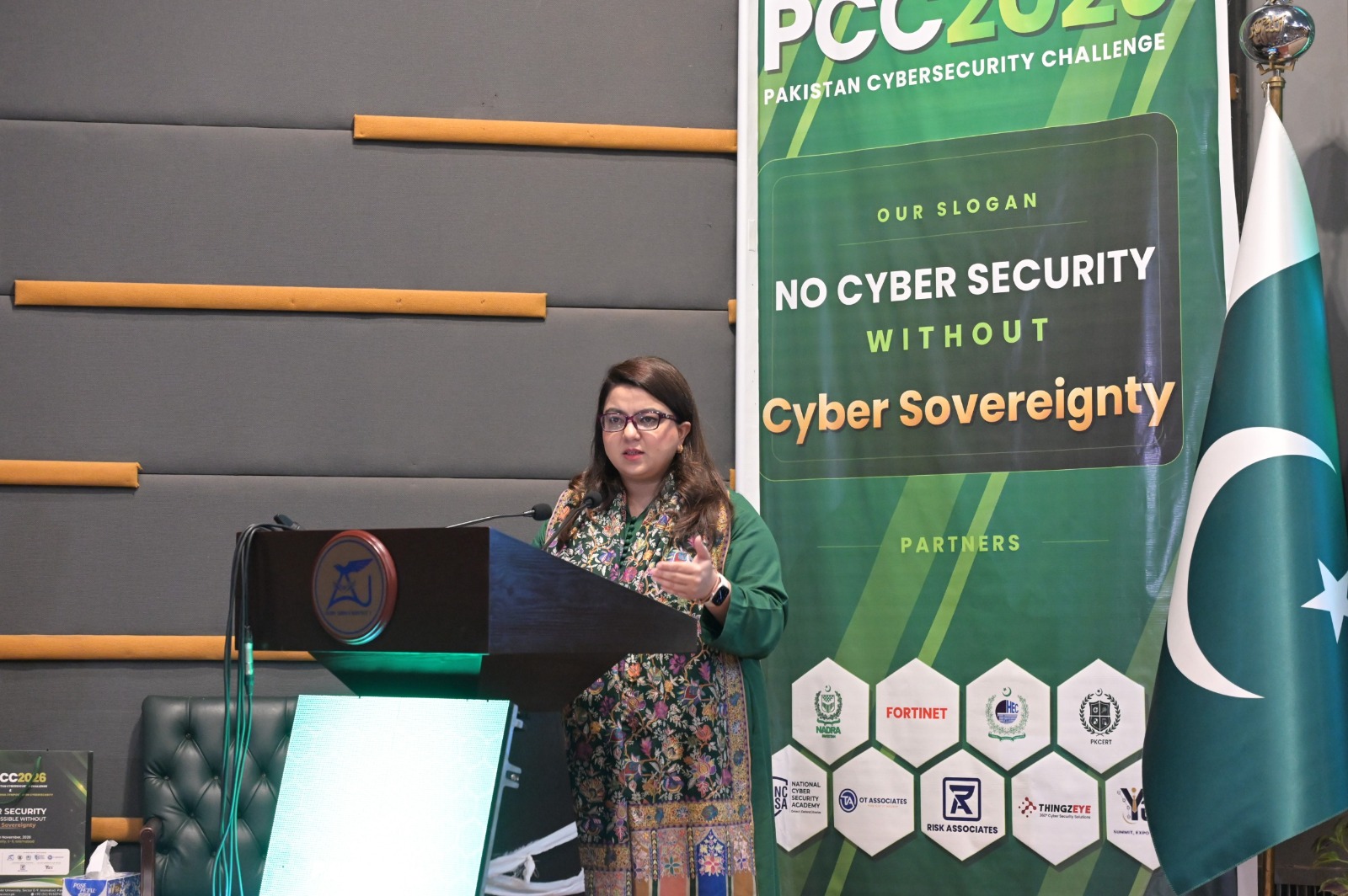
ISLAMABAD, Nov 24 (APP):Federal Minister for Information Technology and Telecommunication, Shaza Fatima Khawaja, on Tuesday said that cybersecurity is fundamental to the vision of Digital Pakistan, national security, and the protection of the digital economy.
Addressing the Pak Crypt International Symposium on Cybersecurity (PCC-2026), held at Air University, she emphasized that promoting cybersecurity and digital trust is essential to ensuring the security and effectiveness of digital payments, digital identity, and the online delivery of government services.
The symposium was attended by Vice Chancellor Air University, Air Marshal (Retd.) Abdul Moeed Khan, Director National Centre for Cyber Security Professor Dr. Ghalib Asadullah Shah, DG CERT Dr. Haider, Dean, National Cyber Security Academy Professor Dr. Zunaira Jalil, experts, faculty members, and students.
The Minister appreciated the organizers for arranging an important event on the subject of cybersecurity.
She said that under Prime Minister’s vision of Digital Nation Pakistan, the country is rapidly digitizing payments, digital identity, and government services. Official documentation has also been digitized, and trust is the foundation of this entire system.
She identified three key pillars of digital trust: cryptographic keys, secure digital systems, and public awareness and human resources.
She informed the audience that between January and March 2026, Pakistan recorded 3.7 billion retail payments, of which 92 percent were digital.
During the same period, 742.1 million transactions were processed through Raast, amounting to Rs. 23.3 trillion.
Similarly, downloads of NADRA’s Pak ID application have exceeded 18 million. These figures, she said, reflect the growing adoption of digital systems in the country and highlight the importance of securing them.
Highlighting three fundamental priorities for cybersecurity, the Federal Minister said that the first priority is the protection of cryptographic keys used in digital systems and preparedness to address future threats.
She explained that advances in quantum computing could pose challenges to existing encryption systems in the future.
Therefore, Pakistan must focus on preparing for post-quantum cryptography and promoting research and expertise in this field.
She urged the National Centre for Cyber Security and the National Cyber Security Academy to include post-quantum migration among their research priorities.
The second priority, she said, is strengthening secure digital systems and institutional cybersecurity mechanisms. The Federal Minister informed the audience that Pakistan achieved Tier One (Role-Modelling) status in the International Telecommunication Union’s (ITU) Global Cybersecurity Index 2024, joining 46 countries worldwide in this category. Pakistan has also made significant progress compared to its previous ranking of 79th position.
She said that the Federal Cabinet approved the Pakistan Information Security Framework 2026, presented by the Ministry of IT, on August 10, 2026. The framework aims to establish effective baseline cybersecurity standards and a centralised monitoring mechanism across the country.
The Federal Minister informed that in September 2026, the National Committee for Information and Communications Security approved a 90-day Cybersecurity Strategic Action Plan.
The plan included the implementation of the Pakistan Information Security Framework at federal and provincial levels, the establishment of provincial and sectoral CERTs under National CERT, and the preparation of a National Cybersecurity Handbook for government officials.
She further stated that National CERT has directed provincial and sectoral CERTs to connect their Security Operations Centres with the National Security Operations Centre, which operates round the clock. Work is also underway on the preparation of a Cybersecurity Act.
She emphasised that an effective cybersecurity system requires trained cybersecurity professionals and analysts, and universities can play a vital role in developing this skilled workforce.
Emphasizing the third key pillar of cybersecurity, namely the human factor and public awareness, the Federal Minister said that human error plays a significant role in a large number of cyberattacks. According to the National Cyber Crime Investigation Agency (NCCIA), a total of 227,757 individuals reported cyber fraud complaints over the past three years, resulting in losses worth billions of rupees. Prominent methods used in these incidents included hijacking WhatsApp accounts and impersonating bank representatives to obtain sensitive information from citizens.
Referring to Marka-e-Haq, she said that the battle was not merely a conventional war but also involved a significant role of cybersecurity.
She stated that Pakistan achieved victory in this battle under the courageous leadership of Prime Minister Muhammad Shehbaz Sharif and Field Marshal, demonstrating to the world that, Alhamdulillah, Pakistan is not behind in any field of defence.
She said that Artificial Intelligence (AI) has further increased the nature and complexity of cyber threats. Therefore, it is essential for students and young people not to limit themselves to merely using modern technologies but also to develop expertise in their underlying principles, mathematical foundations, and practical aspects of cybersecurity.
The Minister also appreciated National CERT’s locally developed Capture the Flag (CTF) platform, CTF Square, which provides students with opportunities to acquire practical cybersecurity skills and enhance their capabilities. She encouraged students to pursue research in cybersecurity, responsibly identify vulnerabilities in systems, and educate their families about ways to stay protected from online fraud, particularly advising them never to share their One-Time Passwords (OTPs) with anyone.
Shaza termed the establishment of a Security Operations Centre at Air University an important development, stating that the centre, established with the support of National CERT, represents a significant step towards translating cybersecurity education into practical training and institutional capacity. The centre will help strengthen cybersecurity in the academic sector and contribute to training the next generation of cybersecurity professionals.
Appreciating the efforts of Air University, the National Centre for Cyber Security, and the National Cyber Security Academy, she said that Pakistan is developing the necessary policies, institutional structures, and technical capabilities for cybersecurity. However, she emphasized that the role of young people, researchers, and educational institutions is crucial to the success of this national effort.
Congratulating the organisers and participants of the symposium, the Federal Minister said that the government, educational institutions, and technology experts must work together to build a secure Digital Pakistan.