Abdul Samad Tariq ANTALYA, Nov 15 (APP):Pakistan has proposed establishing a virtual green university through international academic partnerships and launching a dedicated fund to support youth-led climate innovations, as it seeks to translate climate knowledge and research into practical solutions. Federal Minister for Climate Change and Environmental Coordination Dr Musadik Malik presented the proposals while addressing a session titled “From Learning Campuses to Climate Solutions: Advancing Climate Resilience Through Education, …
COP31: Pakistan proposes virtual green university, fund for climate innovators
Abdul Samad Tariq
ANTALYA, Nov 15 (APP):Pakistan has proposed establishing a virtual green university through international academic partnerships and launching a dedicated fund to support youth-led climate innovations, as it seeks to translate climate knowledge and research into practical solutions.
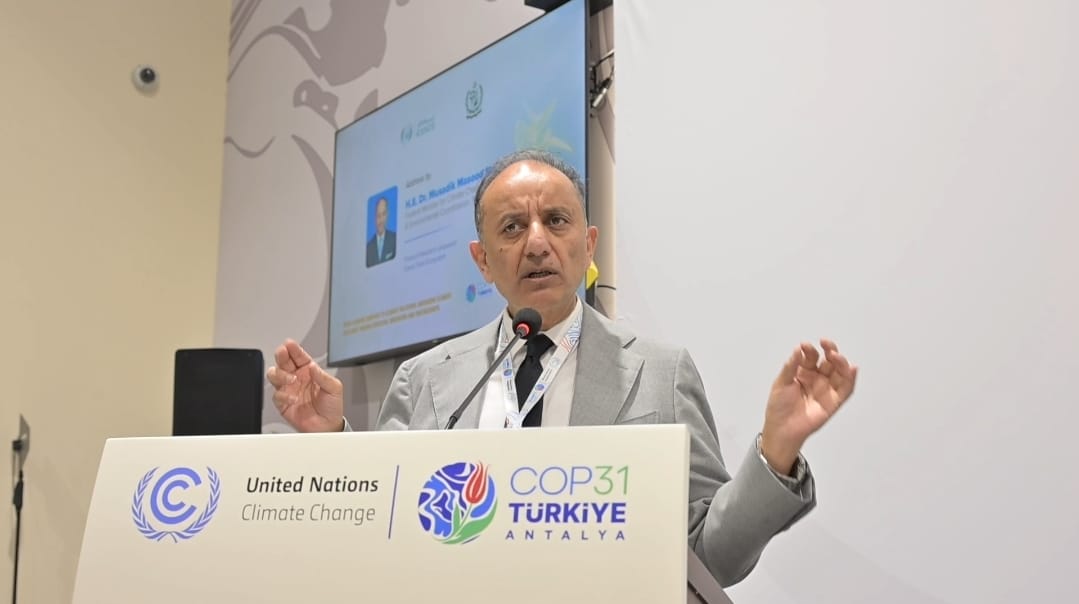
Federal Minister for Climate Change and Environmental Coordination Dr Musadik Malik presented the proposals while addressing a session titled “From Learning Campuses to Climate Solutions: Advancing Climate Resilience Through Education, Innovation and Partnerships”, organised in collaboration with the Islamabad Electric Supply Company (IESCO) on the sidelines of the UN Climate Change Conference (COP31) in Antalya, Türkiye.
Emphasising the need to move beyond climate conference resolutions towards practical outcomes, the minister said Pakistan wanted to build an international platform where students, researchers and academic institutions could collaborate on climate-related challenges and develop solutions relevant to their societies.
Under the proposed virtual green university framework, he invited international academic institutions to collaborate with Pakistan through joint research programmes, faculty and student exchanges, seminars and virtual research centres.
He said the initiative could bring together scholars, experienced researchers and graduate students, particularly from developing countries, to generate knowledge and develop locally relevant solutions to climate challenges.
Dr Malik also offered Pakistan’s research facilities, glacier-related data and support for primary research to international scientists interested in studying mountain ecosystems and the changing cryosphere.
He said mountain regions were among the first to experience the impacts of changes in the cryosphere, warning that developments in these areas could have consequences for downstream plains in the coming years.
The minister invited international researchers to work with Pakistani institutions on glacier studies, saying the country was prepared to facilitate collaborative research and make relevant data and academic resources available.
A second proposal presented by the minister was the Greenfield fund, intended to provide financial support to innovative ideas and climate-related ventures developed by young people.
He said a fund had been announced and a board established, with a proposed five-member team, including private-sector and investment expertise, to assess promising ideas and help finance their development.
The minister described access to risk capital as a major requirement for encouraging young innovators, arguing that promising ideas often failed to reach commercialisation because of inadequate financial support.
He said Pakistan needed to invest in young scientists, entrepreneurs and graduates rather than relying exclusively on conventional institutional approaches.
“Place your bets on your children, not on conferences and resolutions,” he said, urging institutions to provide young people with the resources and opportunities needed to turn innovative ideas into viable solutions.
Dr Malik said innovation should not be confined to science and technology, adding that ideas could emerge from literature, history, arts, music, drama and business models. Their convergence, he said, could generate solutions with economic and social value.
Referring to the experiences of China and Finland, he argued that environmental challenges and the growing sophistication of public demand could create opportunities for innovation. He cited China’s development of solar technology and Finland’s environmental technology sector as examples of how countries could respond to challenges through technological development.
The minister also highlighted the importance of linking different stages of innovation, from idea generation and incubation to acceleration and commercialisation, saying collaboration among academic institutions, businesses and governments was essential for the process.
He said Pakistan was seeking partnerships that could help young people access contemporary scientific knowledge, research opportunities and investment rather than depending on outdated approaches.
The proposals, if developed through institutional partnerships and operational funding arrangements, could provide a framework for linking climate education, research and entrepreneurship with practical climate solutions.
Dr Malik said Pakistan was open to international cooperation and invited researchers, academic institutions and innovators to work with the country on developing solutions to shared environmental challenges.