Federal Minister for Petroleum Ali Pervaiz Malik on Thursday stressed the need for consistent and predictable energy policies to attract major investment in Pakistan’s upstream exploration, particularly offshore projects.
Consistent energy policies vital to attract investment in upstream sector: minister
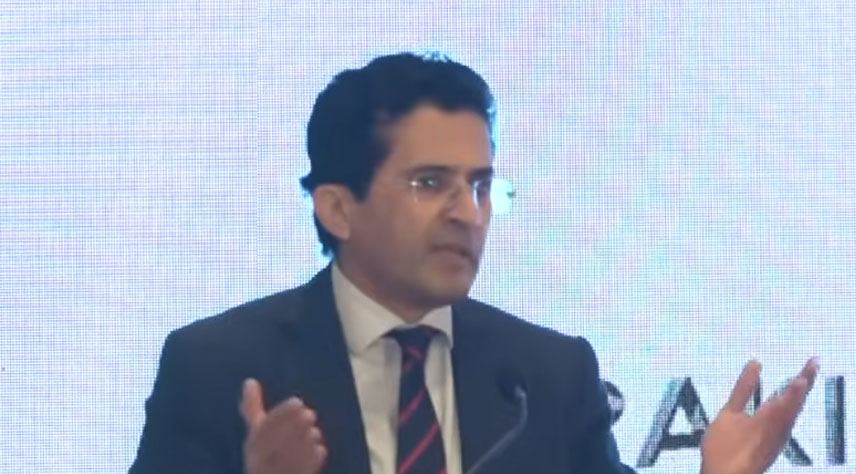
ISLAMABAD, Aug 20 (APP): Federal Minister for Petroleum Ali Pervaiz Malik on Thursday stressed the need for consistent and predictable energy policies to attract major investment in Pakistan’s upstream exploration, particularly offshore projects.
Addressing the Energy Conference 2026, the minister said Pakistan was reviving offshore exploration after two decades under the leadership of Prime Minister Shehbaz Sharif. Friendly countries, Mari Petroleum, Pakistan Petroleum Limited (PPL) and Oil and Gas Development Company Limited (OGDCL) are participating in the effort.
He said the government must provide investors with policy consistency and medium-term visibility, particularly when companies are making major investments in high-risk exploration.
“If we expect them to invest over a hundred million dollars for one well, we must provide them consistency of policy and medium-term visibility,” he said.
Ali Pervaiz Malik said investors should also be allowed to retain profits from successful exploration and reinvest those earnings in developing the required infrastructure.
“That is the only thing that will enable us to sustainably make this sector grow,” he added.
The minister said Pakistan’s foremost crisis was its vulnerability to external shocks. He stressed that petroleum must be made an integral part of the country’s medium-term national energy policy.
He called for greater convergence and coordination among the petroleum, power and water divisions.
He said the government also needed to consider the demand outlook and the impact of wider economic activity on the petroleum sector.
Ali said the inter-ministerial platform of the Cabinet Committee on Energy (CCoE), chaired by the prime minister, had been reactivated and several meetings had already been held.
He said he had personally suggested to Prime Minister Shehbaz Sharif that the committee should meet every two months, regardless of whether it had a specific agenda, to review developments across the energy value chain.
“This is one committee which needs to convene every two months to have a discussion on understanding what is happening in the energy value chain,” he said.
He said the committee brought together the petroleum, power and finance ministers, allowing them to collectively determine how the energy sector could be taken forward on a sustainable basis.
He said every sector and division now needed to stand on its own feet. The Petroleum Division, he added, could not continue to bear excessive taxation and financial interventions merely to meet budgetary requirements.
“The Petroleum Division cannot be a division on which you continue to load exorbitant taxation and exorbitant financial interventions to meet budgetary impacts because the sector’s sustainability is equally important,” he said.
He said sustainable investment was particularly important for high-risk upstream exploration, both onshore and offshore, as Pakistan sought to improve its energy security.
Touching upon circular debt and other legacy challenges, Ali said the government had maintained its flow at near-zero levels without increasing consumer prices.
“Without increasing a single rupee of consumer tariff … we have still been able to maintain the flow of circular debt to near zero,” he said.
Regarding the midstream sector, the minister thanked refineries for providing some relief through reduced diesel prices amid highly volatile market conditions.
He said the refineries had responded positively to the government’s request.
However, Ali Pervaiz Malik said the government needed to address the larger issue of why local refineries remained in a dilapidated state and had not been upgraded to deep-conversion facilities.
“What we need to really get the conversation going is why they are in such a dilapidated state and why have they not been able to upgrade to deep conversion refineries,” he said.
He said the new refinery policy and operational flexibility were intended to address these longstanding issues.
“Why did we not do it in the last 70 years is a debate that we can have some other day, but that policy is in the field,” he said.
The minister said the Petroleum Division secretary was finalising agreements with refineries and a signing ceremony would be held.
He said the government wanted to ensure that future generations did not face the same challenges in meeting the country’s energy requirements.
Ali expressed gratitude to the World Bank for supporting efforts to unbundle and reform the gas sector.
He said the government was examining ways to separate the infrastructure business from the energy business, introduce greater competition, improve liquidity in the upstream sector and enhance efficiency and optimisation.
He said the World Bank-supported report was expected by the end of August and would subsequently be presented to the prime minister.
“Once that is there, it will be presented to the Prime Minister, and we will slowly and gradually move in that direction,” he said.
The minister said greater competition had already been introduced through the third-party access regime and the government would continue developing the platform.
The Minister said deregulation and greater private-sector participation remained key government objectives for reforming the energy sector.
He said the government would continue to push reforms regardless of the criticism they attracted or their popularity.
The minister said the true measure of the government’s work would be how future generations viewed the decisions taken by the current leadership.
“I think the true measure will be how the coming generations view what we did when we had the responsibility of doing something,” he said.