
ISLAMABAD, Feb 03 (APP):The Chief Justice of Pakistan on Tuesday held a consultative meeting with the leadership of the Pakistan Bar Council, Provincial Bar Councils, and the Supreme Court Bar Association to discuss ongoing justice sector reforms, access to justice, and inclusion. The meeting was part of continued stakeholder engagement aimed at strengthening the justice system through institutional coordination between the judiciary and the legal fraternity. The meeting was attended …
CJP consults bar leadership on justice reforms and access to justice
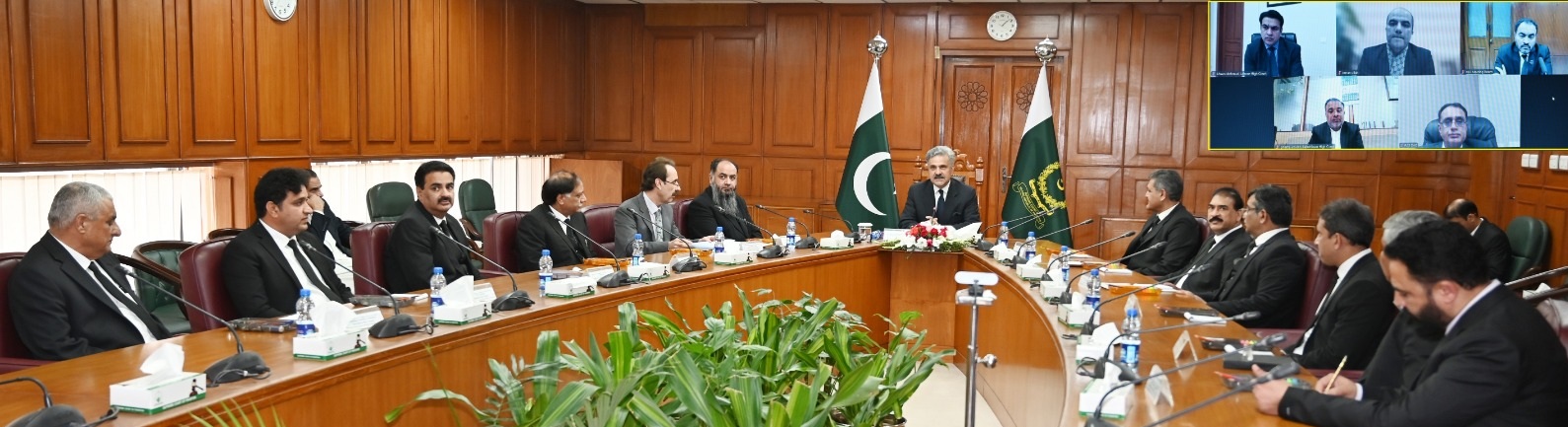
ISLAMABAD, Feb 03 (APP):The Chief Justice of Pakistan on Tuesday held a consultative meeting with the leadership of the Pakistan Bar Council, Provincial Bar Councils, and the Supreme Court Bar Association to discuss ongoing justice sector reforms, access to justice, and inclusion.
The meeting was part of continued stakeholder engagement aimed at strengthening the justice system through institutional coordination between the judiciary and the legal fraternity.
The meeting was attended by Muhammad Masood Chishti, Vice Chairman, and Munir Ahmed Malik, Chairman Executive Committee of the Pakistan Bar Council; Khawaja Qaiser Butt, Vice Chairman, and Fakhar Hayat Awan, Chairman Executive Committee of the Punjab Bar Council; Asfand Yar Khan, Vice Chairman, and Malik Emad Azam, Chairman Executive Committee of the Khyber Pakhtunkhwa Bar Council; Jadain Dashti, Vice Chairman, and Ayaz Khan Mandokhail, Chairman Executive Committee of the Balochistan Bar Council; and Haroon-ur-Rashid, President, and Malik Zahid Aslam Awan, Secretary of the Supreme Court Bar Association of Pakistan. Ishtiaq Ahmed Memon, Vice Chairman of the Sindh Bar Council, participated virtually.
The Registrar of the Supreme Court of Pakistan and the Secretary of the Law and Justice Commission of Pakistan were also present, while Additional Resident Secretaries of the Law and Justice Commission joined the meeting through video link.
Congratulating the newly elected bar representatives, the Chief Justice briefed participants on key decisions taken by the National Judicial (Policy Making) Committee. These included the judiciary’s institutional response to enforced disappearances, safeguards against extraneous influence on judges, the establishment of a Commercial Litigation Corridor, and the creation of Model Civil and Criminal Trial Courts to ensure expeditious justice.
The Chief Justice also highlighted major reform initiatives focusing on time-bound adjudication in thirteen categories of cases, the introduction of a Double-Docket Court Regime, court-annexed mediation, development of a Professional Excellence Index, standardized judicial appointments and training, biometric case verification, video-link hearings for under-trial prisoners and witnesses, ethical guidelines for the use of artificial intelligence, and enhanced judicial welfare measures.
Briefing the participants on access-to-justice initiatives, the Chief Justice said that priority projects under the Access to Justice Development Fund were currently underway. These include solarization of courts, establishment of e-libraries, women facilitation centres, and provision of clean drinking water in court premises, with completion targeted by August 2026.
Representatives of the Bar Councils appreciated the pace of reforms and emphasized the need for capacity building of young lawyers. In response, the Chief Justice highlighted the Continuing Legal Education programmes of the Federal Judicial Academy and announced the launch of a dedicated online course for young lawyers.
The Chief Justice emphasized that engagement with the Bar would remain a continuous process and invited Bar Councils to identify priority needs for improving access to justice under the Access to Justice Development Fund for the coming year. He also directed the Additional Resident Secretaries of the Law and Justice Commission to ensure equitable treatment of all Bar Associations, with particular focus on remote and underserved areas.