
- Advertisement -
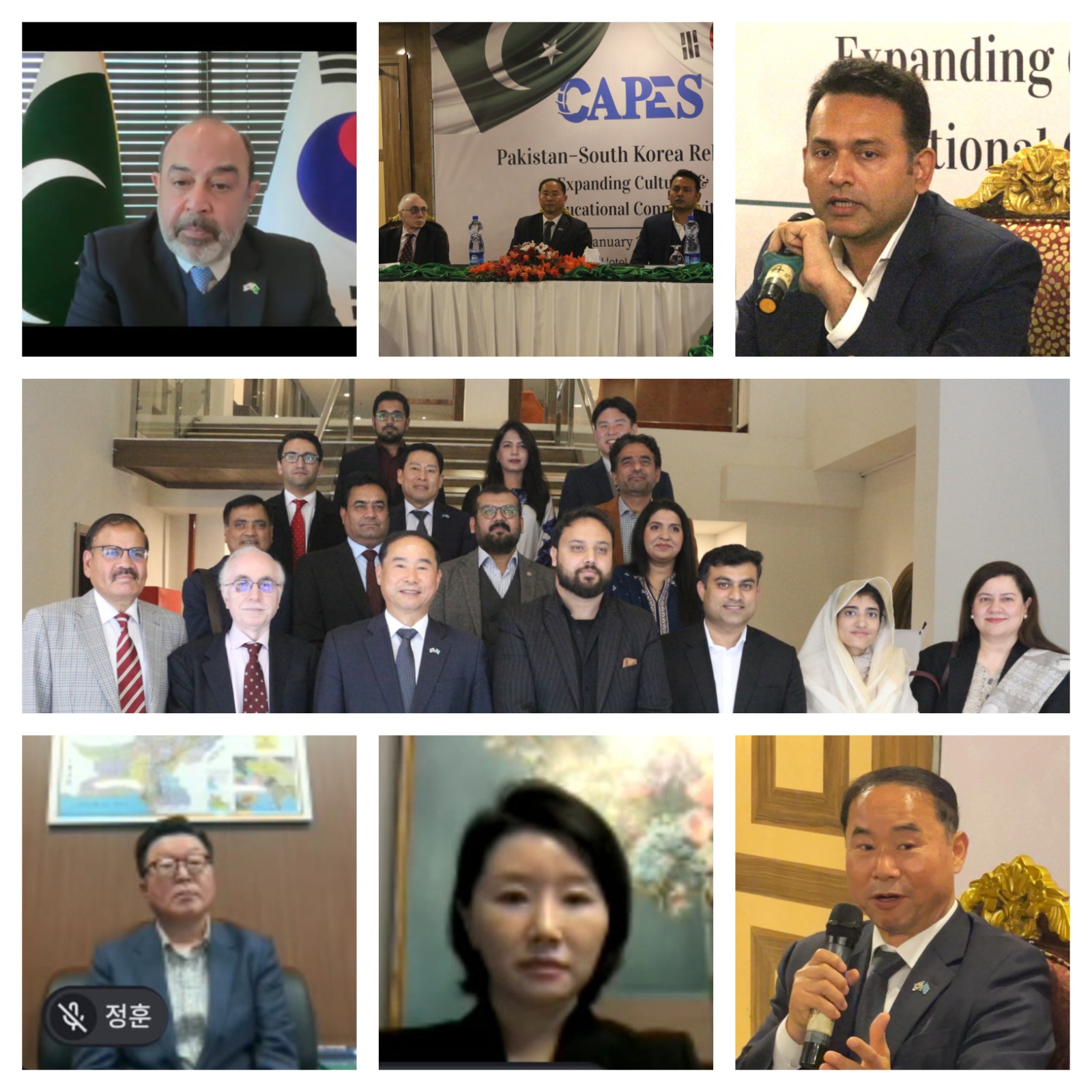
ISLAMABAD, Jan 29 (APP):Speakers at an international seminar organised by the Consortium for Asia-Pacific and Eurasian Studies (CAPES) on Thursday underscored the vast untapped potential for expanding Pakistan–South Korea cooperation in the fields of culture and education.
The hybrid seminar titled “Pakistan–South Korea Relations: Expanding Cultural and Educational Connectivity” brought together ambassadors, scholars, practitioners and academics from both countries to explore avenues of engagement beyond traditional security paradigms.
The seminar began with opening remarks by Dr. Khuram Iqbal, President of CAPES, who underscored the growing importance of non-traditional dimensions of diplomacy in shaping Pakistan–South Korea relations.
He discussed the profound transformation of global order and pointed out the shift educational mobility, moving from West to Eastern institutions in the Asia-Pacific region.
Dr. Khuram highlighted how Eastern educational institutions have adopted strategies such as expanding campuses, promoting enhanced research culture, and investing in diaspora skills enhancement. He suggested that the demographic challenge faced by South Korea serves as a massive opportunity for Pakistan’s huge population.
Delivering the keynote address, Pakistan’s Ambassador to South Korea Syed Moazzam Shah emphasised the steady evolution of bilateral ties since the establishment of diplomatic relations in 1983, describing cultural diplomacy and higher-education cooperation as promising frontiers. He said cooperation had expanded across trade, employment and institutional mechanisms, with South Korean investment visible in sectors such as automobiles, hydropower and manufacturing.
The ambassador shared that bilateral trade volume reached approximately $1.57 billion in 2025, while labour cooperation also increased with South Korea enhancing its quota for Pakistani workers. There are currently 400 researchers and 2600 students in various fields, including science, IT, and engineering. Moreover, an MoU is under the pipeline between HEC and SKKU of South Korea for technical and vocational education.
About 80 students are awarded a scholarship. To address the language barrier challenge Punjab government and Korea embassy engaged and established 4 language centers in Lahore. Till now, 201 students have benefited from this collaboration. In past years, Pakistani culture has been widely promoted in South Korea, which include basant festival, the mango festival, and Eid Milan parties. South Korea approved Pakistani mango export in shipment in 2022.
Former Ambassador of Pakistan to South Korea Masood Khalid provided a historical overview of bilateral relations, recalling diplomatic milestones and shared positions on various multilateral issues.
He lauded South Korea’s economic transformation and stressed the need for greater academic exchanges, digital collaboration, tourism promotion and media engagement to further strengthen ties. He also underscored the role of business communities and ease-of-doing-business reforms in attracting foreign investment.
The academic session featured detailed discussions on education and culture as pillars of engagement. Assistant Professor at Fatima Jinnah Women University Dr Sobia Hanif emphasised the culture-education nexus in building durable people-to-people linkages, suggesting initiatives such as joint festivals, art exhibitions, student exchanges and collaborative film and music productions.
President of the International Interchange Development Association Dr Mun Yong Jo highlighted the role of education and business cooperation in fostering trust between nations. He stressed the importance of virtual language programmes and online academic platforms to bridge communication gaps while pointing to opportunities arising from South Korea’s demographic trends.
Vice President of Tongwon University Dr Choi Jong-in appreciated Pakistani students for their academic performance and urged facilitation of smoother visa and admission processes to encourage greater student mobility. Assistant Professor at the University of Sargodha Dr Adeel Irfan Rao outlined existing higher-education cooperation frameworks and proposed enhanced joint research initiatives, faculty exchanges and institutional partnerships.
Participants agreed that sustained academic collaboration, cultural diplomacy and digital connectivity could open new pathways for a stronger and more diversified Pakistan–South Korea partnership in the years ahead.