ISLAMABAD, Jun 23 (APP):Bilawal urges renewed dialogue between Pakistan, India to curb regional instability Pakistan People’s Party (PPP) Chairman Bilawal Bhutto Zardari on Monday emphasized the urgent need for sustained dialogue between Pakistan and India, warning that the absence of communication only strengthens the threat of terrorism and regional instability. Speaking in the National Assembly, Bilawal said peace between the two nuclear neighbors is impossible without cooperation, especially in counterterrorism …
Bilawal urges renewed dialogue between Pakistan, India to curb regional instability
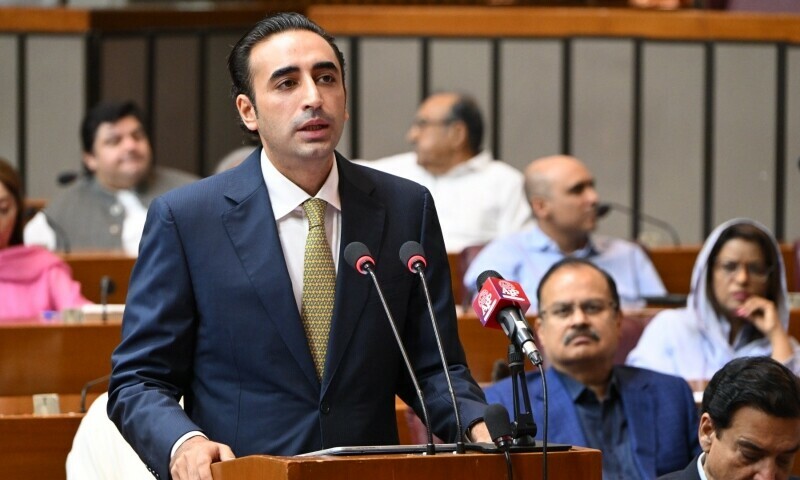
ISLAMABAD, Jun 23 (APP):Bilawal urges renewed dialogue between Pakistan, India to curb regional instability Pakistan People’s Party (PPP) Chairman Bilawal Bhutto Zardari on Monday emphasized the urgent need for sustained dialogue between Pakistan and India, warning that the absence of communication only strengthens the threat of terrorism and regional instability.
Speaking in the National Assembly, Bilawal said peace between the two nuclear neighbors is impossible without cooperation, especially in counterterrorism efforts. “If India and Pakistan refuse to talk, and if there is no coordination on terrorism, then violence will only intensify in both countries,” he warned.
He accused India of weaponizing terrorism for political purposes. “India seeks to exploit terrorism as a political tool to harm Pakistan’s international standing,” he said, adding that during his diplomatic visits to the United Kingdom and European Union as Foreign Minister, it became evident that India had lobbied hard to reverse Pakistan’s progress on the FATF front.
“At a time when Pakistan had successfully moved from the FATF grey list to the white list, India made every effort to drag us back to the grey list using false narratives and diplomatic pressure,” he said. “But thanks to our Foreign Office, the prime minister, and his team, those efforts failed. Once again, Pakistan won — and India lost.”
Addressing the ceasefire and broader regional tensions, Bilawal said merely maintaining a ceasefire is insufficient. “Peace must go beyond silence of the guns. It must translate into long-term understanding between the youth of Pakistan and India,” he stated.
He strongly criticized what he called Indian Prime Minister Narendra Modi’s dangerous doctrine of escalation. “Under Modi’s new ‘abnormal’, any terrorist incident in India becomes an automatic pretext for launching hostilities against Pakistan,” Bilawal warned.
He questioned what would happen if Pakistan were to adopt the same policy. “We suffer from terrorist attacks ten times more than India, many of which are traced back to Indian funding or involvement. Should we then adopt a policy of automatic retaliation too? That would mean surrendering our future to the will of terrorists.”
“That might be Modi’s vision, but it is not ours. We will not let terrorists dictate regional peace,” he declared.
Bilawal asserted that Pakistan’s position is not just in defense of its own people, but in defense of peace for all South Asians. “This is not only our battle. By advocating peace, we are also standing for the rights and future of the Indian people, who are equally victims of Modi’s war-centric politics,” he said.
He said that while Modi may benefit politically from war, terrorism, and aggressive policies, the real benefit for the people of both nations lies only in lasting peace.
Bilawal Bhutto Zardari warned India to uphold the Indus Waters Treaty or face firm retaliation. He stressed that the Sindh-Tass agreement is binding and any attempt to block Pakistan’s water is illegal and could lead to war. He affirmed Pakistan’s armed forces are fully prepared to deliver a decisive response, and if provoked, Pakistan will reclaim all six rivers for its people.
He said that Pakistan will not compromise on its share of water and will take necessary steps to ensure its people get their rightful share from all six rivers. “If India tries to exploit or delay the Indus Waters Treaty, Pakistan will respond resolutely to protect its rights,” he said.
The PPP Chairman also accused India of orchestrating a narrative to label Pakistan a terrorist state in order to justify aggression. “India wanted to degrade Pakistan internationally—whether in FATF, the UN, or other global forums—by branding us as a terrorist hub. Their aim was to replace the name Pakistan with ‘Terroristan’,” he said.
Bilawal emphasized Pakistan’s diplomatic victories on global platforms, particularly at the United Nations. “Despite India’s persistent efforts, we successfully presented Pakistan’s stance on terrorism, while India’s narrative failed,” he said.
“After our delegation returned from the UN, Pakistan was selected to chair committees overseeing counter-terrorism, including Taliban-related issues. This was a clear diplomatic win over India.”
He also commended Pakistan’s Foreign Office and diplomatic corps for their resilience and performance, stating, “India failed at every front—Pakistan won at every front.”
Highlighting economic pressures, Bilawal pointed out that attempts were made to block Pakistan’s access to the IMF package, both externally and internally. “In the past, a political party tried to sabotage Pakistan’s IMF program. They failed. Once again, similar efforts were made during this cycle, and they failed again.”
“On every front—water, diplomacy, terrorism, economy—Pakistan has emerged victorious, and we will continue to protect our national interest with pride and determination”, he added.
Bilawal Bhutto Zardari has termed President Donald Trump’s willingness to mediate on the Kashmir dispute a major diplomatic success for Pakistan and a setback for India’s foreign policy narrative.
Bilawal highlighted that despite Indian objections, US officials—during interactions with both Pakistani and Indian counterparts—acknowledged that President Trump was ready to help resolve the Kashmir issue. “Even the US State Department confirmed in front of international media that President Trump was prepared to mediate between Pakistan and India over Kashmir. This alone is a clear diplomatic victory for Pakistan,” he said.
Bilawal thanked Almighty Allah for Pakistan’s military, diplomatic, and narrative victories over India. He condemned Israel for violating Iran’s sovereignty by targeting its military leaders and scientists, despite the absence of an active conflict, calling Israel an expansionist regime and urging an end to its aggression.
Referring to regional politics, he remarked that “a cheaper imitation of Benjamin Netanyahu exists in our region.” He added that the world is witnessing how the actions of Israel in Gaza are being mirrored by Narendra Modi in Kashmir.
He also strongly criticized the United States for attacking Iran’s nuclear facilities, warning that such actions could have serious repercussions for neighboring countries, including Pakistan. He emphasized that the U.S. attack did not have the support of the American people.
Criticizing former Prime Minister Imran Khan, he said that in 2019, when India revoked Kashmir’s special status, Khan questioned whether Pakistan should go to war, and had called Kashmir an internal matter.
The recent conflict has forced India to acknowledge Kashmir as a bilateral issue. Under the current government, Pakistan delivered a strong response by shooting down six Indian fighter jets. He stressed that the Kashmir dispute must be resolved in accordance with United Nations resolutions.
Bilawal highlighted that the statement made during a press interaction with a U.S. State Department official signaled global recognition of Pakistan’s stance and undermined India’s opposition to third-party involvement in Kashmir.
He also recalled the significant reception given to Pakistan’s military leadership during their visit to Washington. ” Syed Asim Munir, Field Marshal, was not only officially invited to the United States but was personally hosted for lunch at the White House by President Trump himself,” Bilawal said.
He questioned the credibility of Indian claims about Pakistan’s military by pointing to the White House honors. “Would any country host the military leader of a so-called ‘defeated’ army at the White House? Certainly not. This was a clear acknowledgment of Pakistan’s strong military leadership and its role in regional stability,” he added.
Bilawal emphasized that the international community, particularly the United States, is increasingly recognizing Pakistan’s constructive role in regional peace, while India’s aggressive rhetoric continues to lose ground.
“This invitation and reception were not only a sign of respect but a symbolic endorsement of Pakistan’s consistent and responsible approach to peace, especially in contrast to India’s belligerence,” he remarked.
He said that despite India’s strategic ties with the US, including arms deals and defense cooperation, Pakistan’s diplomacy was successful in earning bipartisan engagement in Washington.
Bilawal said “On every international forum—from the UN to the White House—Pakistan’s narrative is gaining traction. India’s disinformation and denial tactics are being exposed. Pakistan has won the diplomatic battle.”
Bilawal Bhutto Zardari has warned that failure to resolve water disputes with India may result in future generations inheriting a prolonged and devastating water war. He called on the Pakistani government to continue its diplomatic efforts to prevent such a scenario.
He stressed that India appears to be steering the region towards generational conflict over water, a situation that must be prevented through a robust and sustained diplomatic strategy.
“It seems they [India] are preparing for a water war that will affect generations to come. We must not allow this,” Bilawal said. “I commend the government of Pakistan for its foreign policy stance, which has strengthened our position internationally. When global powers see us committed to peace and principle, they cannot ignore our voice.”
Bilawal said, “If you succeed in this endeavor—if you can compel India to abandon its rigid policies and embrace dialogue—then your success will be remembered in history.”
He added that such a resolution is still possible, urging the government to intensify its efforts to shape international opinion and build diplomatic pressure on India to move towards cooperation rather than conflict.
Bilawal also pointed to the growing economic hardships facing the Pakistani public, identifying the economy as the second critical front alongside the water dispute. “The people of Pakistan are bearing the brunt of economic strain. We must address this urgently,” he said, indicating that peace and prosperity must go hand in hand.
He said, that true leadership lies in preventing crises before it erupt. “Let us not bequeath to our children a legacy of hostility and scarcity. Let us resolve our disputes today—through dialogue, diplomacy, and determination.”
Bilawal Bhutto Zardari has welcomed the federal government’s decision to a significant increase in defense spending and support for the country’s poorest and salaried classes, calling it a “powerful and commendable message.”
Bilawal acknowledged the difficult times facing the nation but emphasized the importance of not abandoning social responsibility even in times of heightened security needs.
He particularly praised the government’s decision to provide relief to the salaried class, noting that for the first time in years, significant reforms were introduced to alleviate the financial burden on middle-income earners. “Previously, no tax was charged on annual income up to Rs 600,000. Now, that threshold has been raised to Rs 1 million. This is a major relief for hardworking individuals and salaried workers,” he said.
He said that since the beginning of the budget consultation process, his team had consistently demanded that South Punjab be allocated 30% of Punjab’s PSDP share — a proportion that reflects the region’s population and developmental needs.
Bilawal reminded that during the PPP’s previous tenure in government, his party had made it a priority to address the longstanding sense of deprivation in South Punjab. “We ensured, year after year, that South Punjab received nearly 30% of the development budget, in line with its rightful share,” he added.
He acknowledged that despite their efforts, this demand could not be materialized during the current budget cycle due to certain limitations. However, he expressed gratitude to the prime minister for committing to a prior consultation before the next budget. “The prime minister has assured us that he will work with us in advance to rectify these discrepancies and ensure the rightful percentage is allocated to South Punjab,” Bilawal said.
Highlighting another aspiration not fulfilled in the current budget, the PPP chairman underscored the importance of addressing the special status of Khyber Pakhtunkhwa and Balochistan as front-line regions in the fight against terrorism. “If you study history, no region battling terrorism at this level has been left unsupported. We were trying to secure additional allocations for them as well,” he remarked.
Bilawal Bhutto Zardari reaffirmed PPP’s commitment to advocating for the underprivileged regions and pledged to continue the struggle for equitable development across the country.
Bilawal Bhutto Zardari has made a passionate appeal to the prime minister to address the deepening crisis in Pakistan’s agriculture sector, urging for collaborative policy reforms and immediate relief to the country’s farmers.
Bilawal expressed disappointment that the government was unable to implement the agricultural measures PPP had proposed. “We wanted to provide substantial support to farmers, especially in terrorism-affected provinces like Khyber Pakhtunkhwa and Balochistan, but those efforts could not materialize the way we intended,” he said.
He stressed the need for a comprehensive national strategy, jointly developed by all stakeholders, to confront the agricultural challenges and reverse economic decline. “Our economy is weakening. To ensure food security, we must invest heavily in agriculture. Extraordinary investment is required in the entire agri-value chain,” he asserted.
He called for a national-level agricultural conference, led by the federal and provincial governments, to draft a unified action plan for farmer relief and revival of Pakistan’s agri-economy.
Recalling the PPP’s previous reforms, he said, “When Asif Ali Zardari became President, we used the same tools now being restricted — like increasing support prices — and within a year, turned Pakistan from a food-importing nation to one exporting wheat, rice, and sugar.”
Bilawal “If our own farmers are unable to produce, the government ends up buying from abroad in dollars, benefitting foreign farmers instead. We must protect our own. This is economic survival — not just for farmers, but for the entire nation.”
Bilawal Bhutto Zardari has stressed the urgent need to modernize Pakistan’s irrigation infrastructure in light of worsening water shortages and climate change, calling for a transition from traditional flood irrigation to smart, water-efficient systems.
Bilawal said that Pakistan, after Russia, possesses one of the world’s largest irrigation networks, yet still relies on outdated methods. “While the world now values every single drop of water, we continue using flood irrigation. This approach is unsustainable,” he said.
He emphasized that India’s repeated violations and non-compliance with the Indus Waters Treaty have further strained Pakistan’s water resources. “We’re already facing acute water scarcity. If India continues disregarding the treaty, it will compound our national crisis,” he warned.
In the face of climate change, Bilawal advocated a national pivot toward smart irrigation. “If we invest today in transitioning to water-smart agriculture, we will be better prepared for tomorrow,” he urged, suggesting immediate collaboration between the federal and provincial governments to implement such systems.
He added that smart irrigation technologies would not only benefit current agricultural zones but could also extend cultivation to arid regions such as Cholistan and Thar. “Through efficient water management, we can make these barren lands productive,” he remarked.
Bilawal also acknowledged and appreciated the federal government’s performance on the diplomatic front. “I commend the Prime Minister and his entire team. Be it on the battlefield, in diplomacy, or through strategic communication — Pakistan has emerged victorious on every front,” he said.
Bilawal called for collective national focus on water management, terming it essential for future food security, economic resilience, and regional stability. “This is not a matter of political difference — it’s a matter of survival. Smart irrigation is no longer a choice; it’s a necessity,” he asserted.
Bilawal Bhutto Zardari has strongly opposed the federal government’s proposed 20% tax on solar energy, warning that such a move would disproportionately hurt lower-income communities, especially in underdeveloped regions.
Bilawal revealed that the proposed tax on solar panels was particularly harmful for constituents from remote areas where solar energy is often the only affordable option. “In many of the areas from where PPP representatives are elected, solar energy is not a luxury, it is a necessity. We firmly opposed this tax,” he said.
He also criticized the abrupt slashing of Sindh’s higher education budget by 50%, calling the decision unjustified. “We protested strongly, and we are grateful to the Prime Minister and Finance Minister, for engaging in dialogue and restoring the full amount promised to Sindh,” Bilawal said, highlighting the power of constructive political engagement.
“Politics should be used to solve people’s problems, not to fuel division,” he added. He urged opposition parties, particularly those in power in provinces like Khyber Pakhtunkhwa, to engage the federal government with positive proposals for the public’s benefit. “You are in opposition here, but you are in power there. You have a responsibility to deliver to your own people,” he said.
He further appealed to all lawmakers to prioritize public concerns, particularly those of farmers suffering due to flawed policies and economic pressures. “We must change our strategy. If PTI and others begin engaging on real issues, the entire country—not just a party—will benefit,” Bilawal emphasized.
Chairman Pakistan Peoples Party (PPP) Bilawal Bhutto Zardari on announced his party’s support for the federal budget, appreciating the government’s economic direction and efforts led by Prime Minister Shehbaz Sharif and Finance Minister Muhammad Aurangzeb.
Bilawal acknowledged that the PPP was consulted during the budget-making process and expressed satisfaction with several policy decisions, terming them positive steps towards economic recovery.