
- Advertisement -
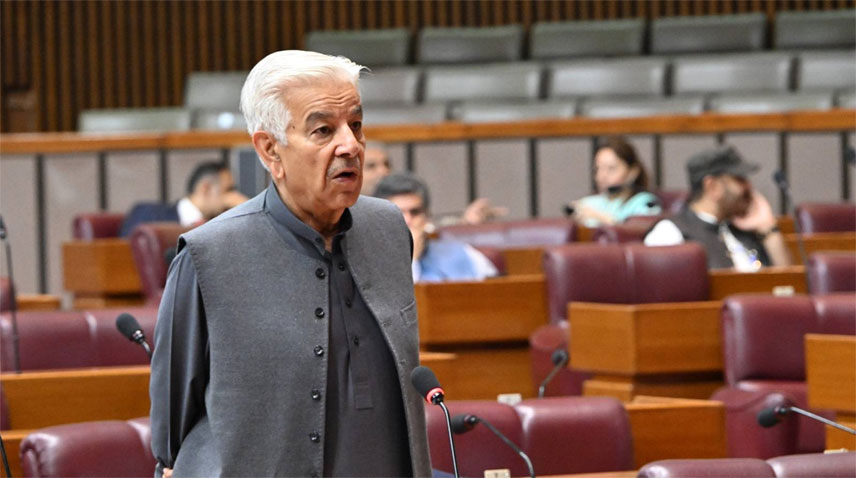
ISLAMABAD, Feb 02 (APP):Defence Minister Khawaja Asif on Monday said that the ongoing unrest in Balochistan was no longer political in nature and was being driven instead by organized criminal networks seeking to recover financial losses following government action against smuggling.
Speaking during a debate on the law and order situation in the National Assembly, the minister said that what was being projected as a “rights movement” had collapsed and transformed into a criminal enterprise motivated by illicit profits.
“This is essentially a business loss issue.
The agitation is being run to recover those losses,” he told the House, adding that criminal elements had taken over the narrative to shield illegal activities.
The discussion followed the adoption of a motion moved by Minister for Parliamentary Affairs Dr Fazal Chaudhary to debate the country’s prevailing security situation.
Citing oil smuggling as a key example, the defence minister said fuel imported from Iran under permits at prices between Rs40 and Rs60 per litre was illegally sold in Karachi for over Rs200 per litre.
He said smuggling networks had been earning nearly Rs4 billion per day from oil smuggling alone, income streams that had been significantly disrupted by recent government measures.
“Once this illegal income was blocked, they claimed their livelihoods were destroyed and launched agitation,” he said, adding that the group’s original claims differed sharply from its current objectives.
Khawaja Asif said criminal elements were now using the name of a so-called movement to provide armed protection to smuggling and illegal trade rather than pursuing any genuine political cause.
He said law enforcement agencies, including the armed forces, were actively conducting operations against such elements and would continue efforts to restore peace and safeguard national interests.
Rejecting what he termed a misleading narrative portraying Balochistan as a neglected province, the defence minister said claims of long-standing deprivation were exaggerated and often used to advance political or foreign agendas.
He said assertions that Balochistan had been ignored since Pakistan’s independence were factually incorrect, noting that successive governments had made substantial investments in education, health and infrastructure.
“At the time of Partition in 1947, Balochistan had only 114 schools. Today, there are 1,596,” he said, adding that universities, medical colleges and technical institutes had expanded significantly.
Providing health sector figures, he said the province now had 13 teaching hospitals, 33 primary healthcare facilities, 756 basic health units, 541 dispensaries, four cardiac centres and 24 dialysis centres, compared to just three major hospitals at independence.
He added that Balochistan had received a higher share of the Public Sector Development Programme relative to its population, though corruption remained a challenge across all provinces.
Despite these allocations, he said, a narrative of deprivation was deliberately constructed to justify criminal activity and external interference. Highlighting security challenges, Khawaja Asif said Balochistan — covering over 40 per cent of Pakistan’s landmass — faced unique issues due to its vast geography and sparse population.
He informed the House that terrorist attacks had resulted in the martyrdom of 177 security personnel, including police, Frontier Corps and Levies officials, while 33 civilians were killed in Gwadar during the same period. He said operations against terrorists and smugglers would continue until their complete elimination, adding that the same nexus had long sought to keep the province underdeveloped.
He said smuggling interests and anti-Pakistan elements, backed by India, of sabotaging development efforts and infiltrating both government systems and feudal structures.
He said arrests linked to unrest were traced abroad rather than in major cities such as Lahore or Karachi. Referring to incidents on highways, he said passengers had been forcibly removed from buses, had their identity cards checked and were killed based on their province of origin, calling the killings unjustifiable and unprecedented elsewhere in the country.
The defence minister said that the armed wing protecting these criminal networks was the Balochistan Liberation Army, describing it as a criminal gang rather than a liberation movement.
He said abductions and killings were part of a broader campaign to protect illegal trade. Citing Islamic principles, he said “fasad fil arz” (spreading disorder on earth) was strictly condemned and could not be justified under any circumstances.
He stressed that the state would not allow anyone to challenge its writ or rationalize violence under the guise of a freedom or rights struggle. He said such groups did not hold permanent control over any area in Balochistan, adding that they carried out attacks and fled. “There will be no negotiations with these elements,” he said, adding that the state would respond with full force to protect civilians.
Paying tribute to fallen personnel, Khawaja Asif said soldiers, Frontier Corps members, paramilitary forces and police officials were laying down their lives across the province.
He urged politicians to rise above differences, avoid political point-scoring at funerals and stand united with the armed forces. “My appeal is that the nation must remain united on this issue,” he said, adding that terrorism could not be justified or sanitised through misleading narratives.
He concluded by saying that while political differences could continue, the fight against terrorism must remain a single-point national agenda, with Parliament standing united to uphold the writ and dignity of the state.
Meanwhile, National Assembly Speaker Asad Qaiser suggested that after detailed discussions, a joint resolution should be passed in line with parliamentary consensus.
He proposed that a draft resolution be prepared and shared with all opposition parties to ensure their input and support.
MNA Ijaz ul Haq said the issue of terrorism had been discussed repeatedly in the past and alleged that foreign forces had played a role in fuelling the situation in Balochistan.
He noted that Western interests, and Indian-backed proxies were active in the area, adding that support had also been provided from Afghan soil. He said much of the movement’s leadership was currently based in Afghanistan and received backing from there.