Federal Minister for Information and Broadcasting Attaullah Tarar on Sunday announced names of an 11-member advisory council which would work under Khyber Pakhtunkhwa Governor Faisal Karim Kundi to run the province’s affairs.
Atta Tarar announces 11-member advisory council for KP Governor
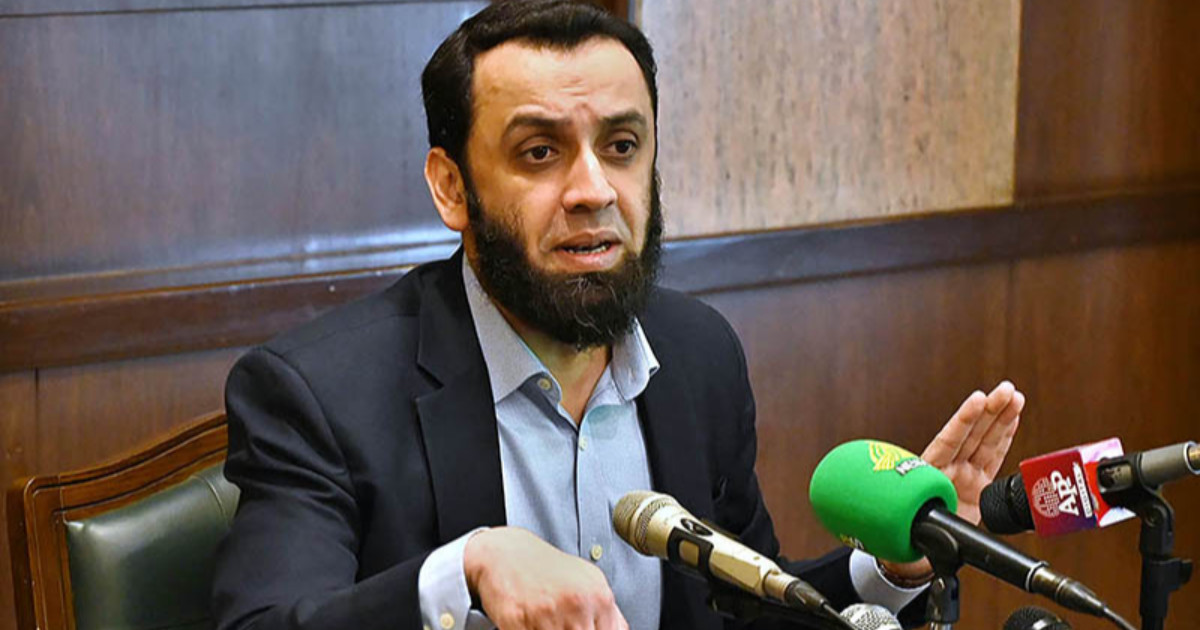
ISLAMABAD, Oct 11 (APP):Federal Minister for Information and Broadcasting Attaullah Tarar on Sunday announced names of an 11-member advisory council which would work under Khyber Pakhtunkhwa Governor Faisal Karim Kundi to run the province’s affairs.
Addressing a news conference here, Tarar said most of the members are technocrats with expertise in their respective fields, who can help bring reforms and steer the province toward progress.
“This selection is entirely on merit,” he said, adding that the council balances regional and district representation with skill and merit.
He was flanked by Law Minister Senator Azam Nazeer Tarar, Interior Minister Mohsin Naqvi, Minister of State for Interior Talal Chaudhry and MNA Samar Haroon Bilour at the press conference.
Attaullah Tarar said Kifayatullah Khan, a former IG Prisons and former chairman of the FATA Tribunal, will be advisor for the Home Department. He has served in the Home and Tribal Affairs Department and as commissioner of Mardan and Dera Ismail Khan. Tariq Mehmood Pasha, a former chairman of the Federal Board of Revenue (FBR), former secretary of the Economic Affairs Division and former joint secretary at the Prime Minister’s Secretariat, will handle Finance.
Tarar said Pasha has an unblemished civil service career.
Amir Javed, an Advocate Supreme Court and former advocate general of Khyber Pakhtunkhwa, will take charge of Advisor for Law. Tarar said the legal fraternity is unanimous that his integrity is beyond doubt. Education goes to Dr Syed Amir Abdullah, who holds a PhD in international relations from the Netherlands and is a former caretaker provincial minister for industries and commerce and a former member of the NACTA expert committee.
He said Lt Gen (retd) Nigar Johar Khan, Pakistan’s first female lieutenant general, will advise on Health. Tarar described her as a source of national pride who has represented the country on international platforms, and said her competence is widely acknowledged. Dr Sarfaraz Ali Shah, who holds a PhD in economics from France and previously served as adviser for planning and development and for communications and works, will advise on Mines and Minerals.
Dr Muhammad Irshad, a member of the board of the Pakistan Red Crescent Society with a PhD in finance and a former FBR chairman, has been assigned the role of Advisor on Industries and Commerce. Asif Rafiq Afridi, an entrepreneur and former caretaker provincial minister, will advise on Communication and Works. Maulana Muhammad Tayyab Qureshi, chief khateeb of Khyber Pakhtunkhwa and administrator of Jamia Ashrafia, will advise on Religious Affairs. Tarar said he has contributed significantly to counterterrorism efforts.
Osman Saifullah Khan, a former senator who served on the board of GIK Institute and the board of management of PSO, and is a former chairman of the All Pakistan Textile Mills Association, will advise on Energy. MNA Samar Haroon Bilour, a former member of the provincial assembly and former chairperson of its standing committee on information and public relations, will advise on Information and Broadcasting. Tarar noted that her husband and father-in-law were killed fighting terrorism, and called her one of the province’s most educated and empowered women.
Tarar lashed out at the PTI-led provincial government, which has been suspended through a constitutional provision. He said its policies were responsible for the deaths of thousands of citizens and accused it of being soft on terrorists.
He said the federal cabinet, which took up the matter earlier in the day, was unanimous that the provincial government had an “unholy alliance” with militants. He claimed reports from the Intelligence Bureau and law enforcement agencies describe a dire security situation in which every political party except the PTI had come under militant attack.
“Failing to perform constitutional responsibilities is one thing,” Tarar said. “Empowering those who have killed innocent citizens, martyred law enforcement personnel and attacked mosques is quite another.” He asked why police stations in some districts had been handed over to militants, adding that a power-sharing arrangement with non-state actors began in the south of the province and gradually spread across it.
Tarar said that during a visit to Kohat, injured residents appealed to him for protection and told him they could not understand why the provincial government was allowing militants to take over the province. He said the father of one martyr, Faheemullah, told him he would sacrifice everything for the country, and added that PTI leaders should learn from martyrs’ families.
He also criticised the provincial government’s police reform legislation, adding that it was meant to enable the recruitment of militants into the police, and questioned why DSPs would be appointed without going through the public service commission or the Central Superior Services. He said there was “irrefutable evidence” of this and criticised the government’s record on governance, health and education.