Secretary-General of the Association of Southeast Asian Nations (ASEAN), Dr. Kao Kim Hourn on Thursday acknowledged Pakistan’s efforts to facilitate dialogue between the United States and Iran.
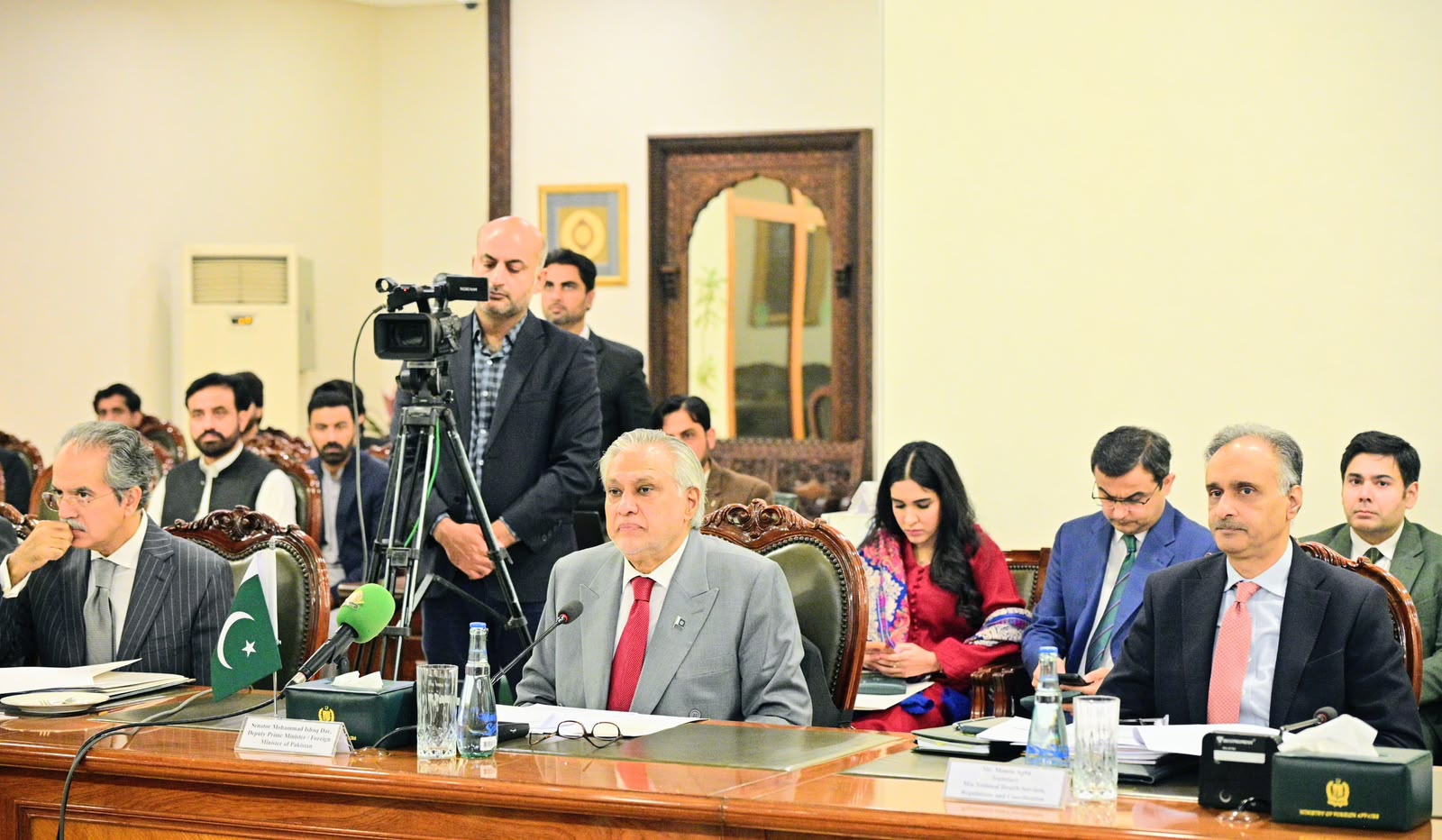
ISLAMABAD, Nov 19 (APP): Secretary-General of the Association of Southeast Asian Nations (ASEAN), Dr. Kao Kim Hourn on Thursday acknowledged Pakistan’s efforts to facilitate dialogue between the United States and Iran.
The ASEAN Secretary General’s remarks came during talks between Pakistan and ASEAN led by Deputy Prime Minister/Foreign Minister (DPM/FM), Senator Mohammad Ishaq Dar who stressed diplomacy, multilateralism and the peaceful settlement of disputes.
Briefing the ASEAN delegation on Pakistan’s perspective, DPM Dar voiced deep concern over the conflict in the Gulf and its consequences for energy security, maritime trade and global supply chains.
He said attacks on ships and critical infrastructure, and disruptions to navigation through the Strait of Hormuz and Bab al-Mandab Strait, had repercussions far beyond the region. They raised transport and energy costs, fed inflation and created added pressure on households and businesses, he said, underlining the urgency of de-escalation and negotiated settlement.
The deputy prime minister recalled that Pakistan had persuaded both Washington and Tehran to exercise restraint and brought them to Islamabad, where they held a 21-hour marathon session on April 10-11. A final memorandum of understanding could not be clinched at that stage, but further diplomatic efforts led to its signing in June 2026 as the Islamabad Memorandum of Understanding.
He also noted that Pakistan had taken the initiative on the theme of multilateralism and the peaceful settlement of disputes during its presidency of the UN Security Council. Resolution 2788, he said, was adopted unanimously after 12 years, a period in which resolutions were often vetoed or passed only by majority.
In his remarks, the ASEAN Secretary General said the global environment was marked by intensifying geopolitical competition, economic uncertainty and erosion of the multilateral and rules-based order.
He said the regional order was being recalibrated by the dynamics among major powers and the growing strategic agency of regional actors.
He recalled that the 59th ASEAN Foreign Ministers’ Meeting in Manila in July reaffirmed the bloc’s commitment to an open, transparent, inclusive and rules-based regional architecture anchored in international law, with ASEAN at the center, and to a culture of dialogue and cooperation instead of rivalry.
On the Middle East, he said, the crisis’ geopolitical, economic and humanitarian implications remained a key concern for ASEAN.
He pointed to the ASEAN Leaders’ Statement of May 8, which welcomed the ceasefire between the United States and Iran and urged restraint and peaceful resolution, as well as the Foreign Ministers’ statement of July 21.
He said ASEAN also noted Pakistan’s constructive engagement with relevant parties in support of a peaceful resolution and regional stability.
He reaffirmed ASEAN’s commitment to mutual respect, dialogue and peaceful settlement of disputes as enshrined in the Treaty of Amity and Cooperation in Southeast Asia (TAC), to which Pakistan is a High Contracting Party.
He also acknowledged Pakistan’s commitment to multilateralism during its 2025-2026 tenure as an elected member of the UN Security Council, including its efforts to build consensus.
He noted Mr. Dar’s call to restore effective multilateralism in addressing peace and security challenges, and for ASEAN to keep playing an active role in promoting dialogue, cooperation and a multilateral order, particularly for the Global South.