ISLAMABAD, Dec 18 (APP): Pakistan on Thursday vowed to exercise all options to retrieve and ensure that its water supply was not restricted by India, urging the international community to take notice of India's continued disregard of the Indus Water Treaty. Foreign Office spokesperson Tahir Andrabi, in his weekly press briefing, apprised the media of the recent abrupt variation in the flow of the River Chenab and the unilateral release …
All options to be exercised to retrieve, ensure Pakistan’s water rights: FO spox
ISLAMABAD, Dec 18 (APP): Pakistan on Thursday vowed to exercise all options to retrieve and ensure that its water supply was not restricted by India, urging the international community to take notice of India’s continued disregard of the Indus Water Treaty.
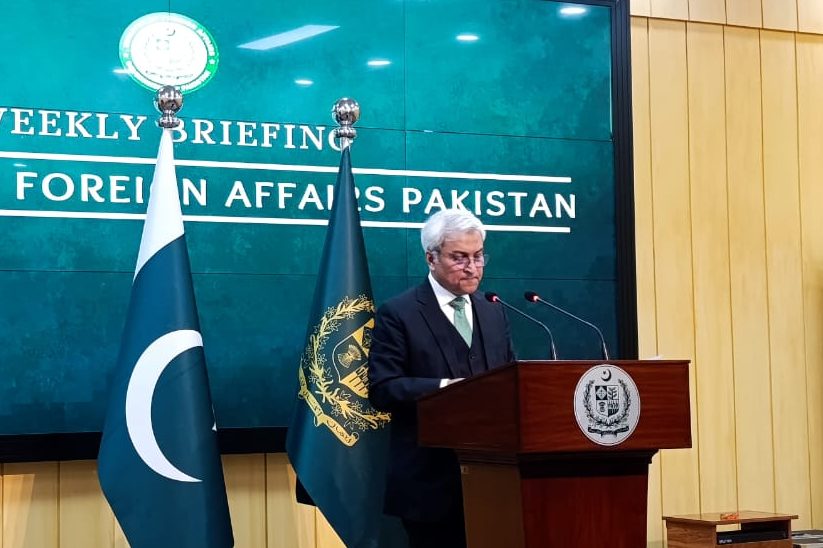
Foreign Office spokesperson Tahir Andrabi, in his weekly press briefing, apprised the media of the recent abrupt variation in the flow of the River Chenab and the unilateral release of water into the river by India without any prior notification or information shared with Pakistan.
Expressing serious concerns over these variations, he said Pakistan’s Indus Water Commission had written a letter to his Indian counterpart seeking clarification on the matters as any manipulation of river flow by India, especially at a critical time of agricultural cycle, directly threatened the lives and livelihoods as well as food and economic security of Pakistani people.
“The Indus Water Treaty is a binding international agreement which has been an instrument of peace, security and stability in the region. Its breach or violation on one hand threatens the inviolability of international treaties and compliance with international law and on the other hand it poses serious threats to regional peace, principles of good neighbourliness.”
The spokesperson reiterated that Pakistan remained committed to peaceful resolutions of disputes and issues with India, but would not compromise on the existential water rights of its people.
Highlighting the incident involving the mistreatment of a Muslim woman by the Chief Minister of Indian State of Bihar and its public mocking by a minister in the state of Uttar Pradesh, Spokesperson Andrabi called it “deeply disturbing” which also warranted a strong condemnation.
He said that such conduct reflects a broader and troubling pattern associated with Hindutva-inspired politics like the alarming rise of religious intolerance and Islamophobia.”
Asked about the defamation campaign by the Indian media following the terrorist attack at Sydney’s Bondi Beach, he said a constant “conveyor belt” of disinformation was run, and eventually the suspect turned out to be of Indian origin and an Indian passport holder.
He urged the Indian media to act more responsibly as the ultimate price they paid for such misinformation was the loss of their own credibility.
Also rejecting the Indian media’s baseless propaganda about the meeting between Prime Minister Shehbaz Sharif and Russian President Vladimir Putin, the spokesperson said, the meeting was “very productive and positive.”
Regarding the media reports, he said that given India’s troubling history of nuclear security collapses, including multiple incidents of radioactive material theft and unlawful sale of radioactive material, the involvement of the private sector in handling of sensitive nuclear material might pose challenges to the global efforts for countering access of private individuals to sensitive nuclear materials.
To a question, he said the closure of Pakistan’s airspace for India was reflective of the relations between the two countries, and factors like the threats against Pakistan and statements by Indian senior leadership about having another wave of aggression against Pakistan caused the airspace closure.
Asked to comment about the UN Security Council report on Afghanistan, the spokesperson said the document corroborated Pakistan’s stance that the presence of terrorist elements in Afghanistan posed a major threat to peace and security of the region, besides undermining any efforts of internal development and state consolidation inside Afghanistan by the Kabul government.
He said the report also reaffirmed Pakistan’s assertion that the major impediment to developing bilateral relations between Pakistan and Afghanistan, like ceasefire, the closure of the border and trade were also linked with the presence of these terrorist elements.
To another question, he said the Pak-Afghan ceasefire was meant to stop terrorist attacks from Afghanistan into Pakistan. He said that as attacks from Afghan side continued so, the ceasefire was not holding.
He told the media that there was no hindrance in the dispatch of humanitarian aid to Afghanistan, including the medicines as a consignment was allowed recently and it would be up to the Taliban regime to accept that.
Responding to the matter of the Norwegian ambassador’s presence in a court case hearing, he said the matter had been rested after he was called to the foreign ministry.
However, highlighting the broader principle, he said that the attendance of ambassadors in a court of law was not their right and the diplomats wishing to attend a court proceeding anywhere in the country needed to approach the foreign ministry for approval.
“The ambassadors enjoy diplomatic immunity and this comes with a certain responsibility…And I also believe that the diplomats wishing to attend a court may have to waive off their diplomatic privilege and immunity if they wish to make an appearance in the court,” he added.
Highlighting the diplomatic engagements during the last week, he mentioned Prime Minister Shehbaz’s visit to Turkmenistan where he attended International Conference on Peace and Trust and met the leaders of Turkmenistan, Turkiye, Russia and Iran.
During the visit, Deputy Prime Minister Ishaq Dar also met his counterparts from Iran, Kyrgyzstan, Oman, Turkiye, Tajikistan and Uzbekistan as well as Secretary-General of the Economic Cooperation Organization.
Andrabi also referred to the statement by foreign minister of Muslim countries highlighting the indispensable role of the UNRWA and condemned the storming of its headquarters in East Jerusalem by the Israeli forces, in flagrant violation of international law and the inviolability of UN premises.
The ministers called upon the international community to ensure sustainable and adequate funding of UNRWA and to provide the agency with the political and operational space needed to continue its work in all five fields of its own operation.