Federal Minister for Information and Broadcasting Attaullah Tarar on Saturday termed the federal budget for 2026-27 an “all-inclusive and relief-oriented” one that reflects the relentless efforts of the government under the leadership of Prime Minister Shehbaz Sharif during the last two years.
All-inclusive budget, outcome of 2 years’ relentless efforts: Atta Tarar

ISLAMABAD, Jun 13 (APP): Federal Minister for Information and Broadcasting Attaullah Tarar on Saturday termed the federal budget for 2026-27 an “all-inclusive and relief-oriented” one that reflects the relentless efforts of the government under the leadership of Prime Minister Shehbaz Sharif during the last two years.
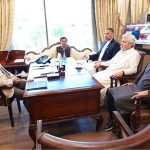
Addressing a post-budget press conference alongside Finance Minister Muhammad Aurangzeb and the Minister of State for Finance, Bilal Azhar Kayani, Atta Tarar said the prime minister has fulfilled his promise to provide meaningful relief to various segments of society, including the salaried class, the business community, and the export sector.
He emphasized that the government is resolutely moving toward export-led growth to strengthen the national economy, noting that the presence of “Made in Pakistan” products in international markets is a source of immense pride.
He added that the increase in turnover for the export sector would facilitate business expansion, ultimately fostering job creation and benefiting the labor class.
As regards the lower-middle class, the minister highlighted the government’s Apna Ghar programme and noted that the budget included the disbursement of Rs 90 billion for the housing sector.
He explained that because the housing and development sectors are deeply connected to over a dozen other industries, this investment is expected to act as a catalyst for broader economic activity. Additionally, the government has reduced taxes on the sale and purchase of housing to further support this sector.
Reflecting on the state of the economy, Tarar recalled that when they came into the government, the country was grappling with a negative GDP growth.
“Our first target was to achieve economic stability, which has been acknowledged at the global level,” he said, recalling that the Managing Director of the International Monetary Fund in Davos appreciated the macroeconomic stability achieved by Pakistan through structural reforms and homegrown agenda.
He added that the World Bank, in addition to the other countries, also appreciated reforms in the Federal Board of Revenue.
These initiatives set the current positive trajectory for our economy, which is now moving toward a 3.7 to 4 percent growth rate.
The minister defined the reforms within the Federal Board of Revenue (FBR) as historic and unprecedented, adding that the institution is now free from political influence.
He emphasized that the government has ensured transparency through the implementation of “faceless” and IT-based systems to address massive revenue leakages.
He specifically addressed the industrial sector, noting that the government had initiated enforcement measures against large industries, such as the sugar sector, to ensure they contribute their fair share to the national exchequer rather than placing the tax burden solely on the salaried class.
Addressing the issue of litigation, he said the government has taken decisive steps to break the collusion between legal counsels who had historically used delaying tactics to stall taxation cases. Through consistent efforts and the digitization of tax processes, the government has created the fiscal space necessary to provide relief across all strata of society.
In the social sector, the minister pointed to significant allocations for educational and healthcare infrastructure, including the Islamabad Jinnah Medical Complex, the Danish University in Muzaffarabad, and various institutions across Sindh, Balochistan, and Gilgit-Baltistan, as evidence of the government’s commitment to the lower middle class.
He said the government has successfully changed the political culture by ensuring that appointments across all government departments are made strictly on merit, and he urged the media to recognize the government’s efforts in transforming a difficult economic situation into an inclusive and stable roadmap for growth.