Federal Minister for Parliamentary Affairs Dr. Tariq Fazal Chaudhry on Sunday said that elections in Azad Jammu and Kashmir (AJK) would be held on July 27 as scheduled, despite attempts by certain elements to disrupt the electoral process and create a law and order situation.
AJK elections to be held on schedule despite disruption attempts: Dr.Tariq Fazal
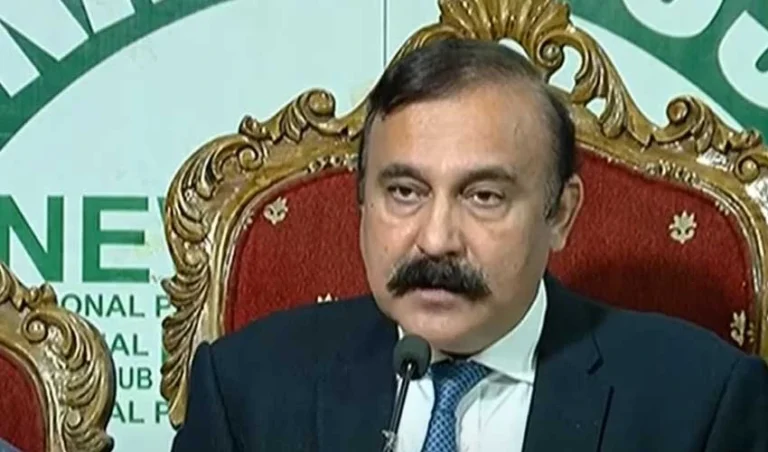
ISLAMABAD, Jun 07 (APP): Federal Minister for Parliamentary Affairs Dr. Tariq Fazal Chaudhry on Sunday said that elections in Azad Jammu and Kashmir (AJK) would be held on July 27 as scheduled, despite attempts by certain elements to disrupt the electoral process and create a law and order situation.
Addressing a press conference alongside AJK political leaders, the minister said that the AJK Legislative Assembly had completed its constitutional term, elections had been announced, and the election schedule had already been issued.
He alleged that some elements were attempting to create unrest and revive the kind of violent protests witnessed in the past, with the aim of affecting peace and stability ahead of the elections.
Dr. Tariq Fazal said that the Joint Action Committee (JAC), formed in September 2023, had initially presented three key demands, including subsidies on flour, a reduction in electricity tariffs, and cuts in elite privileges.
He said the government had accepted these demands, adding that electricity in AJK was currently being provided at Rs3 per unit, while subsidies were also being extended on flour and other essential commodities.
The minister said that in September 2025, the JAC once again called for a long march, shutter-down strikes, and protests, and submitted a 38-point charter of demands.
In response, a committee comprising federal ministers and leaders of the Pakistan Peoples Party was formed. The committee held negotiations with the JAC in Muzaffarabad on October 3 and 4, 2025, resulting in an agreement.
He said Prime Minister Muhammad Shehbaz Sharif had directed the full implementation of the agreement, approved the release of the required funds, and established a committee to oversee its implementation.
Monthly meetings with JAC representatives were subsequently held to review progress on the agreed points.
Dr. Tariq Fazal said that during another round of talks on May 30, the JAC’s principal demand was the abolition of 12 seats reserved for refugees residing in Pakistan.
To address the issue, the government proposed four options, including convening an all-parties conference, debating the matter in the Legislative Assembly, seeking guidance from the Supreme Court of AJK, and postponing the planned June 9 march for a few days.
However, he said, the JAC rejected all four proposals and insisted on holding the march on June 9.
The minister said that both the government of Pakistan and the AJK government wanted to resolve the issue through dialogue, stressing that violence and the loss of human lives could not provide a solution to any dispute.
Rejecting the impression that the October 3–4, 2025 agreement had not been implemented, he said that 35 of its 38 clauses had already been fulfilled, while the remaining points involved legal and judicial complexities.
He said several provisions had been implemented through executive orders, including the withdrawal of FIRs, reduction in the size of the cabinet, payment of compensation to affected individuals, provision of jobs, and other measures.
The minister said that full compensation had been paid to all those who were killed or injured during previous protests.
He further said that billions of rupees had been allocated for development projects related to roads, tunnels, airports, power infrastructure, and healthcare facilities.
However, he added that such large-scale projects could not be completed within a few months and required time.
Dr. Tariq Fazal said that it was not appropriate to repeatedly resort to long marches, shutter-down strikes, and violent protests every few months while demanding the completion of major development projects.
He emphasized that dialogue and mutual understanding remained the only effective means of resolving disputes, rather than violence and attempts to disturb public order.
The minister also questioned whether efforts to destabilize AJK were aimed at portraying AJK and Pakistan as separate entities, weakening their strong relationship, distancing the people of AJK from refugees of Indian Illegally Occupied Jammu and Kashmir (IIOJK), or undermining the Kashmir cause.
He reiterated that Pakistan had always stood by the Kashmir cause and would continue to support the Kashmiri people’s right to self-determination.
He warned that any attempt to create unrest in AJK could benefit Pakistan’s adversaries.
Dr. Tariq Fazal maintained that the demands of the Joint Action Committee had neither been ignored in the past nor were being ignored now, but stressed that negotiations remained the only viable path to resolving outstanding issues.
He added that violence and the loss of innocent human lives could not be allowed under any circumstances.