Federal Minister for Planning, Development and Special Initiatives Ahsan Iqbal has stressed that political stability, national unity and continuity of policies are essential for Pakistan’s development, warning that politics of confrontation and disorder ultimately thrusts the heaviest burden on ordinary citizens.
Ahsan Iqbal stresses political stability, national unity for Pakistan’s development
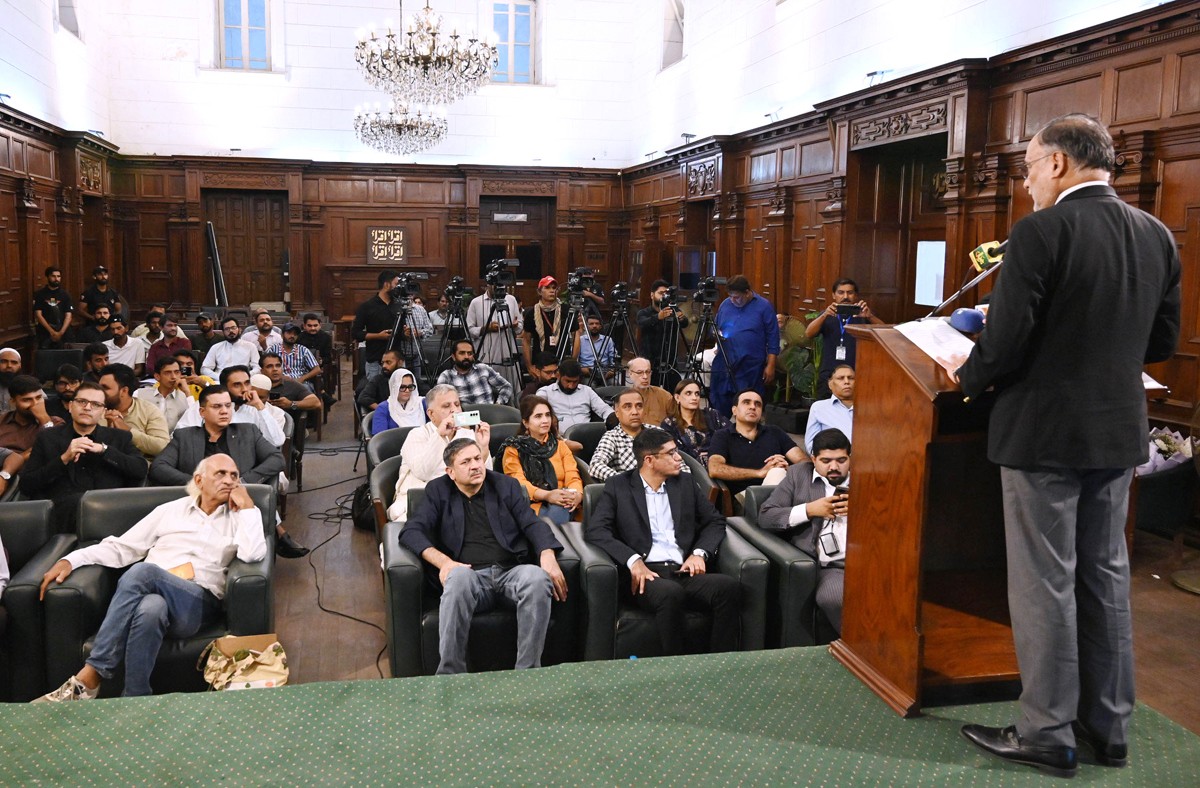
LAHORE, Oct 10 (APP):Federal Minister for Planning, Development and Special Initiatives Ahsan Iqbal has stressed that political stability, national unity and continuity of policies are essential for Pakistan’s development, warning that politics of confrontation and disorder ultimately thrusts the heaviest burden on ordinary citizens.
Addressing the launch of Hafiz Bakhtiar Ahmad’s book “Shah Jahan’s Royal City of Lahore,” he said political differences were a democratic right, but violence, hatred and destruction of property weakened democracy and undermined national progress.
He said the closure of shops, loss of daily wages, postponement of examinations and difficulties faced by patients in reaching hospitals reflected how political confrontations directly affected ordinary households.
Ahsan Iqbal said the government and political leadership must keep the doors of dialogue open, listen to public concerns, strengthen constitutional processes and build public trust through their conduct. Sustainable stability, he added, could be achieved through justice, the rule of law, accountability and confidence in institutions.
He emphasised that Pakistan’s future was greater than the interests of political parties and individuals, urging political leaders to compete democratically while maintaining continuity in pursuing national priorities, including education, economic growth, national security and development.
Drawing lessons from Mughal history, the minister said internal conflicts, power struggles, administrative weaknesses and failure to respond to changing circumstances could undermine even powerful states. When personal interests prevailed over collective welfare and national energies were consumed by confrontation instead of construction, he added, the foundations of progress became weak.
He said political uncertainty discouraged investment, reduced employment opportunities, harmed education and diverted national resources from development towards crisis management.
Highlighting Lahore’s historical and cultural significance, Ahsan Iqbal said the city represented not only architectural grandeur but also the cultural consciousness, creativity and historical journey of its people. Its streets, gardens, mosques and historic gates reflected a civilisation shaped by knowledge, hard work and aesthetic sensibilities.
Congratulating the author, he said the book transformed his love for Lahore into research and writing, helping readers understand the cultural and historical significance of the city’s architectural heritage.
The minister said Mughal-era architecture reflected a remarkable blend of local craftsmanship, Central Asian and Iranian influences, and the artistic traditions of the subcontinent. Lahore remained a prominent centre of this cultural development, particularly during Shah Jahan’s reign.
Referring to Shalimar Gardens, he said their carefully planned layout, water channels, fountains and greenery demonstrated that architectural beauty required imagination, planning, engineering and craftsmanship.
He observed that historical monuments embodied not only the vision of rulers but also the intelligence and hard work of architects, engineers, calligraphers, craftsmen and labourers whose contributions deserved recognition.
Ahsan Iqbal said the true strength of a civilisation lay in human creativity, adding that societies which respected talent and provided opportunities for innovation could establish a distinguished place in the world.
As planning minister, he said, he viewed development not merely in terms of roads and buildings but also through the advancement of human capabilities. He expressed the hope that young Pakistanis would pursue research, develop innovative products, explore new markets and use their creative potential to contribute to national progress.
He said the government’s “Uraan Pakistan” initiative brought together exports, digital development, environmental protection, energy, infrastructure, social justice and empowerment as key areas of national development. Peace, policy continuity and collective national commitment were essential to achieving these objectives, he added.
The minister said Lahore’s historical heritage could also contribute to economic development by creating opportunities in cultural tourism, research, handicrafts, publishing, film and design. He stressed the need for authentic restoration of historical sites, improvement of their surroundings, training of qualified guides, reliable information and digital documentation to preserve their historical identity for future generations.
He said collaboration among authors, universities, archaeologists and relevant institutions could help present the history of Pakistani cities to the public more effectively.
Addressing young people, Ahsan Iqbal urged them to study history critically, learn from the achievements and shortcomings of their predecessors, remain confident in their identity and benefit from global knowledge. He said their lasting contribution would be reflected in the research, inventions, books, institutions and services to humanity they left behind.
He encouraged young people to turn their observations into knowledge, their knowledge into writing and their abilities towards serving society.
Referring to the 500th anniversary of the establishment of the Mughal Empire, the minister called for a renewed national commitment to promoting knowledge, valuing creativity, protecting cultural heritage and ensuring that political differences did not turn into national enmity.
He said the ultimate test for the present generation was to leave behind a Pakistan that was advanced in knowledge, economically strong, confident in its cultural identity and peaceful for all its citizens.