
- Advertisement -
LAHORE, Jan 24 (APP):Federal Minister for Planning and Development Professor Ahsan Iqbal on Friday warned that misinformation and digital disinformation have emerged as major global threats, stressing the need to build digital resilience through education, awareness and strong cybersecurity measures.
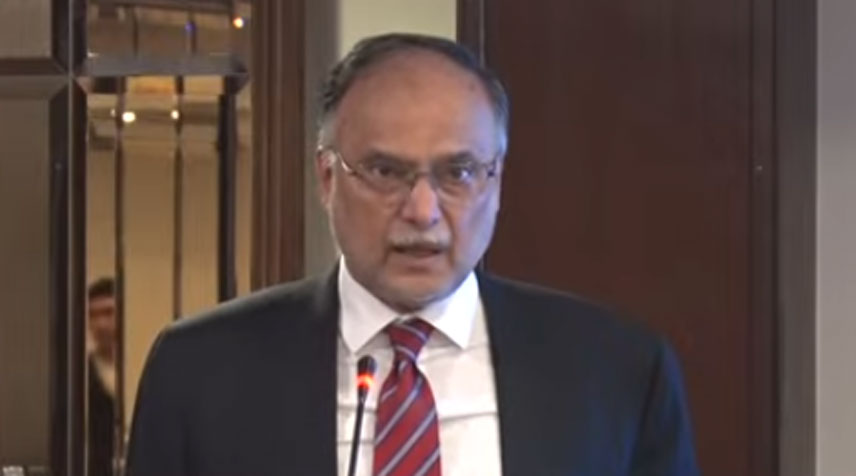
Addressing a panel discussion titled “Building Digital Resilience” at Afkar-e-Taza – Thinkfest 2026, held at Alhamra, here on Saturday, the minister said that while digital transformation had created vast opportunities, it has also generated serious challenges for states and individuals alike.
He said that safe city projects and digital surveillance systems had improved urban security, but if such systems are hacked, they could be misused for criminal and disruptive purposes.
He cautioned that cyberattacks on banking systems could severely affect financial operations, adding that in the modern era even weapons and warfare have become digital. He emphasized that with increasing digitalization, cybersecurity has become as important as the protection of physical borders.
“Just like national boundaries, cyber boundaries also require strong protection,” he said, noting that along with national-level challenges, individuals are also facing growing digital risks. Highlighting misinformation as a key concern, the minister said that spreading disinformation through social media has become extremely easy, while it is increasingly difficult for ordinary citizens to differentiate between
real content and AI-generated videos and audio.
He termed misinformation the second biggest global threat after terrorism, warning that polarization fueled by false narratives could destabilize societies from within. Sharing a personal experience, Professor Ahsan Iqbal recalled that in 2018, political opponents used religious narratives and online hate campaigns against him, which ultimately led to an attempt on his life by a young man influenced by hateful digital content. “Allah saved my life, but sadly, a young man’s life was destroyed,” he said, terming it a tragic consequence of digital hate.
He stressed that the new generation must develop the ability to filter digital information, urging the youth to reject any content based on hatred or prejudice. “Just as highways have warning signs, social media users must have internal filters to identify and reject hate and prejudicial messages,” he remarked.
The minister said that besides conventional wars, a new form of conflict is now being fought in the information domain, where disinformation can create divisions between the state and its citizens. He underscored the importance of addressing these issues through the education system and revealed that instructions have been issued to the Higher Education Commission (HEC) to introduce academic content in universities that helps students distinguish between truth and falsehood. He further said that the government is working to strengthen the capacity of state institutions to control cybercrimes and is also legislating to address the harassment of women on digital and social media platforms.
He emphasized that freedom of expression should not be allowed to harm individuals’ lives. Referring to global trends, he noted that no country has a complete solution to digital challenges, citing Australia’s decision to ban social media use for children under 16 as an example of emerging regulatory approaches. Concluding his discussion , the minister expressed hope that societies would gradually learn to use freedom of expression, social media and digital platforms responsibly, without hurting others.
He stressed that unity in diversity is the cornerstone of democracy and national strength, warning that any country which fails to maintain internal cohesion would weaken itself without the need for an external enemy. Senior journalist and anchor Mehmal Sarfraz, High Commissioner of Canada to Pakistan Tariq Ali Khan, and Chairperson, Department of Digital Media, Punjab University, Dr Savera Shami, also participated as panelists in the discussion.