PESHAWAR, Sep 24 (APP):Parliamentarians, government officials, representatives of the Sikh community and human rights institutions reviewed the proposed Khyber Pakhtunkhwa Sikh Anand Kaaraj Bill, 2026, discussing its key provisions and the remaining steps before it is placed before the provincial legislature. The briefing was organized by Parliamentary Caucus on Minorities, Khyber Pakhtunkhwa Assembly, in collaboration with Blue Veins and the National Commission for Human Rights (NCHR). The briefing was attended …
KP Sikh Anand Kaaraj Bill moves forward in legislative process
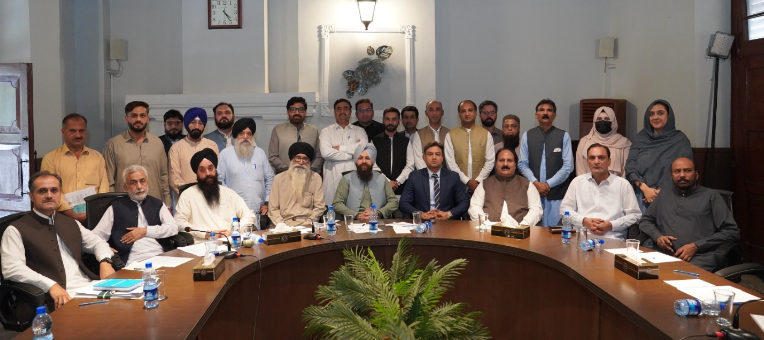
PESHAWAR, Sep 24 (APP):Parliamentarians, government officials, representatives of the Sikh community and human rights institutions reviewed the proposed Khyber Pakhtunkhwa Sikh Anand Kaaraj Bill, 2026, discussing its key provisions and the remaining steps before it is placed before the provincial legislature.
The briefing was organized by Parliamentary Caucus on Minorities, Khyber Pakhtunkhwa Assembly, in collaboration with Blue Veins and the National Commission for Human Rights (NCHR).
The briefing was attended by members of Minority Caucus, Members of Provincial Assembly, minority representatives, officials of the provincial government, Assembly Secretariat, civil society and media.
The proposed legislation seeks to replace the limited framework of the Anand Marriage Act, 1909 with a comprehensive provincial system governing the solemnization, registration, arbitration and dissolution of Sikh marriages.
It also provided for matrimonial rights, maintenance, custody and legal recognition of registered marriages.
Chairperson of the Parliamentary Caucus on Minorities and Member of the Provincial Assembly, Asker Pervaiz said the legislation was intended to provide the Sikh community with a clear legal framework responsive to its religious traditions and practical needs.
“For the Sikh community, marriage is closely connected with religious identity, family life and dignity. Our responsibility as legislators is to ensure a clear and workable legal framework while respecting Sikh religious traditions. The Parliamentary Caucus will continue to facilitate consultation as the legislation moves forward,” he added.
Baba G. Gurpal Singh, Vice Chairperson of the Parliamentary Caucus on Minorities and Member of the Provincial Assembly, said the legislation addressed a long-standing need for an effective mechanism governing Sikh marriages.
“The Sikh community needs a framework that recognises Anand Kaaraj while also providing practical mechanisms for registration, documentation and matrimonial matters. The final law should remain rooted in Sikh religious principles and customs while providing legal certainty and protection to Sikh families,” he said.
The participants were informed that the proposed law sets the minimum marriage age at 18 years for both parties, requires free and full consent and treats consent obtained through force, fraud, coercion, misrepresentation or undue influence as invalid. It also makes registration of Sikh marriages mandatory and provides for licensing Anand Kaaraj Registrars through the Local Government Department.
Muhammad Said-ur-Rehman, Local Government Focal Person for Family Laws, briefed participants on the status of the Bill.
He said that following vetting by the Law Department, the Bill would be sent to the Cabinet Committee on Legislation. Upon its approval, it would be placed before the Provincial Cabinet for approval before being presented in the Khyber Pakhtunkhwa Assembly.
The proposed framework also provides equal rights and duties within marriage and protection from violence, coercion and abuse, while establishing mechanisms for reconciliation and dissolution. Family Courts would have jurisdiction over matters including dissolution, maintenance, custody, guardianship and other matrimonial relief.
Coordinator, NCHR, Rizwan Shah said an effective family law framework was closely linked with dignity, equality before the law and the ability of religious minorities to exercise their rights.
“Legal recognition must translate into rights that people can exercise in everyday life. A clear mechanism for marriage registration and documentation is important because these documents affect a range of civil and family rights. NCHR supports consultative processes that bring communities, legislators and government institutions together,” he said.
Programme Manager at Blue Veins and a member of the Bill’s drafting committee, Qamar Naseem said Blue Veins had been providing technical support to the Local Government Department and the Parliamentary Caucus on Minorities in the development and review of the legislation.
“The technical process has sought to translate the concerns and lived realities of the Sikh community into a legally coherent and administratively workable framework. The significance of the Bill lies not only in recognising Anand Kaaraj but in creating practical pathways for registration, documentation, matrimonial remedies and legal recognition,” he said.
Under the proposed legislation, a registered Anand Kaaraj would constitute a valid marriage for legal and civil purposes, including inheritance, succession, maintenance, guardianship, legitimacy of children, family registration and identity documentation. The marriage certificate would be admissible as proof before courts, tribunals, public authorities and government institutions, Qamar added.
The Bill also provided for the registration of Sikh marriages solemnized before its commencement and required the provincial government to frame rules within 120 days of the law coming into force.
Participants called for continued consultation with Sikh community representatives as the Bill proceeds through the remaining legislative stages and during the subsequent formulation of rules.