PESHAWAR, Oct 24 (APP):When an international polio day arrives on October 25 every year, the pain of 70-year-old Jamsheed Ali who gently pushes his son’s wheelchair towards a small playground in Nowshera, increased with a life-long regret of unvaccinated his loved one. Jamsheed's pain continued after polio deprived his son Abid Ali of a childhood at the age of three years at village Dheri Ishaq where he only see children …
International polio day: Time to create mass awareness against polio’s myths
PESHAWAR, Oct 24 (APP):When an international polio day arrives on October 25 every year, the pain of 70-year-old Jamsheed Ali who gently pushes his son’s wheelchair towards a small playground in Nowshera, increased with a life-long regret of unvaccinated his loved one.
Jamsheed’s pain continued after polio deprived his son Abid Ali of a childhood at the age of three years at village Dheri Ishaq where he only see children chasing a football in a dusty ground on the bank of River Kabul.
The children chase a worn-out football across the dusty ground, their bare feet sending small clouds of dust into the air.
Parents watch from the sidelines, occasionally calling out to their children to be careful due to nearby river.
Abid sits quietly in his wheelchair, his eyes following every movement of the ball. When it rolls close to him, he stretches his hands forward, trying to reach it like the other children.
Sometimes he leans too far and without the strength in his legs to steady himself, he loses his balance and falls from the wheelchair.
His father immediately rushes to him, lifts him gently and settles him back into his seat.
Then he watches silently as the game continues till evenning. For Jamsheed, every such fall is a painful reminder of a decision he wishes he could undo.
“At just three years old, Abid’s life changed forever and so did ours,” he says, his voice trembling.
It began with fever and pain in the child’s limbs. Within days, Abid could no longer stand. Doctors later diagnosed him with polio, leaving both of his legs permanently paralysed.
“I did not vaccinate him,” Jamsheed says quietly. “We believed the rumours and misinformation about the polio vaccine. That guilt follows me every single day.”
Gripping the handles of his son’s wheelchair, he said “When he falls, it feels as if my heart falls with him,”.
Jamsheed remembers a different Abid—a little boy who ran, played and moved freely.
Today, he pushes his son’s wheelchair along the same dusty paths where other children run and play.
His regret has now turned into a warning for others parties.
“I talk to parents and tell them my story,” he says. “I beg them not to make the same mistake. Vaccinate your children. Do not believe false rumours and myths. Do not wait until it is too late.”
“If my story can save even one child,” he adds softly, “then perhaps my regret will mean something.”
Abid’s story is deeply personal, but it reflects a wider public-health challenge facing Khyber Pakhtunkhwa, particularly its southern districts.
Pakistan has made significant progress against polio, with only four cases of wild poliovirus reported nationwide in 2026 up to mid-September last, compared with 31 cases in 2025 and 74 in 2024.
Yet health authorities caution that the decline in cases should not create complacency.
Three of the four cases reported this year have emerged from Bannu division, highlighting the persistence of transmission in vulnerable pockets of southern Khyber Pakhtunkhwa.
The first case of 2026 was reported from Sujawal district of Sindh in March, while two cases were subsequently detected in Khyber Pakhtunkhwa—in Bannu and North Waziristan.
Environmental surveillance has also shown a substantial decline in positive samples, falling from 417 in 2025 to 124 during January-July 2026, according to officials.
But every positive sample is a reminder that the virus can survive silently and re-emerge when it finds an unprotected child.
“Polio is a highly contagious and irreversible disease, and vaccination is the only viable remedy,” says Dr Samiullah, head of the children’s department at DHQ hospital Mardan.
“It can silently attack a child and permanently destroy his or her future within days,” he says, stressing that oral polio vaccine is safe and remains one of the most effective tools for preventing paralysis.
Health workers say misinformation, rumours, negative propaganda and misconceptions about vaccination remain among the biggest obstacles to eradication, particularly in communities where access to reliable health information is limited.
Experts believe that winning the battle against polio is therefore not only a matter of administering vaccine drops but also of changing attitudes and building trust.
On World Polio Day, observed on October 24 under the global theme “One day, one focus: ending polio for good,” health authorities, communities and civil society renewed their commitment to protecting every child from the crippling disease.
In Mohmand district, the District Emergency Operations Centre organised a seminar at Jirga Hall in Ghalanai, followed by an awareness walk.
Additional Deputy Commissioner (General) Iftikharuddin, Deputy District Health Officer Dr Muhtam Shah and Assistant Commissioner Upper Mohmand Sikandar Afzal attended the event along with tribal elders, religious scholars, education officials, community-based organisations, students and members of the DEOC.
Speakers urged parents to ensure that children received polio drops and routine immunisations, while tribal elders and religious scholars were asked to promote vaccination through hujras and mosques.
Government Higher Secondary School (Boys), Ghalanai Principal Alamzeb Khan, Malik Haji Ahmad Khuzaizi, Maulana Shakirullah Junaidi, Maulana Samiullah and Maulana Aminul Haq also addressed the gathering.
The event concluded with an awareness walk during which participants pledged to strengthen public awareness and protect children against preventable diseases.
From headlines to lifelines
In Peshawar, the Emergency Operations Centre (EOC) organised an annual engagement session with media representatives under the title “From Headlines to Life Lines: Reporting for a Polio-Free KP.”
EOC Coordinator Sarah Rehman, health experts, representatives of the World Health Organisation and a large number of journalists attended the session.
The discussion focused on the achievements of anti-polio campaigns, immunisation trends, epidemiological developments, programme progress, social challenges and strategies for reaching missed children.
Sarah Rehman said the media had an important role in changing public attitudes towards vaccination.
“Even if a single door is opened for a polio worker because of the efforts of the media, it would be a great success,” she said, emphasising the need for collective efforts to remove misconceptions and social barriers.
She said an upcoming IPV campaign would help strengthen efforts to interrupt circulation of the virus and protect future generations.
Dr Sardar Alam of WHO said Pakistan was very close to polio eradication, but the final stage required joint efforts, public trust and effective awareness.
He explained that the virus could survive in the environment, including sewage, and become active when it came into contact with susceptible people.
Communication Officer Polio UNICEF Shadab Younas stressed the need to change public behaviour and mindset, saying strategies were being adapted according to the diversity of communities.
She also urged journalists to report evidence-based information, counter misinformation, highlight the work of frontline workers and use social media platforms to promote awareness about vaccination.
Khyber Pakhtunkhwa has intensified its vaccination efforts, targeting around 7.3 million children during the province-wide campaign held from September 21 to 27.
Around 35,000 vaccination teams participated, supported by security personnel and officials from various departments.
Special vaccination campaigns were also conducted in Upper South Waziristan, Lower South Waziristan, North Waziristan and Bannu to improve coverage in hard-to-reach areas.
The provincial government has announced additional measures to strengthen health services in vulnerable districts, including recruitment and deployment of 2,400 doctors, procurement of medicines and outsourcing the management of 72 hospitals in remote areas.
Officials say patients at these facilities will continue to receive free treatment and vaccination services.
At the national level, Prime Minister’s Focal Person for Polio Eradication Ayesha Raza Farooq has recently said Pakistan is moving closer to its goal of becoming polio-free.
She said vaccination campaigns achieved coverage of 98 percent in February, 99 percent in April and 98 percent in May this year.
A sub-national immunisation campaign held on September 21-27 targeted around 31 million children under five in 115 high-risk districts.
The campaign was synchronised with Afghanistan, with special attention to zero-dose children, including those among nomadic and migrant communities.
Pakistan and Afghanistan remain the only countries where wild poliovirus continues to circulate endemically, making the border region a single epidemiological block for eradication efforts.
Health officials say the remaining reservoirs of the virus, particularly in Bannu and adjoining vulnerable areas, require sustained surveillance and repeated vaccination of every eligible child.
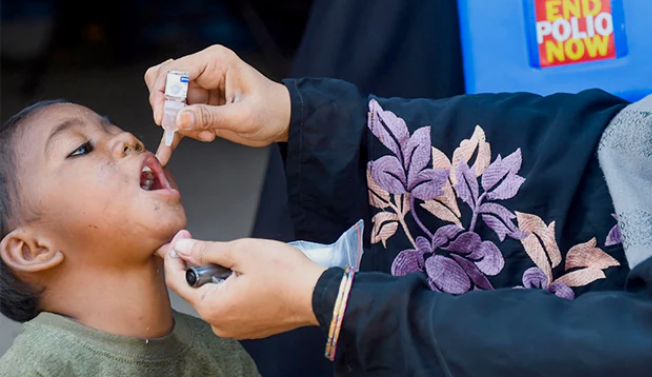
Around 400,000 frontline workers, most of them women, continue to go from door to door, often through difficult terrain and challenging security environments, to administer a few drops of vaccine.
For them, those drops are not merely medicine. They represent a child’s chance to walk, run, play and grow without the shadow of permanent paralysis.
For Abid Ali, however, the importance of those few drops came too late due to criminal negligence of his parents. As darkness begins to settle over Dheri Ishaq, the football game comes to an end. The children gather their belongings and slowly leave the playground, their laughter fading into the evening.
Jamsheed turns his son’s wheelchair towards home with regret. He pushes slowly along the dusty path, his son beside him and decades of regret weighing heavily on his shoulders.
But he is no longer silent and wants other parents to hear what he learned too late.
“I cannot change what happened to my son. But perhaps I can help make sure it does not happen to another child to be crippled for life.”
For Jamsheed, the fight against polio is no longer an abstract public-health campaign.
It is the story of his son and the memory of a childhood lost besides a plea to every parent who still has the power to protect a child from polio.