On low sand dunes in western Pakistan, near the borders with Afghanistan and Iran, researchers have identified a desert lizard previously unknown to science.
A new desert lizard emerges from Pakistan’s Chagai sands
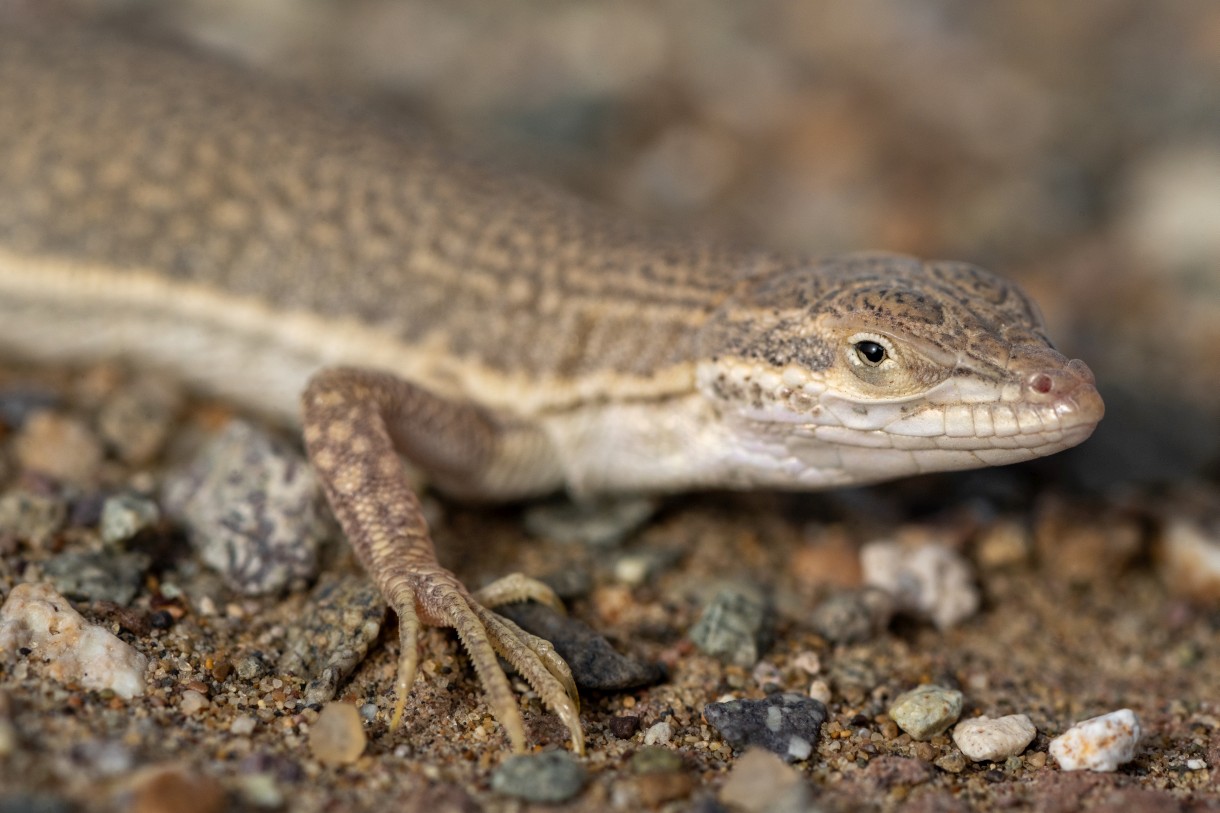
PESHAWAR, Nov 03 (APP): On low sand dunes in western Pakistan, near the borders with Afghanistan and Iran, researchers have identified a desert lizard previously unknown to science.
The species, named Eremias chagaiensis after Chagai District in Balochistan, has a distinctive network of winding brown markings across its back.
An international study reveals a maze-patterned racerunner and resolves a century-old question about another lizard in Balochistan.
The study also provides the first modern specimen- and DNA-based confirmation of Eremias fasciata in Pakistan, more than a century after its first alleged historical report.
The new lizard was documented at four localities during field surveys between 2022 and 2025. Its body reaches 5.7 cm in length, excluding a tail that can be more than twice as long. Unlike the longitudinal stripes typical of many related racerunners, its intricate, maze-like pattern is present in both juveniles and adults.
“Balochistan’s deserts are among the least explored places in South Asia. Finding a new lizard here tells us how much is still undocumented,” says Rafaqat Masroor of the Pakistan Museum of Natural History, who led the research.
The finding adds to a long but uneven history of herpetological research in Balochistan. Recently, research in northwestern Balochistan has revealed Eremias kakari and two further racerunners, E. rafiqi and E. killasaifullahi by Rafaqat Masroor and Daniel Jablonski, researchers that are collaborating almost a decade.
The new discovery therefore builds on decades of Pakistani and international work, while showing how much remains unresolved.
Appearance, however, did not tell the whole story.
The new species closely resembles Eremias graphica, described from Iran in 2023. Analyses of two mitochondrial and one nuclear gene, together with comparisons of body proportions and scale characters, support its recognition as a distinct evolutionary lineage. In the mitochondrial analyses, E. fasciata, a striped species from the same wider landscape, was recovered as its closest relative. The two species differ by approximately 10.6% in the mitochondrial genes examined.
“At first glance this lizard looked like a species from Iran described in 2023,” says Daniel Jablonski of Comenius University in Bratislava and the Natural History Museum Vienna, Austria.
“Appearances can be deceptive. The sand doesn’t stop at the border. Surveys in Afghanistan are needed to learn how far this species really lives.”
The lizards were observed on loose sand, particularly low dunes and sandy patches near desert shrubs, where they excavate burrows. They were not recorded on the neighbouring gravel plains, which were occupied by E. fasciata.
Such differences in habitat use may help explain how closely related desert lizards have diversified, although the evolutionary role of dune isolation remains to be tested.
Reaching and surveying these habitats is demanding even without the political obstacles.
Chagai has intensely hot summers, cold winters, marked differences between daytime and night-time temperatures, and scant, irregular rainfall.
Earlier field researchers described drought affecting vegetation and wildlife, as well as windblown sand that could obstruct roads. A more recent meteorological study also documents widespread aridity and recurrent drought across Balochistan.
During the 2025 surveys, E. chagaiensis was mainly encountered in the morning and late afternoon; at midday, individuals generally sheltered beneath shrubs or in burrows.
Access is further complicated by Balochistan’s long-running socio-political instability and security concerns, especially in its international borderlands. Official travel guidance describes restrictions on movement and requirements for advance permission in parts of the province. Such circumstances make sustained, repeatable biodiversity surveys difficult and leave gaps in the distributional record.
“The desert climate limits when animals can be found, and the political situation limits where scientists can work. Both constraints shape the maps we produce. That is why we should be cautious about calling a species endemic based on just a few localities,” says Daniel Jablonski.
Researchers currently know E. chagaiensis from four sites, giving an estimated extent of occurrence of 911 km² and an area of occupancy of 16 km². These figures describe its documented distribution, not necessarily its full range. Similar sandy habitats extend into southwestern Afghanistan and possibly eastern Iran, but surveys across the border have yet to confirm its presence there. Because its population trends and threats are unknown, the authors recommend a provisional conservation assessment of Data Deficient.
For the authors, the wider message is biogeographic: political boundaries do not delimit desert ecosystems, yet they often define where field data can be collected. Incomplete sampling across the Pakistan–Afghanistan–Iran region can make a widespread lineage appear narrowly endemic or leave locally differentiated species unrecognized. Additional coordinated surveys are needed to distinguish these possibilities.
A second important result concern Eremias fasciata.
The species was reported from Balochistan in 1921, but its presence in Pakistan had remained unconfirmed. New voucher specimens, morphology and DNA data now establish its occurrence in western Balochistan. Together, the two findings bring the number of Eremias species recorded from Pakistan to eight.
“Discovering a new species and confirming the presence of another after more than a century shows how much we still have to learn about Balochistan’s reptiles,” says Rafaqat Masroor of the Pakistan Museum of Natural History. “These findings are the result of years of fieldwork, and they remind us that continued research in this region is essential to understanding and protecting biodiversity of Pakistan.”