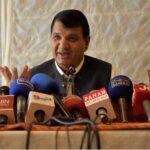
The Chairman of the All Jammu and Kashmir Peoples Freedom Conference and former Convener All Parties Hurriyat Conference, Syed Yusuf Naseem Advocate, said here on Tuesday that October 27, 1947, and August 5, 2019, were the darkest days in the history of the State of Jammu and Kashmir.
Yousaf Naseem terms August 5, 2019; October 27, 1947, the Darkest Days in J&K history

ISLAMABAD, Aug 4 (APP):The Chairman of the All Jammu and Kashmir Peoples Freedom Conference and former Convener All Parties Hurriyat Conference, Syed Yousaf Naseem Advocate, said here on Tuesday that October 27, 1947, and August 5, 2019, were the darkest days in the history of the State of Jammu and Kashmir.
In a statement, he said, the State of Jammu and Kashmir has existed for centuries as a distinct historical, geographical, and political entity. Furthermore, on January 5, 1949, the United Nations recognized the right of the people of Jammu and Kashmir to determine their political future through the exercise of the right to self-determination by means of a free and impartial process.
Unfortunately, he said, India continued to maintain control over major portion of the state, as a result of which nearly 20 million people remain deprived of what he described as their recognized right to self-determination.
Yusuf Naseem said, on August 5, 2019, India revoked the state’s special constitutional status, divided it into Union Territories, and altered its constitutional position. He further stated that these measures affected the state’s historical identity, political character, and cultural heritage and, in his view, were not consistent with international law and the relevant United Nations resolutions.
Syed Yusuf Naseem Advocate said that the movement for the freedom would continue until the people of the state are able to exercise what he described as their recognized right to self-determination.
He said that no nation has the legitimate authority to deprive another nation of its freedom, alter the status of a disputed territory through the use of force, or disregard internationally recognized human rights and legal principles.
He further stated that every region of Jammu and Kashmir and its people remain committed to the struggle for the future of their homeland.
He urged the international community, the United Nations, the Organization of Islamic Cooperation (OIC), and international human rights organizations to take the situation in Indian Illegally Occupied Jammu and Kashmir seriously, play an active role in protecting human rights, and help create conditions in which the people of the state can exercise their right to determine their political future in accordance with the relevant United Nations resolutions.
He also thanked the government and the people of Pakistan for their continued political, moral, and diplomatic support for the people of Jammu and Kashmir, as well as for raising the Kashmir issue at international forums.
He said that Kashmiris around the world observe August 5 as Black Day to draw the attention of the international community to the need for a peaceful, just, and lasting resolution of the Jammu and Kashmir dispute.