With security tightened around the UN headquarters in New York, the 81st UN General Assembly Tuesday opens its high-level debate on a high-stakes agenda addressing Artificial Intelligence (AI) regulation, climate change, systemic inequality, and the ongoing crises in Ukraine, Sudan, and the Middle East.
World leaders converge on NY for 81st UNGA to tackle conflicts & AI governance; Pakistan to push for dispute resol
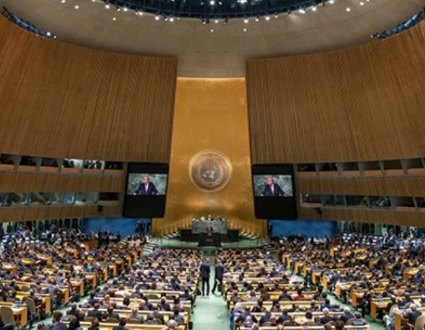
UNITED NATIONS, Sep 21 (APP):With security tightened around the UN headquarters in New York, the 81st UN General Assembly Tuesday opens its high-level debate on a high-stakes agenda addressing Artificial Intelligence (AI) regulation, climate change, systemic inequality, and the ongoing crises in Ukraine, Sudan, and the Middle East.
These crises come at a defining moment for the UN as the organization’s efforts aimed at halting wars and easing civilian suffering remain paralyzed, while funding cuts have weakened it capacity.
This pivotal session will culminate in the appointment of a new Secretary-General, taking place against the backdrop of Pakistan’s expanding diplomatic influence and rising international profile.
Top Bangladeshi diplomat Khalilur Rahman is presiding over the session, held under the theme “Restoring Trust, Managing Transformation: A United Nations That Delivers for All.”
More than 130 heads of state and government, including Pakistan’s Prime Minister Shehbaz Sharif, will take part in the annual debate which begins on Sept. 22 when US President Donald Trump will be among the first speakers. PM Shehbaz is set to address the 193-member Assembly on Sep 25.
“The Prime Minister is coming to the UNGA in the backdrop of unprecedented prominence and profile of Pakistan at the global stage,” Ambassador Asim Iftikhar Ahmad said in an interview with APP correspondent.
In this regard, he referred to developments: from the crushing defeat of the Indian aggression in May 2025, to championing peaceful settlement of disputes, to the high-stakes mediation between Iran and the United States, to the landmark Pak-Turkish-Saudi Makkah Pact.
The prime minister, Ambassador Asim Ahmad added, will be representing Pakistan, “confident, ready and willing to play its role for regional and global peace and stability.”
In his address to the Assembly, according to diplomatic sources, PM Shehbaz will present Pakistan’s perspective on the evolving regional and international security environment and emphasize the importance of dialogue, diplomacy, restraint and the peaceful resolution of disputes.
These principles have been a consistent feature of Pakistan’s foreign policy and have also guided our approach during Pakistan’s current term on the UN Security Council, it was pointed out.
The prime minister will highlight Pakistan’s active diplomatic engagement and meditation efforts aimed at preventing escalation, promoting dialogue and contributing to peace and stability in the region, the sources said.
He will also outline Pakistan’s priorities on a range of pressing international issues, including sustainable development, climate change, counter-terrorism, Islamophobia, global economic challenges, UN reform and the advancement of the Sustainable Development Goals.
The prime minister will underscore the need for greater international cooperation to address the interconnected development, economic, climate and security challenges faced by developing countries.
PM Shehbaz will also draw the international community’s attention to situations of prolonged occupation and the denial of the right to self-determination, particularly in Indian Illegally Occupied Jammu and Kashmir and Palestine. He will underscore the need to address these issues in accordance with the relevant resolutions of the UN Security Council.
The prime minister will also participate in a number of high-level events and meetings focusing on development, climate action and other issues of international and national importance. He will also hold bilateral meetings with several world leaders, as well as with UN Secretary-General Antonio Guterres, whose second 5-year term expires at the end of this year.
“These engagements will provide an opportunity to exchange views on regional and international developments, discuss issues of mutual interest, and further strengthen Pakistan’s bilateral and multilateral partnerships.”
The General Assembly’s high-level week runs from Sept. 22 to 28, following the session’s formal opening on Sept. 8.
The lineup of speakers underscores a week billed as a moment of renewal for the organization even as it confronts one of the most volatile stretches in its history, with active wars, a paralyzed Security Council and a leadership transition all converging on the same seven days.
At his final press conference ahead of the high-level week, Guterres said the gathering should be used to create room for leaders facing active crises to meet face to face.
Asked what the UN should deliver during the week to restore trust in the institution, he pointed to precedent.
“I would remind you that last year, there was a very important meeting of the United States with a number of Muslim countries that led to the peace plan for Gaza,” he said, adding he would work to create opportunities for similar encounters during the week.
The debate opens against the backdrop of active warfare rather than diplomatic calm. In Gaza, a ceasefire that took hold on Oct. 10, 2025 under a US-backed plan has held only unevenly, with repeated Israeli violations blamed for killing at least 1,318 Palestinians and injuring more than 4,300 since.
In Ukraine, US envoys Steve Witkoff and Jared Kushner held more than three hours of talks with Russian President Vladimir Putin in Moscow in early September that produced no breakthrough. Ukrainian President Volodymyr Zelenskyy said afterward that the war would continue, while the Kremlin has left the door open to a resumption of trilateral talks with Washington without committing to a date or venue.
The US-Israeli strikes on Iran at the end of February continued in fits and starts through the summer, flaring again in early September when the United States struck Iranian targets and Tehran retaliated against US bases in Kuwait, Jordan, Bahrain, the United Arab Emirates and Iraq, further straining the Strait of Hormuz shipping route.
The dispute over Iran has also frozen the Security Council’s own machinery, with members divided over whether sanctions reimposed under the “snapback” mechanism in September 2025 are legally in effect, a disagreement that has blocked agreement on basic council business.
Meanwhile, the U.S. granted visas to Iran’s president and foreign minister, creating a pathway for potential talks with President Trump, who said he is open to meeting despite his harsh language against the Islamic Republic.
Leaders are also expected to address the Cyprus issue, the conflict and worsening humanitarian crisis in Sudan, Myanmar’s political and humanitarian crisis, and the security crisis in Haiti, alongside the wars in Gaza, Iran and Ukraine, rounding out an agenda dominated by conflicts with no clear resolution in sight.
Away from the conflicts, a high-level meeting on climate action and the “just transition,” convened by the UN chief, opens on Sept. 23, more than a decade after the Paris Agreement and at what organizers describe as a point where overshoot of its temperature targets is now considered inevitable.
The same day marks the 40th anniversary of the Declaration on the Right to Development, while Sept. 24 brings a meeting on the existential threat that low-lying and island states face from sea-level rise. A high-level meeting on pandemic prevention and preparedness follows on Sept. 25, and the week closes on Sept. 28 with commemorations of the 25th anniversary of the Durban Declaration against racism, alongside a push to advance a global framework for artificial intelligence governance.
In his opening remarks at that press conference, Guterres said artificial intelligence would be a major topic in his discussions with world leaders and that the UN would keep exploring practical approaches in the days ahead, calling for “a shared understanding of how to advance the safe, secure and responsible development of AI” alongside ways to identify when powerful systems need stronger safeguards.
The paralysis over Gaza, Ukraine and Iran has fed louder calls to overhaul the Security Council so it better reflects today’s balance of power, a demand renewed at nearly every recent session but no closer to resolution.
Asked why leaders would heed his renewed call to respect international law and the UN Charter when such appeals have gone unheeded before, and whether enforcement mechanisms for international law and war crimes are decaying, Guterres, in his final news conference, pointed to the geopolitical divide within the Security Council itself.
He called Security Council reform “an absolute priority,” saying it was “unacceptable to have a Security Council with a composition that reflects the world of many decades ago instead of reflecting today’s world.”
Guterres said that paralysis, combined with a poor example set by major powers, has left countries around the world feeling “entitled to do whatever they want” in the knowledge that they can act “with impunity” while the Security Council remains unable to function.
The US, for its part, has signaled that it will use the week to press a narrower vision, describing its goal as bringing the UN “back to basics” by focusing the organization on international peace and security, respect for state sovereignty and measurable results rather than broader institution-building.