BEIJING, Nov 27 (APP):Pakistan's growing partnership with China in space exploration has reached a historic milestone with Pakistani astronaut Muhammad Zeeshan Ali becoming the first foreign astronaut to visit China's Tiangong space station, marking a significant development in bilateral scientific and technological cooperation. Ali has also attracted considerable attention on Chinese social media after demonstrating his command of Mandarin Chinese by reciting classical Chinese poetry in fluent Putonghua. His rendition …
Pakistan’s astronaut reaches Tiangong: a leap for bilateral science and inclusive space exploration
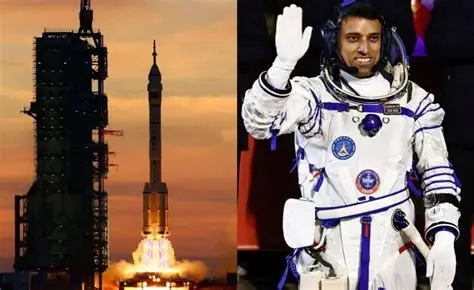
BEIJING, Nov 27 (APP):Pakistan’s growing partnership with China in space exploration has reached a historic milestone with Pakistani astronaut Muhammad Zeeshan Ali becoming the first foreign astronaut to visit China’s Tiangong space station, marking a significant development in bilateral scientific and technological cooperation.
Ali has also attracted considerable attention on Chinese social media after demonstrating his command of Mandarin Chinese by reciting classical Chinese poetry in fluent Putonghua. His rendition of the famous line, “Ascend higher, and you will see farther,” has won appreciation from Chinese internet users and sparked lively discussions about the cultural ties between the two countries.
According to an article by Chen Qingqing, a member of the editorial board of the Global Times English edition, the Shenzhou-24 crewed spacecraft, carrying Chinese astronauts Tang Hongbo and Wu Yi alongside Ali, docked with the Tiangong space station on Wednesday, marking the first space rendezvous involving Chinese and Pakistani astronauts.
Pakistan’s Ambassador to China, Syed Ali Asad Gillani, expressed surprise and admiration at Ali’s ability to speak Chinese. Speaking to Chinese media, he remarked that Chinese had become a language for space, adding, “Learn Chinese well — you never know, it may take you all the way to space.” His comment quickly gained popularity online, symbolising the cultural connections developing alongside the two countries’ space partnership.
The historic mission also reflects China’s decades-long progress in human spaceflight. Since the Shenzhou-5 mission made China the third country capable of independently sending humans into space, its space programme has advanced through successive technological experiments, testing and development, culminating in the establishment of the Tiangong space station.
China has developed an extensive human spaceflight system, including astronaut and cargo transportation, orbital station operations, astronaut training and life-support technologies. Ali’s participation demonstrates the country’s growing capacity to accommodate international astronauts and extend its space programme to scientific partners beyond its borders.
The mission is not limited to diplomatic symbolism, as Ali will also contribute to scientific research during his stay aboard Tiangong. According to the Technology and Engineering Center for Space Utilization of the Chinese Academy of Sciences, he will serve as a payload specialist and conduct four joint China-Pakistan scientific experiments involving cyanobacteria, quinoa seeds and two types of composite materials.
The experiments are expected to generate valuable scientific data and expand cooperation in space-based research. By participating directly in orbital scientific activities, Pakistan will gain practical experience and opportunities to strengthen its research capabilities in advanced scientific fields.
The collaboration also carries broader significance for developing countries seeking greater participation in space exploration. With the International Space Station approaching the later stages of its operational lifespan, China’s Tiangong programme offers an alternative platform for international scientific cooperation, particularly for countries that lack the financial resources and technological infrastructure to establish independent human spaceflight programmes.
Through joint astronaut training, scientific payload projects and shared research opportunities, developing nations can participate in space exploration without having to build costly space infrastructure from the ground up. This approach could widen access to orbital research and create opportunities for countries across the Global South to contribute to scientific advancement.
The Pakistan-China partnership represents an important example of South-South cooperation, demonstrating how developing countries can combine their expertise, resources and research priorities to pursue advanced scientific objectives. While Pakistan contributes its scientific talent and research interests, China provides its established space infrastructure, technological expertise and operational experience.
Beyond the achievements of an individual astronaut, Ali’s journey represents a new chapter in Pakistan-China relations, particularly in science, technology and space research. It also highlights the potential of international partnerships to make space exploration more inclusive, allowing developing countries to become active contributors to scientific discovery rather than merely observers.
The mission is therefore not only a source of national pride for Pakistan but also a significant step towards expanding opportunities for scientific cooperation and technological development across the developing world.