A senior Pakistani diplomat Friday warned the United Nations that India has formalized its last year’s unprovoked military aggression into an official, declared policy, claiming a unilateral right to launch strikes against Pakistan on any manufactured pretext.
Pakistan warns UN of India’s declared policy on cross-border strikes on any manufactured pretext
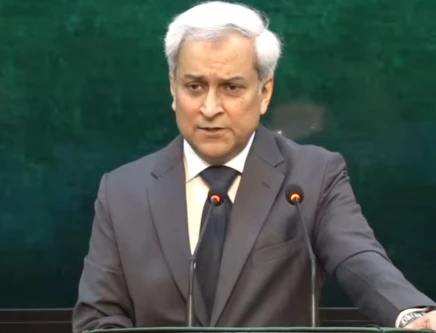
UNITED NATIONS, Oct 10 (APP):A senior Pakistani diplomat Friday warned the United Nations that India has formalized its last year’s unprovoked military aggression into an official, declared policy, claiming a unilateral right to launch strikes against Pakistan on any manufactured pretext.
“South Asia remains hostage to a doctrine of force,” Ambassador Tahir Andrabi, permanent representative of Pakistan to the UN offices in Geneva, told the General assembly’s First Committee (Disarmament and International Security), referring to India’s May 2025 assault and Islamabad’s “precise and effective” response.
“India has since elevated that aggression into declared policy — the so-called ‘new normal’ — claiming the right to strike Pakistan at a time of its choosing, on any pretext it can manufacture,” Ambassador Andrabi added.
However, he declared that Pakistan possesses both the capability and the resolve to decisively defend itself sovereignty against any misadventure.
The Pakistani envoy went on to say India was engaged in the largest military build-up in the region — intercontinental-range, sea-based and hypersonic systems — enabled by discriminatory exemptions of export controls, while it evades dialogue: the last formal talks between the two neighbours on nuclear and conventional confidence-building measures were held in 2012.
Pakistan, he said, does not seek an arms race, but has the capacity to defend itself, as evident by its response in May 2025.
“We will, therefore, maintain Full Spectrum Deterrence within the framework of Credible Minimum Deterrence,” Ambassador Andrabi said.
“The notion that a limited conventional war can be fought, and contained, under a nuclear overhang is a dangerous delusion.”
He said Pakistan’s preference is not war but diplomacy, and remained ready for a meaningful dialogue on all outstanding issues, including the Jammu and Kashmir dispute, in accordance with UN Security Council resolutions.
” Our proposal for a Strategic Restraint Regime in the region remains on the table.”
On war-shattered Gaza, Ambassador Andrabi said the ceasefire remains fragile. “It must hold and lead to a sovereign, viable State of Palestine, with Al-Quds Al-Sharif as its capital based on the pre-1967 borders.”
As regard the wider Middle East conflict, he said Pakistan stood for immediate de-escalation, restoration of normal passage, and respect for the sovereignty and territorial integrity of all States in the region.
The Pakistani envoy expressed regret that the Russia-Ukraine conflict has raged on for four years now.
“It is more than evident that there is no military solution to the conflict,” he said.
Calling for dialogue and diplomacy, he recalled that Pakistan had acted as a mediator between Iran and the United States in an effort culminating in a ceasefire and Islamabad Memorandum of Understanding.
“Repeated aggression against sovereign States, and the failure to prevent it are deeply disturbing trends,” Ambassador Andrabi pointed out. “The Makkah Joint Defence Agreement, between Pakistan, Saudi Arabia and Turkiye, defensive in character and consistent with the UN Charter, aims to promote collective efforts for peace, security and stability in the region and beyond.
At the global level, he said, Pakistan was concerned that arms control was being dismantled, with nuclear weapons being modernized, the doctrines being revised to expand their role across new territories, and the open talk of returning to nuclear testing.
In outer space, he added, the line between militarization and weaponization is being erased, while the Prevention of an Arms Race in Outer Space (PAROS) negotiations remain blocked.
“The introduction of artificial intelligence in theatres of close entanglement of conventional and nuclear systems is fraught with serious risks and must be subject to effective guardrails,” Ambassador Andrabi said, adding, “We believe the decision to employ nuclear weapons, in all circumstances, must remain in human hands.”
A treaty banning only future production of fissile material, while excluding stocks sufficient for thousands of new weapons, is cost-free for its proponents and will remain a non-starter, he said. “The recent announcement by some nuclear weapon states to increase their warheads without resuming fissile material production vindicates our position.”
As a responsible nuclear State, he said Pakistan maintains a comprehensive export control regime. “Our national control list was revised in October 2025 and is fully harmonized with the Nuclear Suppliers Group, the Missile Technology Control Regime and the Australia Group. This year, Pakistan also enacted the Biological and Toxin Weapons Convention (Implementation) Act.”