
UNITED NATIONS, Nov 19 (APP)::A senior Pakistani diplomat has accused India of "weaponizing water" by suspending the decades-old Indus Waters Treaty and threatening downstream supplies, calling the move an "unlawful action" during an informal UN Security Council meeting on natural resources and conflict. "Such actions endanger the livelihoods and well-being of more than 240 million people and risks escalation between the two neighbouring States," Ambassador Usman Jadoon, deputy permanent representative …
Pakistan warns India against ‘weaponizing’ shared rivers prompting a clash at UN
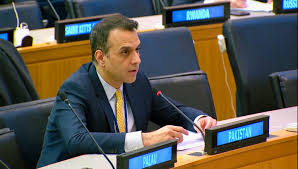
UNITED NATIONS, Nov 19 (APP)::A senior Pakistani diplomat has accused India of “weaponizing water” by suspending the decades-old Indus Waters Treaty and threatening downstream supplies, calling the move an “unlawful action” during an informal UN Security Council meeting on natural resources and conflict.
“Such actions endanger the livelihoods and well-being of more than 240 million people and risks escalation between the two neighbouring States,” Ambassador Usman Jadoon, deputy permanent representative of Pakistan to the UN, warned at the 15-member Council meeting convened by Liberia under Arria-Formula format named after a former Venezuelan Ambassador to the UN, Diego Arriva.
The purpose of the debate was to examine how natural resource cooperation can curb illicit conflict financing, protect livelihoods, and advance peace amid rising global competition over critical minerals.
Arria-Formula meetings are informal that enable Security Council members to have a frank and private exchange of views on relevant subjects.
The meeting brought together Council members and other UN member states, alongside experts and practitioners from international organizations, academia, the private sector, and civil society.
In his remarks, the Pakistani envoy emphasized that cooperation among neighbouring States and the peaceful settlement of resource-related disputes were essential to preventing conflict, something reinforced by Security Council resolution 2788 on utilizing the peaceful means of dispute settlement.
“These principles are particularly relevant to the management of shared transboundary resources, including water, where respect for international law and mutually agreed arrangements is indispensable to regional peace and stability,” Ambassador Jadoon said.
Rejecting India’s “unlawful action” with regard to the suspension of the water treaty with Pakistan, he pointed out that he Permanent Court of Arbitration had reaffirmed that the treaty remains fully in force and that India remains bound by its obligations.
“No State should be permitted to use shared natural resources as instruments of coercion or political pressure, in violation of international law and binding treaty obligations,” the Pakistani envoy told delegates.
On the relationship between natural resources and conflict, Ambassador Jadoon stated that natural resources should serve as instruments of sustainable development, shared prosperity and peace, rather than exploitation and conflict.
Expressing Pakistan’s solidarity with African countries in their pursuit of sovereign control over natural resources, he noted that external interference, illicit exploitation, political exclusion, weak institutions and elite capture often turned resource wealth into a source of conflict.
He cited the Democratic Republic of the Congo (DRC) as a tragic example of immense mineral wealth sustaining conflict instead of delivering prosperity.
In this regard, he highlighted three priorities for preventing resource-related conflicts: addressing their underlying political and governance-related drivers through inclusive settlements and equitable resource-sharing; disrupting conflict financing through supply-chain traceability; responsible sourcing and international cooperation; and ensuring that resource-rich developing countries benefit from investment, local processing, technology transfer and value addition.
The Pakistani envoy emphasized that natural-resource governance must remain anchored in the UN Charter, international law and the principle of permanent sovereignty over natural resources, as enshrined in General Assembly resolution 1803.
Natural resources must become instruments of cooperation, shared prosperity and lasting peace, rather than sources of exploitation, inequality and conflict, he said in conclusion.
Ambassador Jadoon’s sharp remarks about India’s unlawful actions drew a response from Indian Ambassador Harish Parvathaneni that a Pakistani delegate countered effectively.
The Indian envoy accused Pakistan of misusing the forum, insisting that his country’s position of the Indus Water Treaty was “clear and consistent” and went on to target the role of the Pakistani Army.
Exercising his right of reply, Ansar Shah, a first secretary in the Pakistan Mission to the UN, denounced India’s attempt to deflect and deny and resort to rhetoric and baseless assertions.
“India’s gross violation of the Indus Waters Treaty is violation of international law,” he said, asserting that one party cannot unilaterally hold a binding accord between two neighbouring States “in abeyance”.
“The treaty contains no provision whatsoever for any unilateral action of this sort”.
Noting India’s arguments that the Indus Waters Treaty was signed in 1960 and that “the world has changed”, Ansar Shah pointed out that the UN Charter was even older. “Is that outdated for India too? Judging by India’s disregard for Security Council resolutions on Jammu and Kashmir, it would appear so”, the Pakistani delegate said, highlighting that India’s 900,000 troops in occupied Kashmir suppress Kashmiris and their inalienable right to self-determination.
“My delegation also rejects the frivolous and highly inappropriate remarks made by the Indian Permanent representative regarding Pakistan’s domestic affairs,” Ansar Shah said.
He said Pakistan, a vibrant and thriving democracy, upholds the rule of law and Constitution, adding, “our citizens are free to choose their leaders their governance system and exercise their fundamental rights and freedoms.”
The Pakistani delegate added, “These concepts are alien to India today – which is in the grip of an extremist fascist Hindutva regime that openly espouses discrimination against its minorities, stifles free speech, preaches hatred and poses a grave threat to peaceful co-existence within its borders and beyond. It can fool its own people through its propaganda machinery and ‘Godi media’, but it cannot hoodwink the world.”