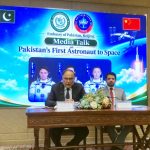
BEIJING, Nov 26 (APP):Pakistan’s Ambassador to China, Syed Ali Asad, on Thursday described the successful participation of Pakistani astronaut Zeeshan Ali in China’s space mission as a major milestone in bilateral relations, saying the achievement reflects the mutual trust, close cooperation and shared vision between the two countries. Speaking to the media at the Pakistan Embassy here following the successful launch of Pakistani astronaut to the Chinese space station, the …
Pakistan-China space cooperation to expand into new frontiers of science and technology: Ambassador

BEIJING, Nov 26 (APP):Pakistan’s Ambassador to China, Syed Ali Asad, on Thursday described the successful participation of Pakistani astronaut Zeeshan Ali in China’s space mission as a major milestone in bilateral relations, saying the achievement reflects the mutual trust, close cooperation and shared vision between the two countries.
Speaking to the media at the Pakistan Embassy here following the successful launch of Pakistani astronaut to the Chinese space station, the ambassador said the remarkable speed with which the mission was accomplished demonstrated the strength of Pakistan-China friendship and the ability of both countries to turn ambitious visions into reality.
He noted that the achievement had been realised within just 20 months, involving extensive coordination, astronaut selection, rigorous training and the development of Chinese-language communication skills.
“The speed has been incredible because it speaks of the mutual trust, cooperation and perfect understanding which the two countries have with each other,” he said, adding that when Pakistan and China jointly pursue a vision, there are no limits to what they can achieve.
Recalling his interaction with the Pakistani astronauts before the historic launch, Ambassador Asad said he had met the participants at the launch site and found them physically fit, energetic and highly motivated.
He said Zeeshan Ali and fellow astronaut Khurram Dawood were in high spirits and demonstrated excellent coordination and harmony with their Chinese counterparts.
According to the ambassador, the astronauts fully understood the significance of their mission and the hopes and expectations associated with representing Pakistan in space.
Describing Zeeshan Ali’s achievement as a moment of national pride, he said the astronaut would return to Pakistan as an icon and role model for younger generations.
He expressed confidence that the successful completion of the mission would inspire Pakistani youth to pursue careers in science, technology and space exploration.
The ambassador revealed that he planned to arrange an interaction between the returning astronaut and students at the Pakistan Embassy School in Beijing, which has Pakistani, Chinese and international students.
He said such an engagement would provide young people with an opportunity to learn directly from the astronaut’s experiences and encourage them to pursue ambitious goals.
Referring to his recent interaction with students from a primary school in Xi’an, Ambassador Asad said he had encouraged them to work hard and pursue their dreams, reminding them that the sky was the limit.
He also highlighted the growing importance of Chinese-language education in Pakistan, saying the space mission could further increase interest in learning Mandarin.
He encouraged students studying Chinese to remain committed to their studies, observing that the language had acquired a new significance in international scientific cooperation and space exploration.
“Who knows that one day Chinese may take you to space,” he remarked.
Discussing the broader prospects of bilateral cooperation, the ambassador said the relationship was evolving beyond traditional trade and infrastructure development towards advanced technologies, satellite applications, space exploration and emerging industries such as 6G.
He said the second phase of the China-Pakistan Economic Corridor (CPEC 2.0) was focused on high-quality and high-value development, with science and technology expected to become important pillars of cooperation.
The ambassador described space collaboration as one of several new frontiers that Pakistan and China would explore together in the coming years.
He identified the proposed lunar mission, including the deployment of a Pakistani-developed lunar rover, as an important next step in the expanding partnership.
He also highlighted the scientific significance of the four experiments to be conducted by Pakistani astronauts during the mission, saying their findings could contribute to scientific progress beyond the two countries.
“The results of those are not going to be confined to China only or Pakistan only. Those would be for the entire humanity,” he said.
Ambassador Asad stressed that Pakistan’s space ambitions were directed towards the peaceful use of outer space and the advancement of knowledge for the benefit of humanity.
He described Pakistan-China cooperation in space as a manifestation of Chinese President Xi Jinping’s vision of building a community with a shared future for humanity.
The ambassador expressed optimism that the partnership would make meaningful contributions to scientific research, technological innovation and the welfare of future generations.
Emphasising the enormous possibilities ahead, he concluded that space represented a new frontier for bilateral cooperation, adding that Pakistan and China were determined to explore it together for peaceful purposes and the common good of humanity.