BEIJING, Nov 26 (APP):Federal Minister for Planning, Development and Special Initiatives Prof. Ahsan Iqbal on Thursday described the successful participation of Pakistani astronaut Zeeshan Ali in China’s manned space mission as a historic milestone in Pakistan-China relations, opening a new chapter of cooperation in space exploration, scientific research and advanced technologies. Addressing a press conference following the successful launch of the Shenzhou-24 mission at Pakistan Embassy here, the minister said …
Pakistan-China space cooperation opens new era of technological partnership: Ahsan Iqbal
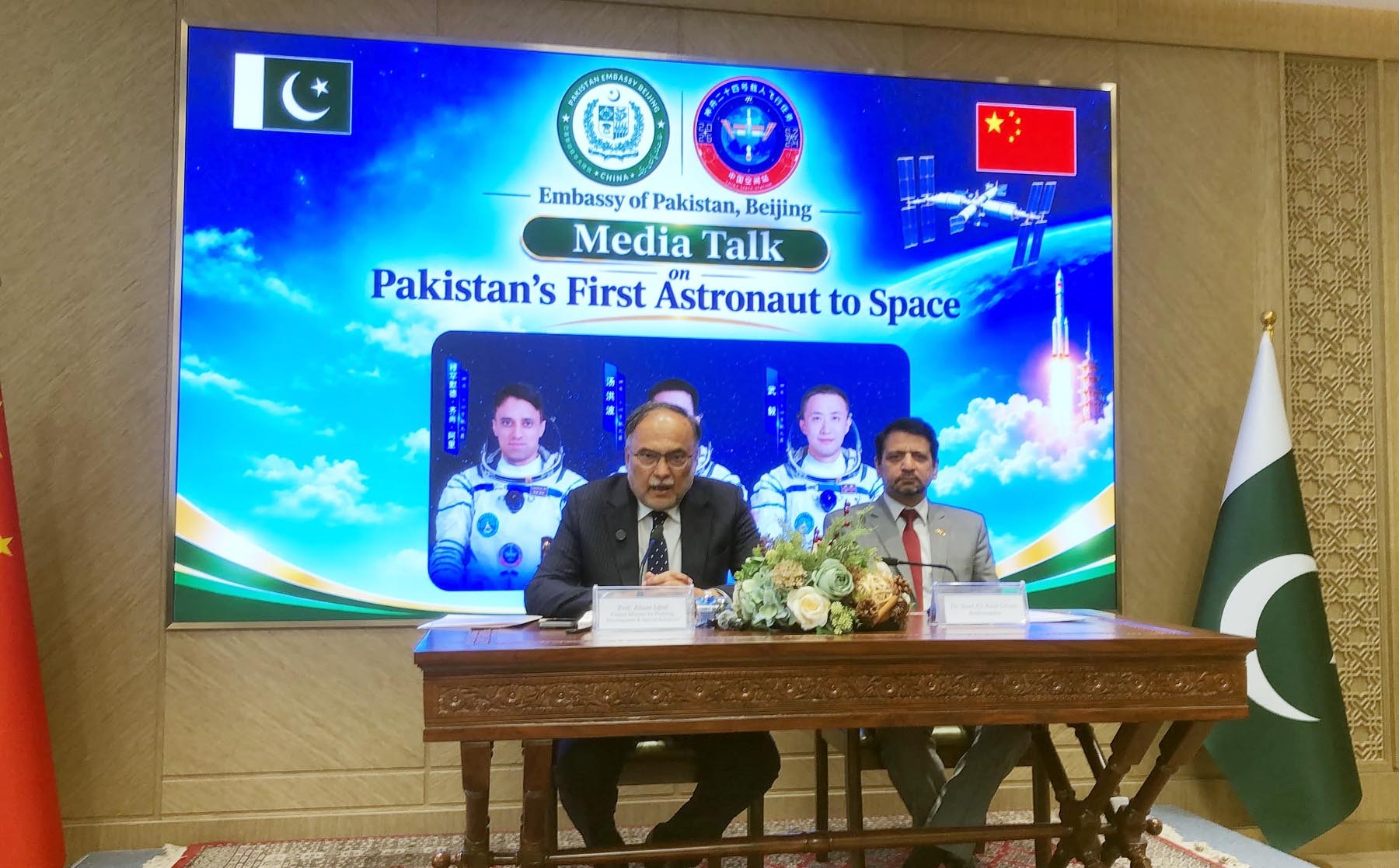
BEIJING, Nov 26 (APP):Federal Minister for Planning, Development and Special Initiatives Prof. Ahsan Iqbal on Thursday described the successful participation of Pakistani astronaut Zeeshan Ali in China’s manned space mission as a historic milestone in Pakistan-China relations, opening a new chapter of cooperation in space exploration, scientific research and advanced technologies.
Addressing a press conference following the successful launch of the Shenzhou-24 mission at Pakistan Embassy here, the minister said Pakistan had earned the distinction of becoming China’s first international partner in a manned space mission and Zeeshan Ali the first international visitor to the Chinese space station.
He expressed gratitude to Chinese President Xi Jinping, the Chinese government, the China Manned Space Programme authorities and the Chinese people for extending this opportunity to Pakistan.
Calling the achievement a reflection of the deep-rooted friendship between the two countries, Iqbal said the traditional expression that Pakistan-China friendship was “higher than the Himalayas” had now acquired a new meaning, as the partnership had reached beyond the skies and into space.
He recalled that bilateral cooperation had initially focused on physical infrastructure, energy projects and highways under the China-Pakistan Economic Corridor (CPEC), followed by digital connectivity through fibre-optic networks. The latest space collaboration, he said, represented another dimension of the relationship.
“This is not the finish line. It is the beginning of a new partnership,” he remarked, emphasising that space technology had become essential for countries seeking sustainable development and economic competitiveness.
The minister highlighted Pakistan’s vulnerability to climate change, noting that the country was among the world’s ten most climate-vulnerable nations and had experienced devastating climate-related disasters, particularly in 2022 and 2025.
He said satellite technology could significantly strengthen Pakistan’s disaster preparedness, early-warning systems, emergency response and relief operations. It could also help address challenges related to food security, water management, urban planning, logistics and connectivity.
Iqbal stressed that Pakistan needed to modernise its agricultural sector through climate-resilient seeds, efficient irrigation and better management of water resources. He also referred to the challenges Pakistan faced following India’s unilateral suspension of the Indus Waters Treaty, describing water security as an increasingly important national concern.
According to the minister, experiments conducted by Zeeshan Ali during his space mission would provide valuable scientific insights, particularly in agriculture and material sciences. The findings could support Pakistani researchers in developing weather-resistant seed varieties and advanced materials for industrial applications.
He also acknowledged the contribution of astronaut Khurram Dawood, who successfully completed the training programme alongside Zeeshan Ali but was not selected for the flight.
Responding to a question about Pakistan’s lunar ambitions, Iqbal said the government was determined to accelerate the country’s space programme. He noted that Pakistan had launched around five satellites over the preceding two years and was seeking to build on its earlier achievements in space research.
He expressed hope that Pakistan would participate in an upcoming lunar mission by sending a rover to the Moon, paving the way for the country’s longer-term ambition of achieving a lunar landing by 2035. Pakistan would benefit from China’s technological expertise and experience rather than having to develop every capability independently, he added.
The minister said discussions with Chinese counterparts were also focused on expanding cooperation in scientific research, education and advanced technologies.
Under the proposed knowledge corridor initiative, Pakistan aims to have at least 10,000 PhD scholars trained at leading Chinese universities over the next decade in fields including artificial intelligence, space sciences, biotechnology, materials science, big data, automation and robotics.
Iqbal said such collaboration would prepare a new generation of scientists, researchers and technology experts capable of leading Pakistan’s development in the emerging global economy.
He linked these ambitions to the government’s Uraan Pakistan development programme, which seeks to transform the country’s economy through innovation, human capital development and technological advancement. The programme envisions a $1 trillion economy by 2035 and a $3 trillion economy by 2047.
Highlighting the wider significance of the space mission, Iqbal said it had inspired young Pakistanis to pursue science, technology, engineering and mathematics (STEM) education. He described Zeeshan Ali’s journey as a source of national pride and a powerful symbol of Pakistan’s aspirations.
He also emphasised the importance of cultural and people-to-people exchanges, saying that cooperation between the two countries should extend beyond economic infrastructure to education, literature, poetry, films and the arts.
Recalling the longstanding cultural connections between Pakistan and China, he referred to Allama Muhammad Iqbal’s poetry and its message of ambition, exploration and progress.
Concluding his remarks, Iqbal said Pakistan-China cooperation was based on mutual trust, shared aspirations and practical results rather than slogans.
He expressed confidence that the partnership would continue to expand into new technological frontiers, contributing not only to the prosperity of both nations but also to the peaceful use of space and the broader interests of humanity.