Jahanara Begum’s determination to educate her children despite growing up in poverty inspired her to establish a nursery business, transforming her into a successful entrepreneur and earning her national recognition.
From struggle to success: Jahanara’s nursery venture wins national acclaim
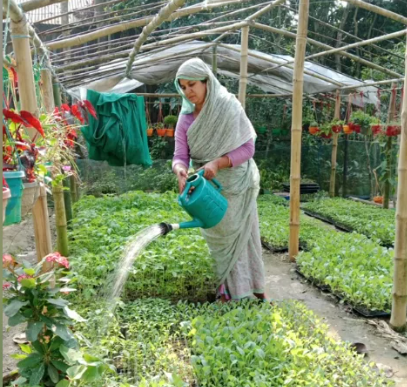
DHAKA, Jul 23 (BSS/APP):Jahanara Begum’s determination to educate her children despite growing up in poverty inspired her to establish a nursery business, transforming her into a successful entrepreneur and earning her national recognition.
Jahanara Begum, 49, had a strong desire to continue her education. She enrolled in school but could not study beyond the fifth grade due to financial hardship. She was married at the age of 14, and poverty defined both her parental and marital homes. Although she was unable to pursue her own education, she was determined to ensure that her children received one.
Through relentless hard work and perseverance, she established a nursery and built it into a thriving business, becoming a successful entrepreneur. Her achievements have earned her national recognition.
Jahanara Begum lives in Chalband village in Bishwambharpur upazila of Sunamganj with her husband and two sons.
A recent visit to her home revealed a sprawling three-acre property. A small courtyard stands in front of the house, while the rest of the land is covered with a wide variety of trees. The nursery features mango, blackberry, jackfruit, orange, litchi, papaya, guava, coconut, areca nut, custard apple, star fruit, olive and pomelo trees, along with many other fruit plants.
She has also propagated green Malta saplings and introduced several improved varieties of mango saplings from Bogura, including Haribhanga, Himsagar and Amrapali.
Recalling her childhood, Jahanara said she grew up in a family of 10, including her parents and siblings. Crushing poverty overshadowed their lives. Many days, the family could afford only one meal, while on others they went to bed hungry. The hardships of those years remain vividly etched in her memory, marked by constant deprivation and neglect.
She was married at the age of 14. Her husband owned no agricultural land and earned a living by working on other people’s farms. After the birth of their two sons, Jahanara realised that if the family was to break free from poverty, she had to find a way to earn an income herself.
In 2006, when her elder son, Belal Hossain, completed primary school, Jahanara became increasingly worried about how she would finance his education. Around that time, she learned about a women’s cooperative society in her village and decided to join it. Through the cooperative, she was selected to attend a three-day nursery training programme at the upazila headquarters.
Until then, she had never travelled beyond her village. Unable to afford transportation, she walked 12 kilometres each day to attend the training. After completing the course, she began producing saplings using chilli and papaya seeds from her own home. To expand her work, she later took out a loan of Tk 4,000 and devoted herself to the business, working tirelessly day and night.
Jahanara said she placed 50 saplings in a basket on the first day and asked her husband, Hasan Ali, to sell them in the market. Initially reluctant, Hasan eventually agreed.
He returned home saying all the saplings had been sold immediately. Within six months, she repaid the loan and still had Taka 10,000 in earnings. From then on, she never looked back and never needed another loan.
Every year, she expanded the nursery using her income. Customers now come directly to her nursery to buy saplings. She and her husband jointly manage the nursery and employ three additional workers.
The nursery currently has around 60,000 saplings and produces nearly 300,000 saplings annually. The saplings are sold both wholesale and retail. Various non-governmental organisations place advance orders for saplings, while some customers purchase saplings worth Taka 100,000 to Taka 150,000 at a time.
Saplings at the nursery are priced from Taka 15 to Taka 1,500. Based on those prices, the nursery currently holds saplings worth Taka 1.5 million.
The family once lived in a small thatched house but has since built a tin-roofed home, installed electricity and redeemed mortgaged land. All these achievements have come from the nursery’s income.
Jahanara said she also started fish farming in 2009. She has two ponds at home, earning Taka 40,000 to Taka 50,000 annually from fish cultivation. She plans to establish a farm for improved-breed cattle.
Family members said Jahanara received the ‘Economically Successful Woman’ award from the Local Government Engineering Department (LGED) on International Women’s Day.
Despite her personal success, Jahanara has continued working for society. She formed an organisation named ‘Esho Kaj Kori’ with 30 women from her village. Through the organisation, they work against child marriage, dowry and violence against women, while encouraging girls to pursue education.
Jahanara Begum said, “From my own life I have learned that if a woman remains dependent on others, she does not receive respect in the family. Women must be educated. An educated woman can transform an entire family. I want every woman to become self-reliant and learn to live with dignity in the family and society.”