
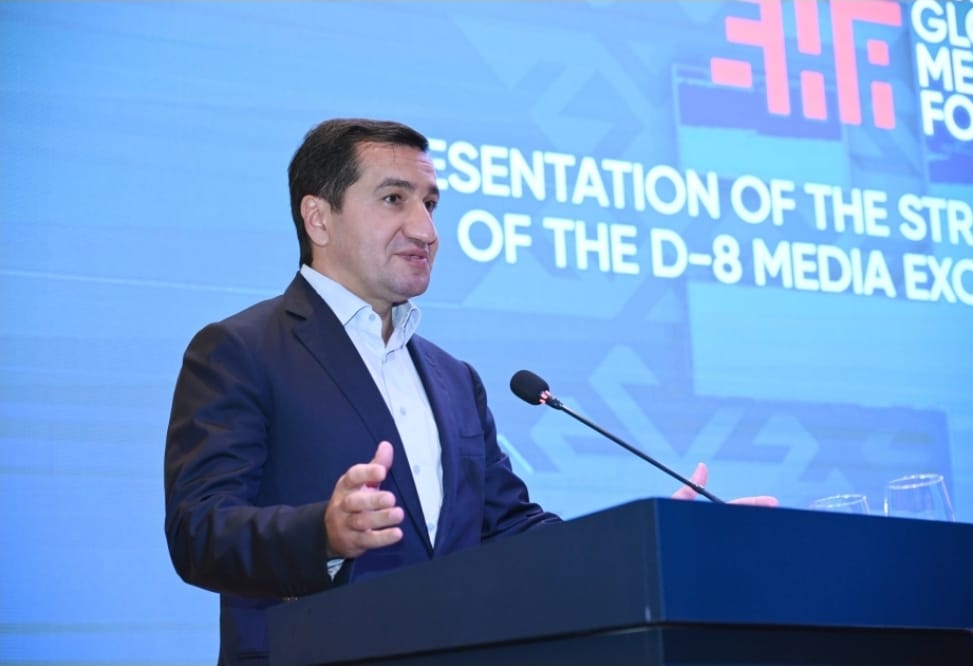
Assistant to the President of the Republic of Azerbaijan, Head of the Department of Foreign Policy Affairs of the Presidential Administration Hikmat Hajiyev at the Shusha Global Media Forum highlighted the growing role of the D-8 group, which represents 1.28 billion people and a combined GDP of more than $5 trillion, and stressed the need for stronger media cooperation among member states.
By Mudassar Iqbal
SHUSHA, Azerbaijan, Jul 14 (APP): Assistant to the President of the Republic of Azerbaijan, Head of the Department of Foreign Policy Affairs of the Presidential Administration Hikmat Hajiyev at the Shusha Global Media Forum highlighted the growing role of the D-8 group, which represents 1.28 billion people and a combined GDP of more than $5 trillion, and stressed the need for stronger media cooperation among member states.

Discussions focused on the proposed D-8 Media Excellence Center, a project aimed at improving training, research, digital skills, and cooperation among media organizations across the D-8 countries.
Addressing participants, Hikmat Hajiyev thanked the participants of the Shusha Global Media Forum, who brought together policymakers, media leaders, academics, and communication professionals from different parts of the world. The forum provided an opportunity to discuss major developments affecting media and information systems at a time of rapid global change.
Ambassador Sohail Mahmood Secretary General of the D-8 Organization has expressed appreciation to President Ilham Aliyev for supporting cooperation among D-8 member countries and for proposing the establishment of three D-8 Centers of Excellence in Azerbaijan. These include the Media Center, the Energy and Climate Center, and the Transport Center. Once operational, the centers are expected to strengthen cooperation in information sharing, energy, environmental issues, and regional connectivity.
Secretary General said that the proposed D-8 Media Excellence Center was described as one of the most significant initiatives undertaken by the organization in recent years. The idea has developed through consultations among member states and gained momentum during the first D-8 Media Forum held in Baku in November 2025. That meeting resulted in the adoption of the Baku Declaration on Collaborative Media Development and Cooperation.
According to the declaration, he said the center will serve as a hub for professional training, research, innovation, digital capacity building, and coordinated communication initiatives. It is expected to support journalists, researchers, media organizations, and communication experts across member states.
Sohail Mahmood said the global media environment is changing rapidly due to technological developments and new challenges. Artificial intelligence, digital transformation, cybersecurity concerns, misinformation, disinformation, and cross-border information flows are reshaping the way information is produced and consumed. Addressing these issues requires stronger cooperation, professional development, and institutional partnerships.
The forum also reflected on how the global landscape has changed since the D-8 was established in 1997. Economic and political influence is becoming more widely distributed, while regional cooperation is playing a larger role. In this environment, D-8 countries have expanded their economic and political influence.
Today, the nine-member organization includes countries with growing economic strength and increasing international engagement. Several members play important roles in regional and global affairs, while two are already members of the G20. The growing influence of D-8 countries was evident in recent diplomatic efforts related to developments in the Middle East.
He emphasized that media cooperation is not only about communication. It also supports economic cooperation, sustainable development, information accuracy, and greater understanding among nations. The proposed center is expected to promote ethical journalism, responsible use of emerging technologies, media literacy, and collaborative research.
To ensure success, Ambassador Sohail said member states were urged to appoint national coordinators, contribute expertise, support journalist exchanges, and participate actively in the center’s governance structure. Suggestions for future initiatives included a digital media knowledge platform, an annual media fellowship program, a fact-checking network, joint documentaries, research projects, and a two-year action plan with clear targets and timelines.
Participants agreed that the vision outlined in the Baku Declaration now requires practical implementation through collective action by all D-8 member states.

