Amid rising violence in Yemen, Pakistan Tuesday called for de-escalation and renewed dialogue during an emergency UN Security Council meeting — its second in less than a week — that followed the Houthi forces’ capture of several Red Sea islands.
At UNSC, Pakistan calls for de-escalation, dialogue after Houthi Red Sea island seizures
Iftikhar Ali
UNITED NATIONS, Sep 16 (APP):Amid rising violence in Yemen, Pakistan Tuesday called for de-escalation and renewed dialogue during an emergency UN Security Council meeting — its second in less than a week — that followed the Houthi forces’ capture of several Red Sea islands.
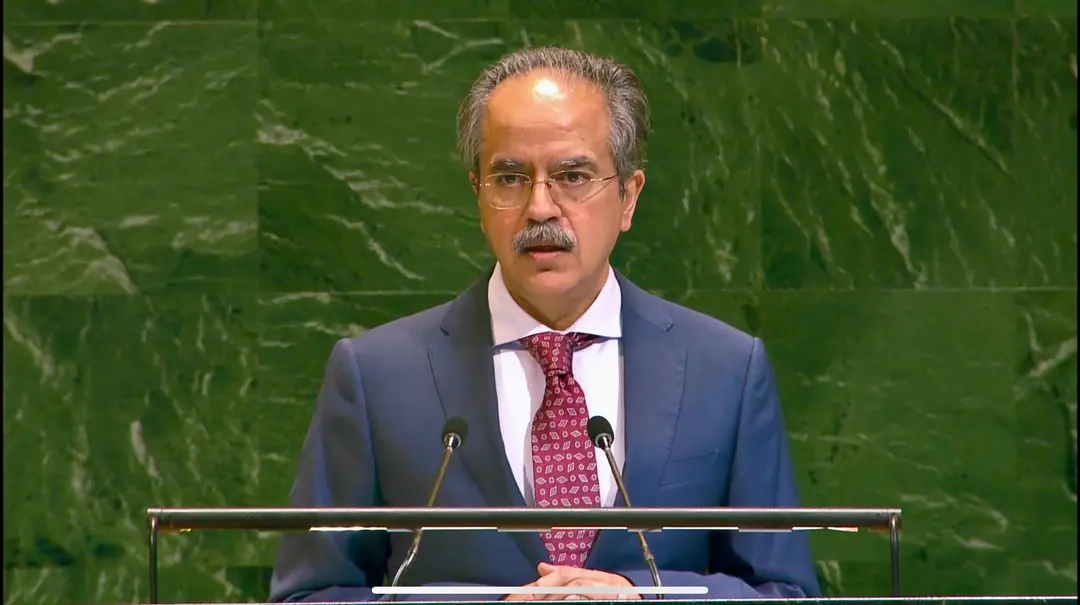
“The expansion of Houthi attacks in and around Bab al-Mandab, this vital maritime corridor, represents a serious escalation,” Ambassador Asim Iftikhar Ahmad, permanent representative of Pakistan to the UN, told the 15-member Council.
“Combined with continued violations of international law against commercial shipping, these developments pose a growing threat to freedom of navigation and the uninterrupted flow of international maritime commerce,” the Pakistani envoy said.
He warned that any attempt to threaten, obstruct, or weaponize the vital waterways will have consequences for international trade and commercial shipping, global supply chains, and energy security.
Yemen has been in crisis periodically since 2014 when Houthi militia seized Sanaa, the capital, setting off conflict with the internationally recognized Yemeni Government until the United Nations brokered a truce in 2022.
“The relative calm painstakingly maintained in Yemen since 2022 has unfortunately collapsed,” Ambassador Asim Ahmad said.
“Continued escalation risks reigniting a full-scale conflict and drawing Yemen deeper into the wider regional confrontation. This must be prevented.”
At least 125,000 people have been displaced since the start of September. The escalation threatens a critical international maritime route and has spread beyond Yemen, with Houthi attacks in Saudi Arabia.
Pakistan has condemned all Houthi attacks against the kingdom, underscoring that they threaten regional peace and stability with serious consequences for the global economy and energy security.
Ambassador Asim Ahmad told the Security Council that Pakistan will continue its earnest efforts at the highest levels to help defuse tensions and advance peace and stability in the region.
Reaffirming its unwavering support for the sovereignty, territorial integrity, security, and prosperity of Saudi Arabia, he said, “Pakistan fully supports the kingdom’s legitimate right to take all necessary measures to defend its territory, protect its citizens, and safeguard its national assets against any threat.”
The Pakistani envoy said that the current developments exacerbate the already dire humanitarian situation in Yemen, compounding the suffering of the Yemeni people, adding that diplomacy must assume urgency in proportion to the gravity of this situation.
“We strongly support the resumption of an inclusive, Yemeni-led and Yemeni-owned political process under United Nations auspices,” Ambassador Asim Ahmad said.
Pakistan, he said, will support all efforts towards de-escalation, dialogue, and a comprehensive political settlement that would usher in lasting peace and stability to Yemen and the wider region.
Opening the debate, Khaled Khiari, UN Assistant Secretary-General in the Departments of Political and Peacebuilding Affairs and Peace Operations, called for efforts to prevent further escalation of the conflict in Yemen and safeguard freedom of navigation in the Bab al-Mandab Strait.
“The situation in and around the Bab al-Mandab Strait has become increasingly volatile in recent days,” he said, noting that fighting has recently intensified along Yemen’s west coast as the Houthis have continued their advance towards the Strait and reportedly captured several islands in the southern Red Sea.
“According to maritime tracking sites, commercial shipping flows through the Red Sea appear to remain unaffected for the time being,” he observed.
Meanwhile, Khiari said Yemen’s Government reportedly launched a counteroffensive that included “extensive air strikes”, with localized clashes reported across several front lines and unconfirmed estimates of hundreds of combatant casualties in recent days.
As for the civilian impact, he pointed to at least 125,000 people displaced across Yemen since the start of September, as well as 40 civilian casualties over that same period — more than half of which are women and children.
Meanwhile, across the Red Sea in Djibouti, approximately 2,300 people have arrived fleeing the escalating conflict in Yemen, and further arrivals are expected, Khiari told the Council.