UNSC adopts Bahraini draft condemning Iran’s retaliatory Mideast strikes , rejects Russian text seeking ceasefire; Pakistan backs both
UNSC adopts Bahraini draft condemning Iran’s retaliatory Mideast strikes , rejects Russian text seeking ceasefire; Pakistan backs both
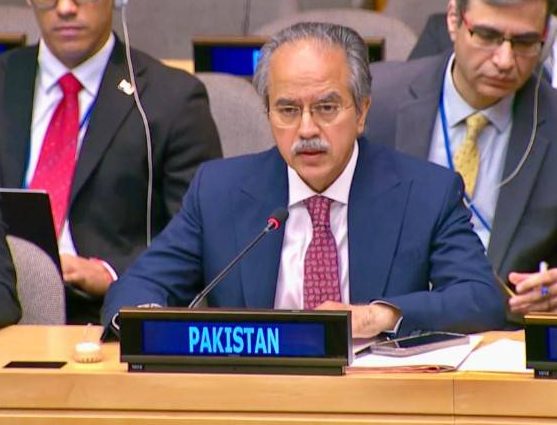
UNITED NATIONS, Mar 12 (APP):: With Pakistan supporting, the UN Security Council on Wednesday adopted a Bahrain-sponsored resolution condemning Iran’s retaliatory attacks on the territories of several Persian Gulf states amid the rapidly spiraling crisis in the Middle East.
Thirteen members of the 15-nation Council voted in favour of the measure, while Russia and China abstained.
A second resolution calling for a halt to all military action in the Middle East, which was drafted by Russia, failed to pass.
The resolution mustered four votes in favour — Russia, China, Pakistan an Somalia — two against (US and Latvia), with nine members abstaining. Nine votes are required for a resolution to pass.
Both draft resolutions were aimed at addressing the devastating war in the Middle east, which was triggered by the joint US-Israeli strikes on Iran that began on 28 February and Iran’s subsequent retaliation across the region.
Russia’s UN Ambassador Vasily Nebenzya said he had abstained on the Bahraini resolution because the text was “extremely unbalanced” and that it “does not meet the purpose” of maintaining international peace and security.
Explaining his positive vote for both texts, Pakistan’s UN Ambassador Asim Iftikhar Ahmad said, “This is a conflict that should never have happened,” adding that It was unfortunate that the Council could not unify behind a comprehensive response to end the conflict.
“That’s the sad reality,” he lamented.
The conflict and its disastrous fallouts, the Pakistani envoy pointed out, are no more isolated – the regional and global dimensions are obvious.
“When international law is violated, peace is imperiled, not advanced,” he said.
“We call for immediate and complete cessation of hostilities and return to the dialogue table. Only a peaceful settlement will serve everyone’s interest,” the Pakistani envoy added.
“The deplorable turn of events unfolding in the region –from the initiation of unwarranted attacks on the Islamic Republic of Iran on February 28th, which Pakistan also condemned – have seriously jeopardised international peace and security, given rise to grave consequences, and unnecessarily embroiled the entire region,” he said.
“As a brotherly neighbouring country, Pakistan supports the sovereignty and territorial integrity of Iran. We are deeply concerned by the instability in Iran.”
Pointing out that these developments also carry profound socio-economic and humanitarian repercussions, as a neighbouring country, Pakistan has not remained immune from these impacts — two of its nationals lost their lives in attacks on the UAE.
“Our fuel supplies have been seriously hampered, obliging the Government to take extraordinary measures for conserving the use of oil, gas and electricity; Several essential aviation links have been severed, while others face disruptions.”
The Bahrain resolution, which has a record number of 135 co-sponsors, “demands the immediate cessation of all attacks by the Islamic Republic of Iran against Bahrain, Kuwait, Oman, Qatar, Saudi Arabia, the United Arab Emirates and Jordan”.
It describes the attacks as a serious threat to regional stability and international peace and security.
The resolution reaffirms the right of merchant and commercial ships to navigate international waters and condemns “any actions or threats by the Islamic Republic of Iran aimed at closing, obstructing, or otherwise interfering with international navigation through the Strait of Hormuz, or threatening maritime security in the Bab Al Mandeb”.
It warns that any attempt to impede lawful passage or freedom of navigation in these international waterways constitutes a serious threat to international peace.
Iran has struck Gulf states in retaliation to US-Israeli attacks that killed Iranian supreme leader Ayatollah Ali Khamenei and many other people as well as causing huge damages in the Islamic Republic.
Ambassador Asim Ahmad, the Pakistani envoy also said, “Our positive vote on the draft resolution introduced by Bahrain signifies the affirmation of Pakistan’s strong solidarity with the brotherly countries of Bahrain, Kuwait, Oman, Qatar, Saudi Arabia, the United Arab Emirates and Jordan and underscored Pakistan’s condemnation of all the unwarranted attacks faced by them, especially those targeting civilians, civilian objects and critical civilian infrastructure.
“I reiterate Pakistan’s complete support for the territorial integrity, sovereignty and political independence of all these countries. As demanded by the resolution, we hope that the attacks on their territory will cease immediately and the navigational rights and freedoms in the Strait of Hormuz will not be undermined.”
After the vote, Bahrain’s Ambassador to the UN, Jamal Alrowaiei, expressed his “deepest gratitude” on behalf of the Gulf Cooperation Council (GCC)
“This region is a lifeline for the global economy and a vital corridor for international trade and energy security,” he said.
Ambassador Alrowaiei underscored the strategic importance of the Gulf to global economic stability and the need to protect navigation and critical infrastructure in the region.
“Ensuring the security of this region is not merely a regional concern,” he added. “It is a shared international responsibility that is closely linked to the stability of the global economy.”
In his remark, the Russian Ambassador also said, “The attacks against the territory of Iran itself, not to mention those who are behind them and carrying them out, are not only not condemned in the document, they’re just simply left out and the Security Council has just signed off to that,” he said.
Ambassador Nebenzya pointed out that Washington, “through their aggressive action”, ignored the Gulf’s “repeated requests not to use the territory of the Arab states to conduct military operations against Iran”.
“We’re deeply disappointed,” said the Russian envoy, taking the floor again after his resolution failed to get the required number of votes, adding that many Council members’ positions are dictated purely by short-term political interests, bloc solidarity and “the fear that they might fall out of favour with their elder friends”.
China’s Ambassador FU Cong also expressed regret that Moscow’s draft resolution was not adopted, declaring: “This is a war that should not have happened, and a war that benefits no one.”
Iran’s Ambassador Amir Saeid Iravani, said, “Today’s adoption is a serious setback to the Council’s credibility and leaves a lasting stain on its record.”
The very State responsible for the brutal war of aggression against his country — the United States — sits in the Chamber as Council President, abusing his position while obstructing every effort to bring an end to the barbaric war, he said.
“Let me make it clear — this resolution is a manifest injustice against my country, the main victim of a clear act of aggression.”