United Nations Secretary-General Antonio Guterres Friday warmly congratulated South African jurist and former UN High Commissioner for Human Rights Navi Pillay, on winning the 2026 Nobel Peace Prize, saying the move reminded the world that “peace must be built on lasting principles, not the will of the powerful.
UN chief hails Navi Pillay’s Nobel win that follows historic panel’s verdict that Israel committed genocide
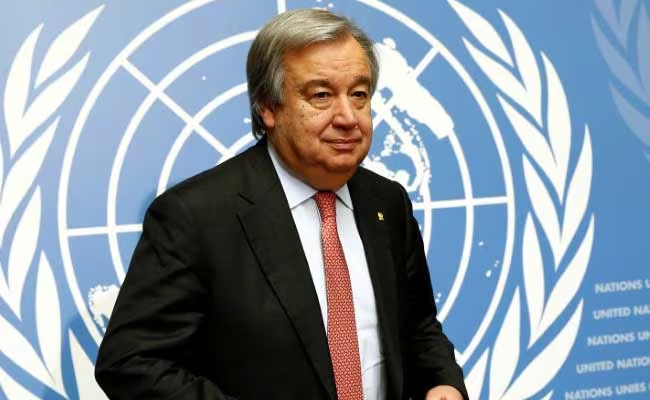
UNITED NATIONS, Oct 09 (APP): United Nations Secretary-General Antonio Guterres Friday warmly congratulated South African jurist and former UN High Commissioner for Human Rights Navi Pillay, on winning the 2026 Nobel Peace Prize, saying the move reminded the world that “peace must be built on lasting principles, not the will of the powerful.
While Ms. Pillay’s work spans decades, the decision to choose her this year carries distinct political undertones. She led a U.N. Commission last year that said that Israel had committed genocide against Palestinians in Gaza, a finding that infuriated Israel and the United States. Ms. Pillay’s country — South Africa — has also spearheaded accusations of genocide against Israel in the international court system.
On its part, the Norwegian Nobel Committee said she was honoured “for her efforts to promote peace and international law”.
The committee said the award was going “to a person who with exceptional courage and integrity has led the way towards a more comprehensive global legal order,” noting that she “has been instrumental in ensuring that war crimes, crimes against humanity and genocide are prosecuted.”
In his statement the UN chief paid tribute to her dedicated work, saying Ms. Pillay has shown “that the force of law must prevail over the law of force and that defending human rights is the surest safeguard against injustice.”
He hailed her as “a champion of international law and human rights, and a steadfast, independent voice of justice”, adding that “in its citation, the Nobel Committee reminded the world that peace must be built on lasting principles, not the will of the powerful.
Ms. Pillay served as the UN human rights chief from September 2008 through August 2014, but her career has spanned more than 50 years – from fighting apartheid in her homeland to defending civilians in conflict zones.
She is a former chair of the UN Independent International Commission of Inquiry on the Occupied Palestinian Territory and was appointed a judge at the International Criminal Tribunal for Rwanda (ICTR) and the International Criminal Court (ICC) in the Hague, in addition to serving as an ad hoc judge with the International Court of Justice (ICJ), the UN’s highest court.
“A common thread runs from her early work defending Nelson Mandela and others who stood up against apartheid to her service as a judge in some of the key international court cases of our time,” the Nobel Committee said.
Navanethem “Navi” Pillay was born in South Africa in 1941 to a Tamil Indian family and was the first non-white woman to establish a legal practice in the country.
As a lawyer, she acted as a defence attorney for anti-apartheid activists, exposing torture, and helping to establish key rights for prisoners on notorious Robben Island.
In her role as chair of the Independent International Commission, which is appointed by the UN Human Rights Council, she oversaw its 2025 report that said Israel’s actions in the Gaza Strip constituted genocide.
On receiving the news of Ms. Pillay’s honour, the current UN human rights chief, Volker Turk, warmly congratulated the woman he described as a big sister.
“To say it is well deserved is a total understatement, and especially at a time when human rights are under attack on so many fronts, including from those who wield enormous power, this award is particularly poignant,” he said, speaking in Geneva.
“It is an award to all those who around the world dedicate their lives to the defense of human rights, often at great risk to their security.”
Moreover, it is “a recognition, a reaffirmation, that human rights, the rule of law and justice and accountability are fundamental to everything – to peace, to security and prosperity,” he added.
In an October 2025 interview with UN News in Geneva, Ms. Pillay reflected on her lifetime of fighting for human rights, justice and equality.
“I didn’t think apartheid would end in my lifetime,” she recalled. “So, what happened? We had the collective support of people all over the world, even children. If we can achieve that, we can have a better human rights protection system.”
Her experience in the anti-apartheid struggle shaped her belief in international solidarity, which she carried into her role as a judge and president of the ITCR, which prosecuted persons responsible for the 1994 genocide in Rwanda.
During her eight years there, she helped establish groundbreaking legal precedents in the fight against genocide and gender-based violence.
As UN human rights chief, Ms. Pillay continued to champion the participation of civil society and victims’ voices in shaping global human rights standards.
“When the UN started, it was just a club for the States,” she told UN News. “Everything we have today for human rights protection didn’t happen just because the States woke up one day. It comes from the pressure of civil society. That’s why I value these institutions.”