UNITED NATIONS, Feb 20 (APP): As Sudan marks 1,000 days of a brutal war between its rival military factions, a senior Pakistani diplomat Thursday told the UN Security Council that the only viable path forward lies in meaningful dialogue as he backed the efforts and peace plan presented by the transitional Sudanese Government. "We stress that there is no military solution to this conflict," Ambassador Usman Jadoon, deputy permanent representative …
Pakistan urges ‘meaningful dialogue’ as deadly Sudan conflict nears third year
UNITED NATIONS, Feb 20 (APP): As Sudan marks 1,000 days of a brutal war between its rival military factions, a senior Pakistani diplomat Thursday told the UN Security Council that the only viable path forward lies in meaningful dialogue as he backed the efforts and peace plan presented by the transitional Sudanese Government.
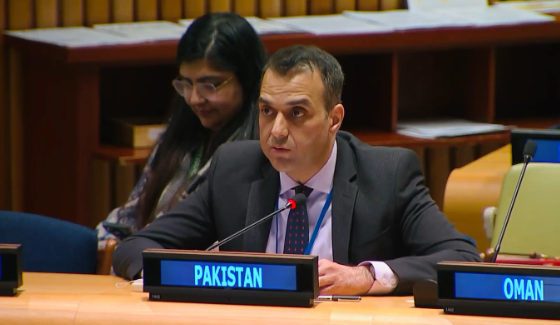
“We stress that there is no military solution to this conflict,” Ambassador Usman Jadoon, deputy permanent representative of Pakistan to the UN, said in the 15-member Council’s debate on the sharply deteriorating situation in Sudan where violence is intensifying, famine conditions looming and civilians remaining trapped between shifting front lines.
“The Sudanese people have suffered for far too long; The guns must fall silent, and a credible political horizon restored,” he said.
Sudan has been engulfed in the conflict since April 2023, when fighting erupted between former allies — the Sudanese Armed Forces (SAF) and Rapid Support Forces militia (RSF).
What began as a power struggle metastasized into deadly conflicts across the country, most devastating in the Darfur region, which also saw longstanding ethnic tensions that prompted allegations of genocide in the early 2000s to be reignited.
In his remarks, Ambassador Jadoon condemned in “the strongest terms” the atrocities committed by RSF in Darfur, including in El Fasher and earlier in El Geneina, as well as the continued violence now unfolding in Kordofan. “We reiterate that deliberate attacks against Peacekeepers, United Nations personnel, humanitarian workers and facilities are unacceptable and may amount to war crimes,” he said while stressing the need for holding those responsible for the atrocities accountable.
Pointing out that Pakistan’s position on Sudan remains firmly anchored in the principles of the UN Charter,” the Pakistani envoy said, “We reaffirm our unwavering support for the sovereignty, unity and territorial integrity of Sudan. The preservation of a unified Sudan is essential not only for its people but also for the peace and stability of the Horn of Africa, the Sahel and the Red Sea region.”
In this regard, Ambassador Jadoon urged all parties in Sudan to demonstrate the requisite flexibility and sagacity to reach peaceful and sustainable settlement that preserves the unity of the country and prioritizes the interests and wellbeing of the brotherly people of Sudan.
Highlighting Sudan’s dire humanitarian situation, he called for sustained, safe and unimpeded humanitarian access to the affected areas of the country. The recent delivery of aid by the UN in South Kordofan with the assistance of Sudan government was a welcome development, he said, while calling for an urgent scaling-up of international funding for the humanitarian response, which remains severely under-resourced despite the immense needs.
Ambassador Jadoon urged the Security Council to discharge its responsibility by supporting a unified, sovereign and stable Sudan and by advancing a coordinated political process that leads to peace.
Opening the debate, Rosemary DiCarlo, UN Under-Secretary-General for Political and Peacebuilding Affairs told the Council that the Sudanese fighting continues to expand.
She described a conflict marked by “staggering violence and unimaginable suffering” and total impunity for the perpetrators of a long list of atrocities and war crimes that has nearly destroyed Africa’s third-largest country.
Frontlines are shifting, she said, across North Darfur, North Kordofan, South Kordofan and Blue Nile states, with military activity, including drone attacks, putting civilians at great risk, Ms. DiCarlo said. North Kordofan’s capital, El Obeid, is besieged from three sides by the Rapid Support Forces (RSF).
“The risk of regionalization of the conflict is a matter of urgent concern,” she added, citing the 16 January announcement by Chad that seven soldiers were killed in a confrontation with Rapid Support Forces’ elements. Weapons continue to transit through Sudan’s neighbours and civilians face grave threats, including summary executions, sexual violence, arbitrary detention and family separation. “The time to act to prevent a repeat of atrocities elsewhere in the country is now,” she stressed.