
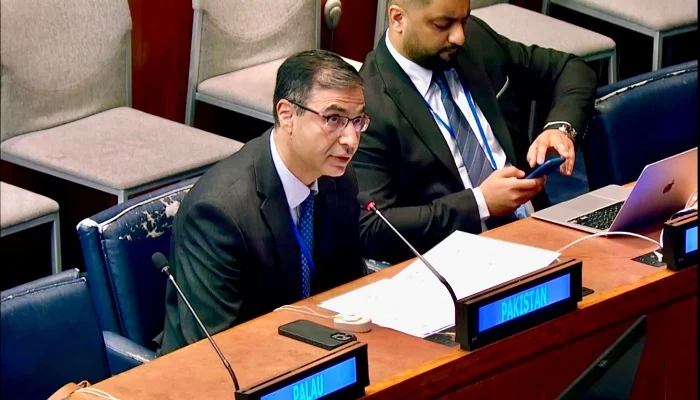

UNITED NATIONS, Jan 16 (APP): Pakistan has brushed aside India’s untenable claim that Jammu and Kashmir was its “integral and inalienable part”, saying that the UN resolutions recognized the Himalayan state as a disputed territory.
“Jammu and Kashmir is not ‘an integral part’ of India, nor has it ever been so under international law,” Pakistani delegate Asif Khan told the UN General Assembly on Thursday.
He was responding to Indian delegate Eldos Punoose who protested a pointed reference to the unresolved Kashmir dispute made by Pakistan’s Ambassador Asim Iftikhar Ahmad while commenting on the Secretary-General Antonio Guterres’ priorities for 2026 that the UN chief presented to the 193-member Assembly.
Punoose, a counsellor in the Indian Mission to the UN, called “unwarranted” the Pakistani Ambassador’s remark that the denial of the right of self-determination to the Kashmir people undermined the credibility of the international system.
Exercising his right of reply Asif Khan, Minister in the Pakistan Mission to the UN, said the Indian arguments represented “a tired trope intended to obscure established facts and legal realities.”
Setting the record straight, Asif Khan said India continues to deny this right to the people of Jammu and Kashmir for decades, a right affirmed by the Declaration on the Granting of Independence to Colonial Countries and Peoples, coupled with systematic suppression.
The final disposition of the State of Jammu and Kashmir is to be determined in accordance with the freely expressed will of its people, through a free and impartial plebiscite conducted under United Nations auspices, he said.
“This position is also reflected on official United Nations maps. India accepted these decisions and remains bound to implement them under Article 25 of the UN Charter.”
Since 5 August 2019, the Pakistani delegate said, India has embarked on a course aimed at transforming the occupied territory from a Muslim-majority state into a Hindu-majority territory, in blatant violation of the Fourth Geneva Convention and international law.