Pakistan calls for protecting under-pressure UN peacekeeping devoted to working to keep global peace
Pakistan calls for protecting under-pressure UN peacekeeping devoted to working to keep global peace
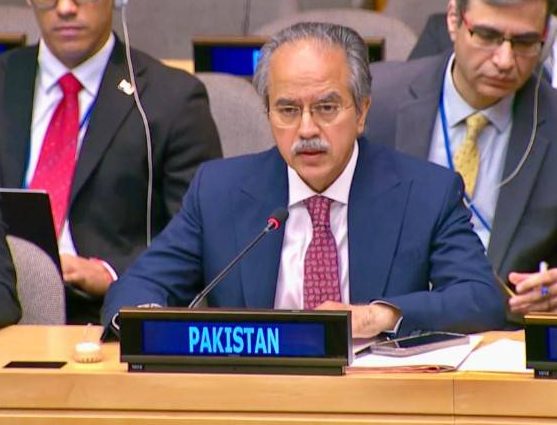
UNITED NATIONS, Feb 19 (APP): With UN peacekeeping facing operational and financial pressures, Pakistan has called for safeguarding “this indispensable instrument” of the organization that has protected civilians, stabilized fragile situations, and created space for political processes in some of the world’s most complex conflicts.
“UN peacekeeping operations stand at a defining moment,” Ambassador Asim Iftikhar Ahmad, permanent representative of Pakistan to the United Nations, told the Special Committee on Peacekeeping Operations, known informally as C34, on Wednesday.
The committee institutionalizes the General Assembly’s oversight on policy and execution of UN Peacekeeping Operations.
“While several missions have transitioned or drawn down in recent years, it is striking that no new peacekeeping mission has been established for over a decade,” the Pakistani envoy said, warning that this retrenching sends a worrying signal against a backdrop of rising global instability and the highest levels of conflicts since the Second World War.
“Yet,” he added, “the resort to non-UN and ad-hoc missions recently does reflect a continuing demand for peacekeeping”, pointing out that challenges of peacekeeping are not merely technical – they are essentially political, and that these can only be addressed through collective political will.
Highlighting the comparative advantages of UN peacekeeping, Ambassador Asim Ahmad said that legitimacy derived from its universal participation, assessed predictable financing, established and proven mechanisms, including command and control structures, logistics and accountability frameworks, represented the products of shared ownership and collective responsibility.
With predictable financing becoming the “biggest challenge”, he said the ongoing liquidity crisis has triggered contingency planning measures leading to significant reduction of troops and civilian staff across missions, in their patrols, mobility and field presence, directly affecting mandate implementation, particularly protection of civilians and deterrence against violence as well as putting the safety and security of peacekeepers at risk.
“Peacekeeping cannot deliver effectively when operations are impacted by financial constraints and uncertainty,” Ambassador Asim Ahmad told delegates.
The Special Committee, he said. must reaffirm the simple, core principle: mandates authorized by the Security Council must be matched by commensurate and predictable resources.
“A serious and structured review of the financial architecture underpinning United Nations peacekeeping is in order, to ensure that it is predictable, sustainable and aligned with the mandates entrusted to it by the Security Council.”
Peacekeeping, a collective endeavor, he said, requires both financial contributions as well as contributions of troops, police and equipment, in a state of fine equilibrium. “If financial commitments wane and missions continue to contract without clear strategic direction, the capacity and readiness of TCCs to maintain forces earmarked for United Nations deployment may also contract.”
While most of the permanent members of the UN Security Council have historically contributed little in terms of personnel for UN peacekeeping, the Pakistani envoy said, if they were to withdraw also from financial obligations, serious questions may arise as to what justifies their privileged status in the Council.
Underscoring the need for reform, he said they should be result of collective decision-making.
“Protection of civilians, deterrence against violations, and ceasefire monitoring and verification remain foundational tasks of peacekeeping,” Ambassador Asim Ahmad said, adding, “In fragile and volatile environments, these functions are often the difference between life and death for thousands.”
“In many contexts,” he said, “the presence of a United Nations mission is itself a stabilizing factor.”
“At a time of geopolitical transition, global public goods must be safeguarded; United Nations peacekeeping is one such good,” the Pakistani envoy said.
“If its field presence is weakened without reason, the Organization risks losing one of its most visible and credible instruments. Without effective presence in the field, UN’s peace and security role risks being reduced to conference halls.”