
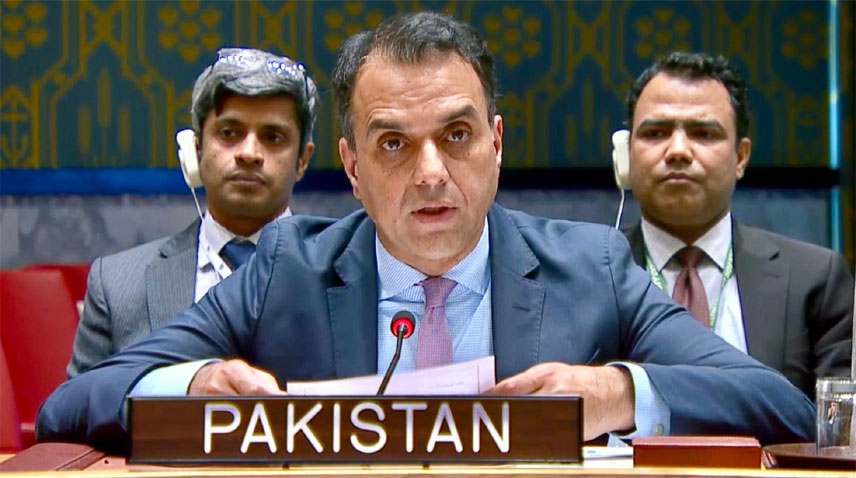
UNITED NATIONS, Dec 19 (APP): Marking a year since the fall of the Assad regime in Syria, Pakistan has praised the country’s reforms amid the threat of terrorism and emphasized that its future must be guided by Syrians themselves.
“We note with appreciation the transitional steps undertaken by the Syrian Government over the past year, including the issuance of a constitutional declaration, the formation of a new cabinet, the conduct of legislative elections, and the convening of a National Dialogue Day,” Ambassador Usman Jadoon, deputy permanent representative of Pakistan to the UN, told the UN Security Council on Thursday.
Upholding the unity, sovereignty and territorial integrity of Syria, he emphasized that all state institutions and security structures operate under a single, central framework to prevent fragmentation and ensure effective governance, and encourage Syrian government’s efforts toward reintegrating armed factions under a unified command.
Referring to the treat of terrorism, the Pakistani envoy condemned the recent terrorist attack on a joint US-Syrian patrol in Palmyra and express deep condolences on the precious lives lost. Da’esh/ISIS remains a threat and must be decisively confronted. Similarly, addressing the presence of foreign terrorist fighters and advancing disarmament, demobilization and reintegration measures were critical to consolidate long-term security.
On the economic front, Ambassador Jadoon welcomed the lifting of sanctions by the United States and the European Union, alongside growing investment by regional countries including Saudi Arabia, Qatar and Turkiye.
Attention should now shift toward sustainable development and reconstruction for restoring livelihoods, rebuilding critical infrastructure, and enabling the people of Syria to regain a sense of normalcy after years of hardship, he said.
Despite Syria’s continued efforts to exercise restraint and pursue diplomatic avenues, repeated and blatant violations of Syria’s sovereignty by Israel undermine stability and risk further escalation, the Pakistani envoy said.
Condemning the attacks in Beit Jinn and occupation of the Syrian territory by Israel, Ambassador Jadoon said these actions were not only against international law but also run counter to peace efforts and must be stopped in accordance with UNSC resolutions.
Earlier, Joyce Msuya, Assistant Secretary-General for Humanitarian Affairs and Deputy Emergency Relief Coordinator, commended Syrian-led strides, saying, “The hope that was kindled a year ago [in Syria] continues to radiate.”
“Vigorous and diligent international support remains vital” as Syria continues to navigate immense opportunities and complex challenges.”
Success will depend largely upon two related factors, she said: reducing humanitarian need — “in what has been, for more than a decade, one of the world’s largest humanitarian crises” — and scaling back the size of the UN’s humanitarian operations in the country. In that regard, she said her Office is developing a new cooperation framework with Syria, and that its work has already become more streamlined and efficient, reaching 25 per cent more people in 2025 than in 2024 despite cuts in funding.
Rosemary DiCarlo, Under-Secretary-General for Political and Peacebuilding Affairs, agreed that Syrians have made great progress in the last year. Meanwhile, the Syrian Government and the opposition Syrian Democratic Forces reached an agreement relating to the security and political transition on 10 March.
However, she warned: “Years of conflict and decades of repressive rule and human rights violations exacerbated tensions along sectarian lines.” Those tensions have also boiled over in the past year, with large-scale violence in the coastal region and clashes in the Druze-majority city of Swieda in July.
Condemning such acts, Ms. DiCarlo also cited a resurgence of the presence of ISIL/Da’esh and foreign terrorist fighters — including a deadly attack on United States forces earlier this month — and Israeli airstrikes and incursions in the southern city of Beit Jinn.