
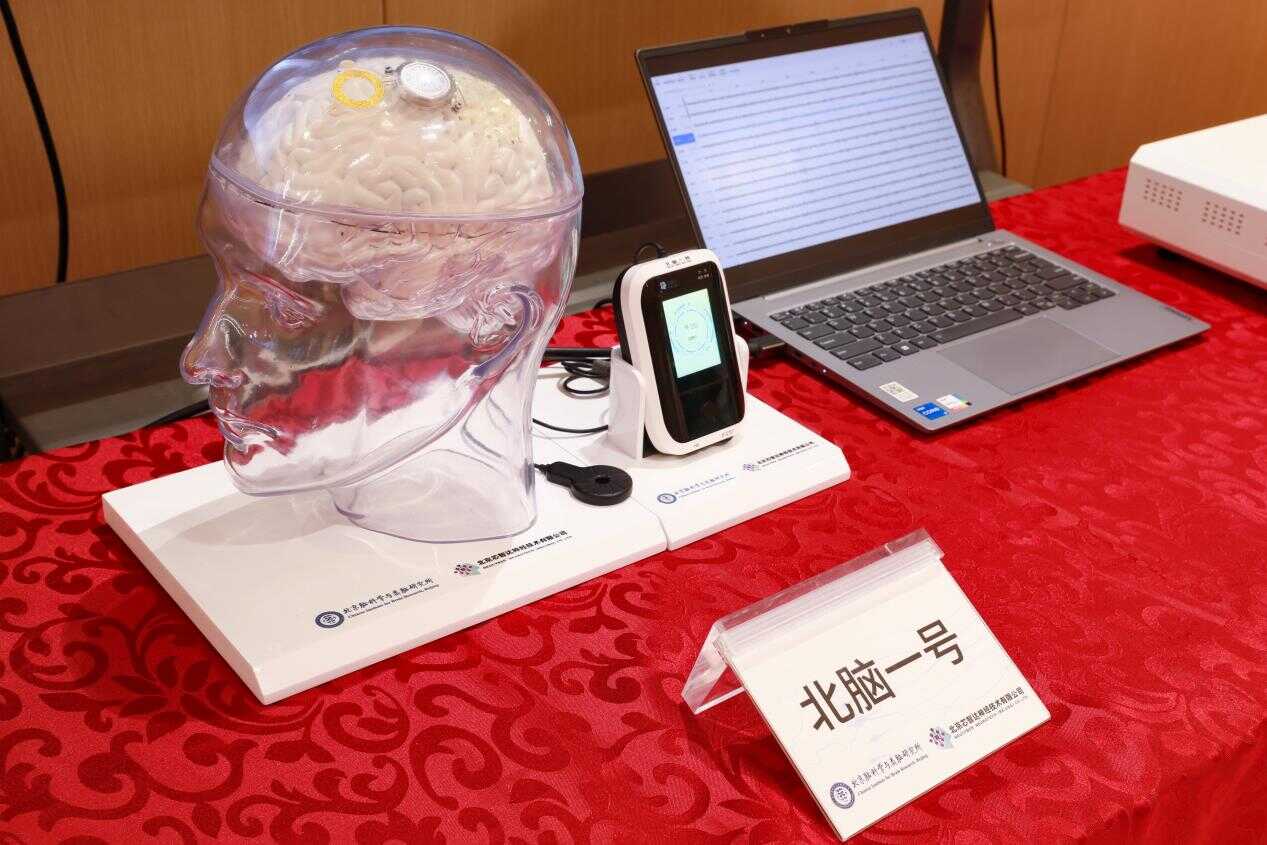

BEIJING, Mar 3 (APP): Five years post-spinal injury, a patient is back on his feet. The NeuCyber Matrix BMI System (Beinao-1) made it possible. Through brain-controlled rehabilitation, the patient graduated from total paraplegia to walking with crutches.
Once confined to laboratories, BCIs are now entering clinical and commercial pathways.
For countries with aging populations and significant neurological healthcare burdens, BCIs represent a medical technology opportunity grounded in real healthcare demand, core technological challenges, and long industrial cycles. In China, they have also become a clearly defined future industry, embedded in long-term national planning and backed by an expanding ecosystem of hospitals, startups, manufacturers, and regulators.
Why BCIs?
China’s interest in Brain-Computer Interfaces (BCIs) is driven by a triad of strategic imperatives, namely, technological sovereignty in key supply chains, large clinical demand from neurological disease and disability, and new economic growth opportunities.
As a field that integrates advanced materials, semiconductor chips, AI decoding algorithms, and clinical systems, BCIs are now considered vital to future neurotech competitiveness. To secure this competitive edge, the Chinese government has officially designated BCIs as a strategic “future industry.” According to a set of guidelines released by seven central government bodies on July 23, 2025, Beijing’s multi-department roadmap seeks to achieve key technological breakthroughs in the industry by 2027, alongside the establishment of advanced technology, industry, and standards systems, CEN reported.
This policy push reflects mounting pressure from an ageing population and a healthcare system facing a surge in neurological disease. According to the China Neurological Disorders Report 2024 released in November 2025, neurological disorders—including cerebrovascular disease, epilepsy, traumatic brain injury (TBI), and amyotrophic lateral sclerosis (ALS)—impose a heavy burden on China’s national healthcare system, which are linked to reduced rates of economic involvement and significant costs to society, not to mention it is a challenge intensified by rapid population ageing. Rising rates of neurological and neurodevelopmental disorders, combined with growing demand from patients and healthcare providers for functional recovery, are expanding the market for brain–computer interface technologies.
Beyond their clinical value, BCIs are beginning to attract investor attention by linking healthcare demand with advances in chips and AI, drawing capital into what is increasingly seen as a long-cycle medical technology market. As per the Brain Computer Interface Market Size, Share and Trends 2026 to 2035 report by Precedence Research, the global BCI market is calculated at USD 2.94 billion in 2025 and is predicted to increase from USD 3.33 billion in 2026 to approximately USD 13.86 billion by 2035, representing a CAGR of 16.77%.
This growth is already reflected in global investment activity. As noted in the Brain–Computer Interface Technology and Application Research Report (2025) by the China Academy of Information and Communications Technology (CAICT) and the Brain–Computer Interface Industry Alliance, more than 1,000 BCI-related financing transactions have been disclosed worldwide as of April 2025. With nearly 400 BCI companies globally securing external investment, total disclosed funding is now approaching USD 10 billion, signaling a robust economic future for the industry.
A Market Defined by Constraint, Not Hype
Despite frequent media comparisons with consumer tech breakthroughs, the industry as a commercial ecosystem remains grounded in real medical markets constrained by patient need, regulation, and clinical evidence.
Despite rapid progress, invasive BCIs still face fundamental engineering problems that limit their reliability and long-term clinical use. For instance, neural signals often drift over time, meaning patterns recorded today may differ weeks or months later. This presents a significant hurdle for young patients with spinal cord injuries or neurodegenerative diseases, for whom devices must remain stable and functional for decades.
As Dr. Minmin Luo, director of the Chinese Institute for Brain Research, Beijing (CIBR), noted, long-term biocompatibility, mechanical durability, and surgical safety are therefore as important as decoding accuracy; a system that performs well for months but degrades over years is simply not clinically viable.
Beyond hardware limitations, data scarcity further complicates industry progress. According to recent clinical trial data, only around 200 people worldwide have received invasive BCIs. Furthermore, recording methods, electrode designs, and behavioral tasks continue to vary widely across these cases, making it difficult to pool data at scale or develop decoding systems that work reliably across patients.
Accompanying these technical hurdles are significant ethical concerns. Because neural data can reveal disease risk, cognitive decline, and aspects of personal identity, certain neural information—particularly signals related to intent and identity—must be treated as inviolable mental privacy. As a result, clear consent rules, strong data protection, and strict oversight are essential if the industry is to gain public trust.
Also, the path to widespread adoption is hindered by economic and systemic barriers. Currently, BCIs are expensive; even non-invasive procedures can cost tens of thousands of dollars once surgery, testing, and rehabilitation are included. Achieving integration into public healthcare systems will require substantial cost reduction through manufacturing advances and reimbursement integration.
Finally, as BCIs sit at the intersection of neuroscience, materials science, AI, and medical regulation, expanding educational pipelines and cross-disciplinary training will be crucial if the industry is to sustain its growth.
Global Implications Beyond National Competition
Brain–computer interfaces emerged from neuroscience experiments in the United States in the late 20th century, before entering an engineering and clinical validation phase in the 2000s, with Europe advancing non-invasive systems and the US leading invasive implant research. For much of this period, BCI development remained confined to laboratories and small-scale trials, constrained by signal instability, surgical risk, and ethical concerns.
China entered the field later, but its progress has accelerated in recent years as BCIs were reframed not as speculative frontier technology but as a response to rising neurological disease burdens and population ageing. Backed by large hospital networks, coordinated policy support, and manufacturing capacity, China has moved quickly from research to early clinical deployment—particularly in rehabilitation-oriented and non-invasive applications—positioning itself as a new but increasingly consequential player in the global BCI landscape.
China’s industrial strategy in BCIs offers an alternative model that is healthcare driven and institutionally coordinated rather than purely venture capital fuelled. For example, in 2025, BCI procedures were granted a standalone medical insurance reimbursement category in parts of China, signaling early institutional support for commercialization. In a recent media interview, Ming Dong, a member of the Chinese People’s Political Consultative Conference National Committee and vice president of Tianjin University, noted that the industry is now at a pivotal stage as real-world applications continue to expand. For emerging economies with rising neurological disease burdens but limited research infrastructure, non invasive BCI solutions could be cost effective assistive technologies in the long term.
Western innovators like Neuralink and Synchron retain advantages in deep foundational research and venture funding, but China’s clinical scale, manufacturing depth, and coordinated policy support provide complementary contributions that could enrich global ecosystem knowledge. In this sense, technology innovation in BCIs is less a geopolitical zero sum game and more a shared learning environment.
The idea of “technology for good” enters measurable clinical reality when a quadriplegic patient now steers a wheelchair outdoors and commands a robotic dog to fetch takeout—all via neural signals. Whether this strategy succeeds will ultimately depend on clinical results, device durability, regulatory certainty, and sustained long-term investment.