UNITED NATIONS, Sep 18 (APP):Asserting the "paramount" importance of maritime safety and security, a top Pakistani diplomat has warned that disruptions to commercial shipping and attacks on merchant vessels in the Strait of Hormuz and Bab-Al-Mandab create grave implications for countries and continents alike. "It is our principled position that global shipping should not become a casualty of conflict and strife. Instead, it should remain a driver of global trade …
At UN, Pakistan warns of economic fallout from disruptions of Mideast trade choke points
UNITED NATIONS, Sep 18 (APP):Asserting the “paramount” importance of maritime safety and security, a top Pakistani diplomat has warned that disruptions to commercial shipping and attacks on merchant vessels in the Strait of Hormuz and Bab-Al-Mandab create grave implications for countries and continents alike.
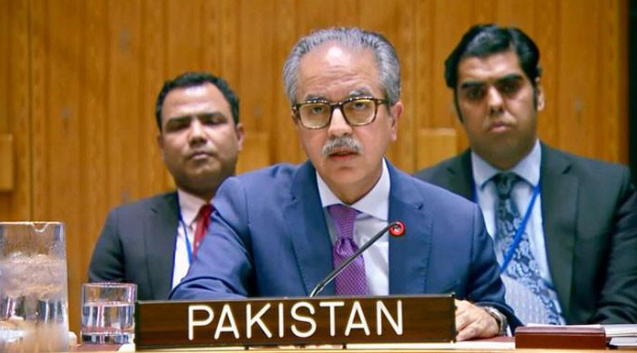
“It is our principled position that global shipping should not become a casualty of conflict and strife. Instead, it should remain a driver of global trade and economy,” Ambassador Asim Iftikhar Ahmad, permanent representative of Pakistan to the UN, told an informal meeting of the Security Council on Thursday.
The meeting on ‘Safe Seas, Shared Security: Protecting Freedom of Navigation in an Evolving Security Environment,’ was convened by Bahrain under Arria-Formula format named after a former Venezuelan Ambassador to the UN, Diego Arriva.
Arria-Formula meetings are informal that enable Security Council members to have a frank and private exchange of views on relevant subjects.
In his remarks, Ambassador Asim Ahmad reiterated Pakistan’s strongly condemnation of the “nefarious” designs of Houthi militia to weaponize Bab-Al-Mandab by launching attacks on merchant shipping and innocent seafarers navigating the Strait.
Reaffirming Pakistan’s solidarity with Saudi Arabia, he said that the Houthi attacks “seriously undermine maritime security and threaten peace and development of regional countries,” and reaffirmed Pakistan’s support for the Kingdom’s “sovereignty, territorial integrity, security and prosperity.”
Calling for an immediate cessation of Houthi attacks, the Pakistani envoy said such provocative acts “could have dire consequences for maritime security, and regional peace and stability.”
About the situation in the Strait of Hormuz, Ambassador Asim Iftikhar Ahmad said Pakistan was deeply concerned by disruptions and attacks on commercial shipping and called for “an immediate de-escalation of tensions, security of ships and crew members, and restoration of normal passage through the Strait.”
The Strait of Hormuz was a critical maritime trade route, with disruptions there having significant implications for global energy and fertilizer supplies, he said.
Ambassador Asim Ahmad emphasized that, as a littoral state of the Indian Ocean and a party to the UN Convention on the Law of the Sea, Pakistan attached “paramount importance to maritime safety and security.”
Highlighting Pakistan’s diplomatic efforts following the outbreak of hostilities between Iran and the United States, Ambassador Asim Ahmad said Pakistan had spearheaded efforts for de-escalation and broader regional stability, culminating in a ceasefire and the Islamabad Memorandum of Understanding.
He reaffirmed Pakistan’s commitment to diplomatic engagement, saying that Islamabad would continue efforts “for a negotiated settlement of all outstanding issues for an early return to normalcy at sea and land.”
Pakistan, he added, would continue to work with peace-loving nations in the region and beyond to advance maritime peace and security and ensure the safety of commercial shipping and merchant vessels.