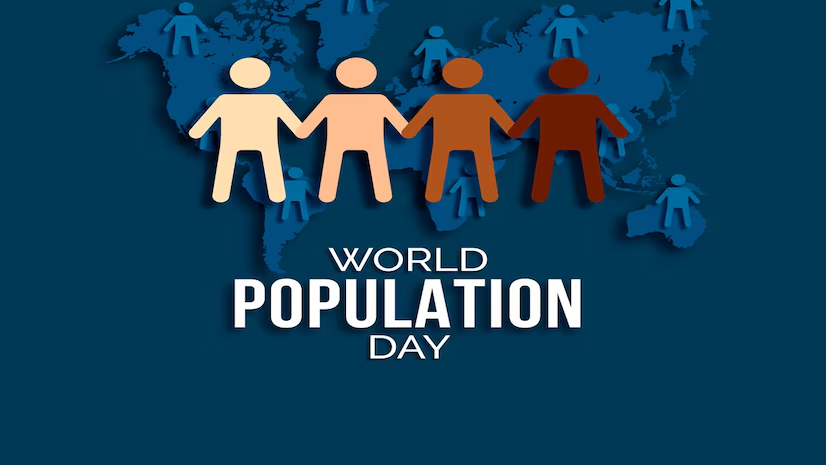
As the world observed World Population Day on Saturday, the debate on overpopulation growth was often framed through statistics and projections rather on highlighting its negative effects on human life.
World Population Day: Time to raise awareness about family planning for economic prosperity
By Fakhar-e-Alam
PESHAWAR, Jul 11 (APP): As the world observed World Population Day on Saturday, the debate on overpopulation growth was often framed through statistics and projections rather on highlighting its negative effects on human life.
In Khyber Pakhtunkhwa (KP), the issue of rapid population growth is measured not only in numbers but also in overcrowded hospitals, transport, struggling schools, shrinking forest as well as housing resources where dreams deferred in hope of better economic opportunities.
This year’s world population day is being observed under the theme “realizing the hopes and aspirations of young people today and for the future,” emphasizing investment in the health, education, and rights of young people to build a more sustainable future.
According to the United Nations statistics, the global population has now crossed 8.3 billion, while Pakistan’s population in 2026 is estimated at approximately 259 million, making it the world’s fifth most populous country. The country’s rapid population growth, driven by a high birth rate and a predominantly young population, presents both opportunities and formidable challenges.
Experts warned that without effective population planning, Pakistan’s population could continue to rise sharply in the coming decades, placing unprecedented pressure on healthcare, education, employment, housing, food security, water resources and the environment.
In Tehsil Pabbi Nowshera, a mother’s life lost in pursuit of a son. As evening descends on Mohib Banda village on river Kabul the dim glow of a candle illuminates the modest home of Nargis Bibi where her children quietly prepare summer tasks, turning fragile pages of worn-out textbooks.
On a mud-plastered wall rests an old photograph being the only reminder of the mother she barely had the chance to know and recalled.
Nargis gently wiped away tears as she recalled the tragedy that forever changed her family’s life.
“I have three sisters,” she said softly while speaking to APP. “My parents desperately wanted a son. My mother died during her fifth pregnancy. That desire took her life and left us without her love forever.”
“My sisters and I grew up without a mother’s affection. We had to become adults before our time,” she said. “No child should lose a mother simply because society places greater value on having a son.”
Her story reflected the silent struggles of thousands of families across KP, where cultural preferences for male children, early marriages, limited reproductive health awareness and inadequate family planning continue to influence family decisions.
Population growth stretches every sector. Economists and development experts said rapid population growth is placing extraordinary stress on Pakistan’s already limited socioeconomic resources.
Prof. Dr Muhammad Zilakat Malik, former Chairman of the Economics Department at the University of Peshawar, believed that the negative consequences of overpopulation are evident in every sphere of life.
“Population explosion has become the mother of many socioeconomic problems,” he said.
“Our hospitals, schools, universities, transport infrastructure, agriculture, housing sector and job markets are struggling to keep pace with the growing population.”
He said unemployment, poverty, corruption, social inequality and declining public services become increasingly difficult to address when population growth consistently outpaces economic expansion.
Pakistan’s economy, heavily dependent on agriculture, also faces mounting pressure. Domestic agricultural production cannot fully meet growing food needs, forcing the country to spend billions of dollars annually on food imports while inflation continues to squeeze household budgets.
Doctors working on the frontline witness the impact almost every day. Dr Malik Riaz, former head of the Children’s Department at Government Hospital Pabbi, said overcrowded health facilities are treating growing numbers of mothers and children suffering from preventable health complications.
“Nearly 30 to 40 percent of children suffer from stunting due to poor maternal nutrition, repeated pregnancies and lack of awareness about reproductive healthcare, which significantly affect children’s physical and mental development.”
He said the first six months of a child’s life are critical, yet many mothers are themselves malnourished and physically exhausted due to closely spaced pregnancies.
“The health of mothers and children is directly connected,” he added. “Healthy mothers give birth to healthier children.”
Climate change compounds the food problems in KP where challenges of rapid population growth are being intensified due to deforestation and induced weather patterns.
Successive floods, including the devastating disasters of 2022 and 2025, displaced large number of people across Pakistan, destroying homes, crops, schools and health facilities.
The resulting economic losses have deepened poverty, particularly in rural and underdeveloped districts of KP.
With increasing demand for clean water, cultivable land, housing and employment, experts warned that environmental degradation and population growth together pose one of Pakistan’s greatest development challenges.
Recognizing the urgency, the Khyber Pakhtunkhwa Population Welfare Department has launched the province’s first comprehensive population policy with a main focus on awareness about family planning.
The strategy seeks to increase contraceptive use, improve maternal and child healthcare, and gradually reduce fertility rates from 3.9 births per woman to 2.1.
Under the initiative, authorities plan to establish 260 family welfare centres, expand mobile health services to remote communities, strengthen adolescent reproductive health programmes and increase access to family planning services in underserved districts.
The government has also approved 120 additional family planning centres in the merged tribal districts, while psychologists have been deployed in educational institutions across 14 districts to promote awareness among young people.
Officials said more than 3,500 religious scholars are also being engaged to help educate communities about responsible parenthood and maternal health within the framework of religious teachings.
Despite policy interventions, experts believed that the greatest obstacle remains social attitudes.
Deep-rooted cultural traditions, misconceptions about family planning, early marriages and the persistent desire for male children continue to influence reproductive choices in many communities.
“Population control is not about limiting families,” Prof. Dr. Zilakat said.
“It is about enabling parents to provide better education, nutrition, healthcare and opportunities for every child.”
He stressed that sustainable progress requires coordinated efforts by government institutions, religious leaders, educational institutions, civil society organizations, healthcare professionals and the media.
With nearly two-thirds of Pakistan’s population under the age of 30, experts believed the country’s young people represent its greatest asset provided they receive quality education, healthcare and employment opportunities.
World Population Day serves as a reminder that investing in young people today will determine the country’s social and economic future.
For mothers like Nargis, however, the message goes beyond policy.
Watching her children continue studying under the flickering candlelight, she hoped future generations will be spared the pain her family endured.
“I wish people understood the price families pay in this race for sons,” she reiterated quietly.
“We lost our mother. I pray no child has to grow up with that loss.” Her words echo far beyond her small village, reflecting a challenge that affects millions across Pakistan—a reminder that behind every population statistic lies a human story, and behind every policy debate are families striving for healthier, more secure and more hopeful futures.