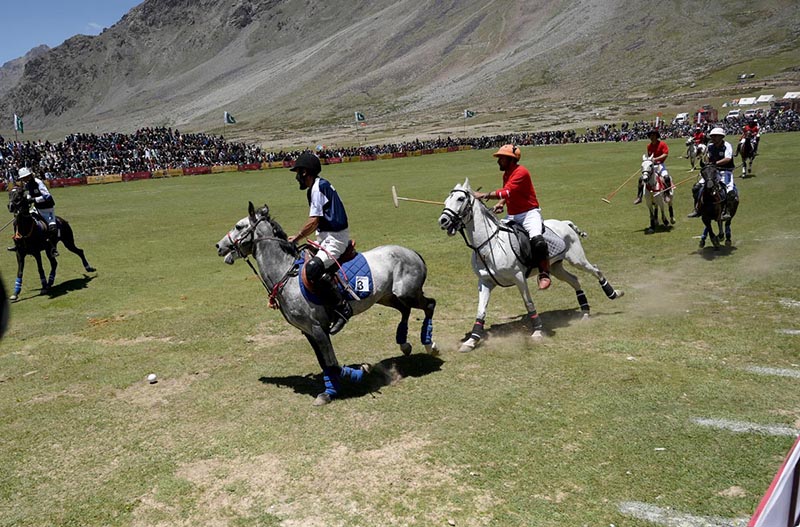
As the thunder of galloping horses echoed across the snow-capped mountains of Shandur in Chitral recently, thousands of spectators held their breath amid full-throated slogans of Pakistan Zindabad.
Polo: The Game of Kings that elevates Pakistan’s global image
By Fakhar-e-Alam
PESHAWAR, Jun 17 (APP): As the thunder of galloping horses echoed across the snow-capped mountains of Shandur in Chitral recently, thousands of spectators held their breath amid full-throated slogans of Pakistan Zindabad.
At 12,200 feet above sea level, on the windswept plains of Shandur, one of the world’s most extraordinary sporting spectacles unfolds each year, a nail biting polo final contest that is as much about culture, sports, heritage and identity as it was about victory.
Widely known as the “Game of Kings and the King of Games,” freestyle polo has long been associated with royalty, nobility and prestige worldwide.
In Pakistan, however, the polo sport has evolved into something even greater due to consistent Govt patronage. The annual Shandur Polo festival has become a symbol of national pride, showcasing the country’s rich heritage, breathtaking landscapes and enduring sporting traditions to the world.
Often described as the world’s highest polo tournament, the event brings together fierce rivals from Chitral and Gilgit-Baltistan in a close contest that transcends sport on Saturday last at Shandur.
For local communities and polo lovers, it represents history, honour and a centuries-old bond rooted in the mountains of Chitral where the Games of Kings evolved over centuries.
This year’s festival once again captured international attention as Gilgit-Baltistan defeated Chitral 6-5 in a thrilling final, reclaiming the coveted Shandur Polo Cup 2026 after a 15-year wait. The nail-biting encounter kept spectators on edge until the final whistle, highlighting the passion and competitiveness that define the tournament.
Despite the defeat, Chitral remains the most successful team in Shandur’s history. Records from finals played between 1982 and 2026 show Chitral winning 17 titles compared to Gilgit’s 14 championships.
The rivalry has produced countless memorable matches, helping establish Shandur as one of Pakistan’s most celebrated sporting events.
For many visitors, the festival offers far more than polo. Against a backdrop of snow-capped peaks and lush green meadows, tourists witness traditional music, folk dances, cultural exhibitions, paragliding and the hospitality of mountain communities.
The event attracts thousands of domestic and foreign visitors every year, transforming the remote plateau into a vibrant celebration of culture and sport amid Pakistani flag hoisting on top of Shandur.
The roots of polo stretch deep into history. During the Mughal era, emperors such as Babur and Akbar were passionate players, with historical accounts noting that matches were sometimes played at night using burning wooden balls.
Across centuries, the sport retained its royal associations and remains popular among elite circles worldwide. Members of the British Royal Family have all been known to play the sport. Yet at Shandur, polo belongs not to kings but to the people.
Generations of players from Chitral and Gilgit-Baltistan have preserved the tradition through dedication and sacrifice. Polo remains an expensive sport, requiring significant spending on horses, training and maintenance.
Despite these challenges, players continue to invest their time, resources and passion to keep the game alive.
One of the most respected figures in Shandur Polo history is Shahzada Sikandar-ul-Mulk, who served for many years as Chitral’s captain and played a key role in shaping the team’s successes. His leadership remains an inspiration for younger players entering the sport.
The festival’s journey has not always been smooth. Several editions were disrupted by extraordinary circumstances. No match was held in 1999 due to the Kargil conflict, while boycotts affected the festival in 2010 and between 2013 and 2015. The COVID-19 pandemic forced the cancellation of the 2020 and 2021 tournaments, and the event was also not held in 2024.
Despite these interruptions, the spirit of polo has endured and played with great spirit this year.
In fact, the sport is witnessing a remarkable revival. There was a time when only 13 teams participated in district-level tournaments in Chitral, raising concerns about the future of the game.
Today, those fears have largely disappeared. This year, a record 63 teams competed in the Pre-Shandur Polo Tournament, reflecting renewed enthusiasm among young players and local communities.
Sports experts believed the festival serves as a bridge connecting people across regions while preserving centuries-old traditions. More importantly, it presents a positive image of Pakistan to international audiences.
Former Ambassador Manzoorul Haq believed that the event plays an important role in enhancing the country’s reputation abroad.
“Shandur Polo is the identity of Pakistan, and this sport has enhanced the country’s image at the global level,” he told APP.
He emphasized that greater digital coverage and media promotion can further attract young people to the sport while highlighting Pakistan’s rich sporting heritage to the international community.
Ambassador Manzoor said that Pakistan could earn substantial revenue by promoting polo sports.
As the sun sets behind the majestic mountains of Shandur and the cheers of spectators fade into the evening air on Saturday last, one message remains clear that polo is more than a game in northern Pakistan.
It is a living tradition, a celebration of resilience and culture, and a powerful ambassador for a country eager to share its positive stories with the world.