
By Dr. M Ashraf Wani ISLAMABAD, Nov 1 (APP)::In a major shift for the country's farming economy, Pakistan is moving to turn soil restoration and climate-friendly farming into an economic opportunity by tapping global carbon markets. The initiative could create a new revenue stream for small farmers while improving soil health, strengthening climate resilience and reducing dependence on imported chemical fertilizers. This soil-restoration plan addresses a quiet crisis across Pakistan's …
Pakistan eyes global carbon markets through soil-friendly agriculture
By Dr. M Ashraf Wani
ISLAMABAD, Nov 1 (APP)::In a major shift for the country’s farming economy, Pakistan is moving to turn soil restoration and climate-friendly farming into an economic opportunity by tapping global carbon markets. The initiative could create a new revenue stream for small farmers while improving soil health, strengthening climate resilience and reducing dependence on imported chemical fertilizers.
This soil-restoration plan addresses a quiet crisis across Pakistan’s farmlands. Decades of heavy chemical use and intensive farming have depleted soil life, reducing organic matter in cultivated fields to around one percent or less.
This degradation leaves crops vulnerable to climate shocks, including heatwaves and floods, while trapping small farmers in a costly cycle of dependence on imported synthetic fertilizers.
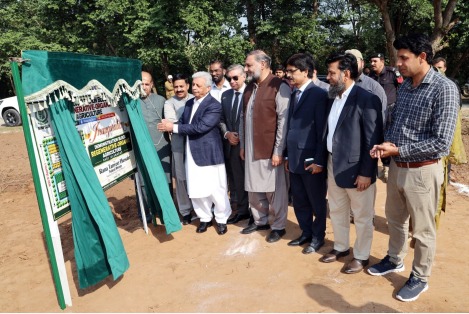
To address this challenge, a 10-acre Regenerative-Organic Agriculture demonstration block has been established at the National Agricultural Research Centre (NARC) in Islamabad. Federal Minister for National Food Security and Research Rana Tanveer Hussain inaugurated the project.
The initiative aims to show farmers how low-cost, environmentally friendly practices work in the field, not just in research papers. Official sources said the project is a joint effort of Pakistan Agricultural Research Council (PARC) Chairman Dr. Syed Murtaza Hassan Andrabi and NARC Director General Dr. Muhammad Mansoor to develop a practical model for nationwide adoption.
“Enriched soil structure acts as a natural buffer, dramatically increasing resilience during prolonged dry spells and preventing catastrophic crop washouts during heavy rain and waterlogging,” Dr. Mansoor told APP.
He said the model could also turn Pakistan’s carbon challenges into an economic opportunity by opening access to international carbon markets.
“Earning carbon credit revenue is not a matter of guesswork; it requires credible baselines and strict proof to show that the environmental benefit would not have happened under normal, conventional farming,” Dr. Mansoor told APP.
Rather than depend on imported technology, the project uses locally developed systems to reduce farming costs and restore soil health.
The biological component centres on a fermenter at NARC that produces beneficial bacteria, according to sources familiar with the project. These microbes help crops access nitrogen and release phosphorus already locked in the soil.
At the field level, a purpose-built fermentor — a lined structure or pond near the main irrigation source — will prepare and store organic nutrients and biofertilizers. These inputs can then enter the irrigation supply and reach the demonstration plots with water, eliminating the need for separate application to each plot.
The approach aims to distribute nutrients and beneficial microorganisms more evenly, improve soil biological activity and strengthen nutrient cycling. It will also help reduce dependence on synthetic fertilizers.
By making better use of naturally available nutrients, farmers can cut purchases of urea and other imported fertilizers, saving foreign exchange.
The mechanical component addresses another problem: conventional plowing. Repeated soil disturbance can release stored carbon into the atmosphere and damage beneficial underground fungal networks. To tackle this, NARC engineers have developed a machine called the “Precision Planter”.
“This machine cuts directly through leftover crop residues, dropping seeds into the ground with minimal soil disturbance to keep carbon safely locked under the earth,” Dr. Mansoor said.
Pakistan’s experience with Permanent Raised Bed (PRB) technology, introduced by PARC in 2000, provides a scientific foundation for regenerative and low-carbon agriculture.
Research across major cropping zones has demonstrated the technology’s potential to improve water-use efficiency and crop productivity, reduce production costs and soil disturbance, and support long-term soil health through residue retention and crop rotation, PARC sources said.
Beyond improving soil and crop resilience, the model aims to connect farmers with international carbon markets. These markets reward verified reductions in greenhouse gas emissions and the removal or storage of carbon dioxide.
To meet international buyers’ requirements, Pakistan is developing a modern Measurement, Reporting and Verification (MRV) system. It will combine regular soil testing at the 10-acre demonstration block with satellite remote sensing and computer modelling to estimate carbon storage.
However, verification costs remain a major barrier for Pakistan’s small farmers. Most cannot afford individual soil testing and certification. To address this, sources close to the project said the government plans to aggregate thousands of small farms under a single network.
This arrangement would spread verification costs across participating farms, reducing the financial burden on individual growers and allowing them to share in potential carbon revenues.
The demonstration site is divided into four 2.5-acre plots dedicated to cereals, vegetables, oilseeds and legumes. Leading research scientists say the data collected from these plots will help establish Pakistan’s official agricultural carbon records.
The findings will also provide scientific evidence for Pakistan’s reporting under the Paris Agreement, positioning agriculture as part of the climate solution rather than merely a victim of climate change, Dr. Mansoor concluded

