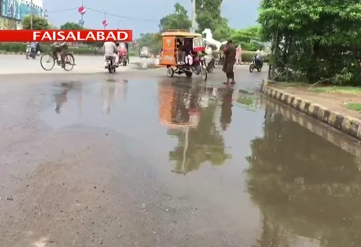
As clouds hover over Faisalabad in anticipation of the monsoon season, the civic authorities, residents and health officials of the city brace themselves for the annual seasonal tests and challenges the rains bring.
Monsoon rains: A recurring challenge for civic authorities
IFTIKHAR AHMAD
FAISALABAD, Sep 13 (APP):As clouds hover over Faisalabad in anticipation of the monsoon season, the civic authorities, residents and health officials of the city brace themselves for the annual seasonal tests and challenges the rains bring.
Though the monsoon refreshes the environment, replenishes underground water reservoirs and brings much-needed relief from the sweltering summer, it also exposes deep-rooted infrastructural and environmental shortcomings of Pakistan’s third-largest city.
The monsoon is not just a seasonal event; it is a challenge that exposes gaps in infrastructure, flaws in planning and inefficiencies in administration.
From urban flooding and overflowing sewage to disease outbreaks and traffic gridlocks, the monsoon is a litmus test of how well the city’s systems can withstand nature’s fury. The stakeholders across Faisalabad are calling for proactive measures rather than reactive firefighting.
A senior town planner, Engineer Muhammad Asif, said that the monsoon-related challenge is multifaceted. Meteorological, the rains are intense and prolonged, often exceeding infrastructure capacity within just a few hours. In recent years, rainfall patterns have also become more erratic.
Faisalabad city has frequently found itself underwater after torrential rains. For instance, Faisalabad received more than 100 mm of rain in a single day a few weeks ago, which paralyzed the city. The drainage system was overwhelmed and a power outage occurred, making routine life very difficult. The lack of an efficient storm-water management system turned roads into small distributaries and underpasses into drowning traps.
The drainage system in many parts of the city was laid decades ago. It was designed for a far lower population density and less intense rainfall. Over time, many of the drains have been blocked by plastic waste, encroachments and illegal constructions, he added.
Shahida Bibi, an educated widow living in a low-lying part of the city on Jhang Road, said that during last year’s rains, water came knee-high into her living room. It ruined her furniture and short-circuited the wiring. No one came to pump out the water until two days later.
She said that the civic authorities often conduct last-minute desilting operations, but these are rarely comprehensive or timely. The solid waste management system is also inadequate, leading to garbage being dumped into canals and drains. This not only clogs the system but also creates breeding grounds for disease-spreading vectors, she added.
An educationist, Akbar Ali, said that a major concern in Faisalabad is the lack of coordinated urban planning. Over the years, rapid urbanization has resulted in the unplanned expansion of colonies.
Natural drainage routes have been encroached upon; wetlands have been converted into housing societies and green belts have disappeared.
The rainwater that once seeped into the soil now accumulates on paved surfaces, contributing to urban flooding, he added.
A health expert, Dr. Sohail Hameed, said that the public health implications of the monsoon are serious but often neglected. Stagnant water becomes a breeding ground for mosquitoes, which can lead to outbreaks of dengue, malaria and other diseases.
Contaminated water supplies cause gastroenteritis, hepatitis A, typhoid and other infections. Children, elderly people and those with compromised immunity are particularly vulnerable during the monsoon period.
During the monsoon, hospitals often see a spike in patient numbers. Overburdened public healthcare systems find it difficult to manage the sudden increase, which can also lead to inadequate care, especially for underprivileged communities. Additionally, the monsoon increases the risk of electrocution, wall collapses and road accidents, he
added.
Dr. Fatima Ali, a senior medical officer, said that Faisalabad’ s healthcare system is already operating under strain due to rising temperatures and seasonal diseases. With the onset of the monsoon, public hospitals prepare for an influx of patients suffering from dengue, malaria, diarrhea and skin infections.
“We are preemptively increasing our isolation beds and stockpiling medicines and diagnostic kits for dengue, but the real fight is at the grassroots. Without drainage, clean drinking water and mosquito control, the hospitals alone cannot win this battle, as standing water near homes and schools is the biggest culprit in dengue outbreaks,” she
added.
Environmentalists argue that monsoon woes are symptoms of deeper ecological neglect. Hafiz Qaisar Khan, a local urban ecologist and activist of the Clean Faisalabad movement, said that the city is heading towards a climate disaster unless it rethinks its infrastructure model.
“Faisalabad has no significant wetlands left. Rainwater, instead of being absorbed into the soil, floods roads because there are no soakaways, green zones or permeable pavements. We can’t concrete over nature and expect to stay safe,” he said, advocating rainwater harvesting at the municipal level, rooftop gardens and the revival of dead canals as ecological buffers.
According to a spokesman for the Faisalabad Development Authority (FDA), a comprehensive master plan has been devised for Faisalabad to overcome the crises of the metropolis.
He said that most housing societies ignore environmental guidelines. They build over green belts, seal natural waterways and then expect the city to absorb the damage during heavy rainfall. These violators were issued notices, but unless heavy penalties are enforced and land regularization is revisited, things will not improve, he added.
Spokesman for WASA Qadeer Sikandar said that the Water and Sanitation Agency (WASA) Faisalabad conducted prompt and effective drainage operations this year. He said that despite 126 millimeters (mm) of monsoon rainfall recently, WASA cleared all major roads within a few hours.
He said that special measures were taken to provide drainage relief. In the past, rainwater remained on roads for 12 or more hours. However, now, under the dynamic leadership of Managing Director WASA Engineer Saqib Raza, WASA managed to clear all major roads and intersections within two to four hours.
Samundri Road was historically considered a site prone to water accumulation during rain, but not a single drop of water accumulated at this location this time, he added.
He said that the government is committed to providing quality services. WASA has also made extensive arrangements to prevent rainwater stagnation, which often damages road infrastructure, he added.
As Faisalabad braces for another season of heavy rains, the challenge goes beyond clearing flooded roads and drains. It is about building a city that can absorb the rain rather than surrender to it.
For a rapidly expanding urban centre, every monsoon is a reminder that resilient infrastructure, coordinated planning and environmental protection are no longer choices but necessities because a city’s true resilience is tested when the rain begins to fall.