Matiullah Mati QUETTA , Aug 9 (APP):For Munir Rahman, a young graduate from the Balochistan University of Information Technology, Engineering and Management Sciences (BUITEMS), navigating the competitive job market after university has been a daunting challenge where opportunities for young degree holders remain difficult to secure. Like many bright graduates across the province, Munir shared a deeply felt dream to see his hard-earned university degree open …

Matiullah Mati
QUETTA , Aug 9 (APP):For Munir Rahman, a young graduate from the Balochistan University of Information Technology, Engineering and Management Sciences (BUITEMS), navigating the competitive job market after university has been a daunting challenge where opportunities for young degree holders remain difficult to secure.
Like many bright graduates across the province, Munir shared a deeply felt dream to see his hard-earned university degree open doors to a meaningful career. In a region brimming with youthful potential, the bridge from academic success to dignified employment has often felt like an uphill climb.
Yet, participating in the Chief Minister Youth Employment Program marked a inspiring turning point; for the first time, the process reflected a renewed commitment to merit, transparency and equal opportunity, restoring the faith of Balochistan’ s youth in a brighter, more inclusive future.
However, his recent participation in the recruitment test for the Chief Minister Balochistan Youth Employment Program offered him a fresh perspective one rooted in merit and operational
transparency.
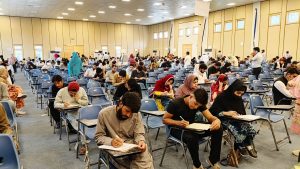 “For university graduates like us, this is a vital opportunity,” Munir said, describing the initiative as one of the first provincial programs giving graduates a fair chance to compete for jobs through an entirely merit-based system.
 Munir’ s journey highlights a broader structural challenge facing Balochistan’ s youth population: securing a university degree is merely the initial milestone, while entering a labour market that rewards skills and qualifications remains the primary hurdle.
According to the Pakistan Bureau of Statistics (PBS) Labour Force Survey 2024–25, Balochistan has a youth population of approximately 2.4 million aged between 15 and 24 years. Of these, around 900,000 form part of the active labour force, with nearly 800,000 currently employed.
At present, 127 technical institutes, colleges and vocational centers across the province offer specialized training in 34 distinct fields.
To address the employment gap, the Balochistan government has accelerated efforts to align technical education with private-sector demand and modern industrial requirements.
Speaking to APP, Secretary Labour and Manpower Balochistan, Saleh Muhammad Nasar, said the provincial government is taking comprehensive measures to equip young people with market-driven skills and connect them directly with job opportunities.
“Skilled human resources form the foundation of industrial development. Strong partnerships between the government, the private sector and training institutions are essential for sustainable economic growth,” Nasar said.
He explained that the government is focusing on key economic drivers including mining, agriculture, livestock and industrial potential to design targeted skill-building initiatives.
“We have initiated a comprehensive skill-mapping process across Balochistan to identify district-level needs, available resources, and local industrial demand,” Nasar told APP.
He added that recommendations for establishing a unified coordination unit have been submitted to the Chief Minister of Balochistan to streamline communication between training centers, industries and government departments.
A proposal for a one-window operation is also under active implementation to ease private investment and accelerate job creation.
Underscoring the commercial perspective, Vice President of the Quetta Chamber of Commerce, Engineer Mir Wais Khan Kakar, told APP that while Balochistan possesses vast natural resources and mineral wealth, commercial facilitation and skilled manpower remain essential to unlock this potential.
“Skill mapping must be carried out in every district based on local industrial requirements so youth are trained in sectors with actual hiring capacity,” Kakar emphasized, urging dedicated training programs for small and medium enterprises (SMEs) to foster entrepreneurship.
The statistical landscape also underscores a pressing need for gender inclusion. PBS data reveals that the female youth population (aged 15 to 24) in Balochistan stands at 1.1 million, yet female labour force participation remains low at 11.6 percent, signaling an urgent requirement for targeted vocational training for women.
Director General of the National Vocational and Technical Training Commission (NAVTTC), Hussain Bakhsh Magsi, told that NAVTTC updated its curriculum in 2024 to match modern market standards.
“Our goal is to ensure technical institutions maintain permanent links with industrial chambers so training stays aligned with practical market requirements,” Magsi stated.
According to the Labour Force Survey 2024–25, the number of young Pakistanis receiving technical or vocational training grew nationally from 4.4 million in 2020–21 to 4.9 million in 2024–25, comprising 3 million males and 1.9 million females.
At the provincial level, Punjab leads with 3.2 million trained youths, followed by Khyber Pakhtunkhwa with 800,000, Sindh with 700,000, and Balochistan with 300,000. Notably, Balochistan’ s trained technical workforce expanded threefold from 100,000 in 2020–21 to 300,000, boosting its national share from 1.2 percent to 5.1 percent.
Magsi disclosed that NAVTTC has signed a formal agreement with the Balochistan Technical Education and Vocational Training Authority (B-TEVTA) to train an initial cohort of 1,000 youths, alongside efforts to align national technical certifications with international standards.
Speaking to APP, NAVTTC representative Maqbool Ahmed noted that closer institutional coordination is essential to convert training programs into direct employment pipelines.
Through ongoing skill mapping, system modernization, and institutional collaboration, Balochistan aims to convert its youth demographic into a central driver of regional economic expansion.
For candidates like Munir Rahman waiting for the next phase of selection, these systemic reforms represent far more than a routine recruitment drive they offer a transparent pathway toward professional
dignity.