Abdul Samad Tariq ISLAMABAD, Oct 7 (APP):Every morning, thousands of motorists travel from Rawalpindi towards Islamabad, making Kashmir Chowk a vital link in the daily movement between the twin cities. As traffic from different directions converges at the junction, the growing volume of vehicles highlights the need for modern infrastructure capable of ensuring smoother, safer and more efficient mobility. At Kashmir …
Abdul Samad Tariq
ISLAMABAD, Oct 7 (APP):Every morning, thousands of motorists travel from Rawalpindi towards Islamabad, making Kashmir Chowk a vital link in the daily movement between the twin cities.
As traffic from different directions converges at the junction, the growing volume of vehicles highlights the need for modern infrastructure capable of ensuring smoother, safer and more efficient mobility.
At Kashmir Chowk, traffic arriving from Islamabad, Rawalpindi and the Murree side converges, turning an already busy junction into one of the capital’s most demanding traffic points. For commuters, the familiar scene is one of long queues, frequent stoppages and precious minutes lost during peak hours.
Now, a major infrastructure intervention is set to change that experience.

The Rs1.4 billion Kashmir Chowk underpass, being developed by the Capital Development Authority (CDA) is designed to separate major traffic movements and provide a faster, more efficient route for thousands of motorists using the junction every day.
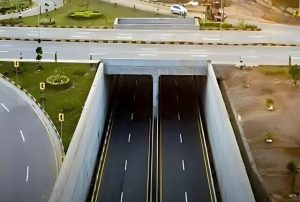
According to the CDA, around 107,000 vehicles pass through Kashmir Chowk daily. With traffic volumes continuing to rise across the Islamabad-Rawalpindi metropolitan area, the need for a permanent solution has become increasingly clear.
For commuters like Sara, a university student who travels daily from Rawalpindi towards Serena, the project is not simply another road scheme it is a long-awaited relief.
“As someone who drives through Kashmir Chowk every day, I feel this underpass is long overdue. The congestion during peak hours is unbearable. If it is completed within the promised one-month time-frame, it will save commuters a great deal of time and stress,” she said, while stressing the importance of properly managing traffic diversions during construction.
Rizwan, another regular motorist, also welcomed the project.
“Thousands of vehicles pass through this junction every day, and it has become particularly difficult when traffic from the Murree side mixes with Rawalpindi-bound traffic. Separating the Rawalpindi-bound movement through the underpass is a smart solution,” he said.
The project has gained particular attention because of the government’s decision to pursue an accelerated construction schedule.
Prime Minister Shehbaz Sharif laid the foundation stone of the underpass, which is being executed by Habib Construction Services (HCS). While the bidding documents provide a completion period of 90 days, CDA officials have said the contractor has the capacity and experience to complete the scheme in just one month.
That ambitious target places Kashmir Chowk among the government’s fast-track infrastructure initiatives aimed at delivering visible improvements to Islamabad’s road network within a short period.
The road arrangement planned for the junction is straightforward but significant. Traffic travelling from the Serena side towards Rawalpindi will pass through the underpass, while traffic heading towards Murree will move over it.
Four slip roads are also part of the scheme, while approximately five acres are being incorporated for expanded road infrastructure and related facilities.
The project’s cost has also been brought down through cost optimization. According to the CDA, the initial estimated cost of Rs1.6 billion was reduced to around Rs1.4 billion. HCS submitted a bid of Rs1.45 billion against the Rs1.486 billion amount mentioned in the Notice Inviting Tender, after another bidder was declared technically
non-responsive.
For the government, the project therefore represents more than a new underpass. It combines cost efficiency, faster execution, engineering standards and improved mobility at one of Islamabad’s busiest junctions.
Preparatory work, including site clearing, traffic-diversion planning and utility shifting, has already been undertaken. These steps are particularly important because construction at Kashmir Chowk must continue alongside regular traffic and existing utility infrastructure.
CDA Chairman Sohail Ashraf has also personally reviewed the project and temporary traffic arrangements. During a September visit to the site, he directed officials to ensure effective traffic management throughout construction and called for close coordination among relevant departments.
The message is clear: speed of construction cannot come at the expense of public convenience or safety.
A CDA spokesperson said the project remained a priority under the authority’s fast-track development
programme.
“With preparatory work already completed and Habib Construction Services mobilized, we are confident of delivering the project within the accelerated one-month target while maintaining quality and safety standards,” the spokesperson said. “Effective traffic management during construction remains our top priority so that the public faces minimum disruption.”
The Kashmir Chowk project is part of a much wider transformation taking place across Islamabad.
The CDA says it completed 18 development schemes in 2025 at a combined cost of around Rs15 billion. These included major road projects such as the Serena Interchange, Murree Road underpass, F-8 Interchange, T-Chowk flyover and Shaheen Chowk underpass, along with Park Road and the Business Facilitation Centre.
Shaheen Chowk, completed on an accelerated basis and opened to traffic at the beginning of 2026, provides a recent example of the fast-track approach now being applied to Kashmir Chowk.
The broader objective is to build a road network that reflects the changing mobility needs of the capital rather than simply addressing individual congestion points.
This is increasingly important as Islamabad and Rawalpindi function as one interconnected metropolitan area. Every day, students, office workers, traders, professionals and families cross between the two cities, making efficient road links essential to economic and social activity.
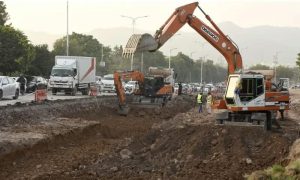
The Kashmir Chowk underpass is also being developed alongside the expansion and rehabilitation of the Islamabad Expressway service road and other major connectivity projects.
Interior Minister Mohsin Naqvi has said that after completion of the Kashmir Chowk underpass and Expressway expansion, travel time between Islamabad and Rawalpindi could fall to around 16 to 18 minutes.
The projected improvement reflects the combined impact of several infrastructure projects, but Kashmir Chowk is expected to play an important role by removing a major bottleneck from the network.
For commuters, however, the ultimate test will be simple: less waiting, smoother movement and more predictable journeys.
For the government and CDA, the project offers another test whether modern planning, cost optimization, coordinated execution and fast-track construction can deliver infrastructure at the pace demanded by a rapidly growing capital.
If the one-month target is achieved while maintaining safety and engineering standards, Kashmir Chowk could become more than an underpass. It could stand as another example of Islamabad’s transition towards a modern, integrated and mobility-focused urban network.
And for the thousands of motorists who pass through the junction every day, the reward may be even simpler: fewer queues, shorter journeys and one less traffic headache on the daily route between Rawalpindi, Islamabad and the Murree side.