
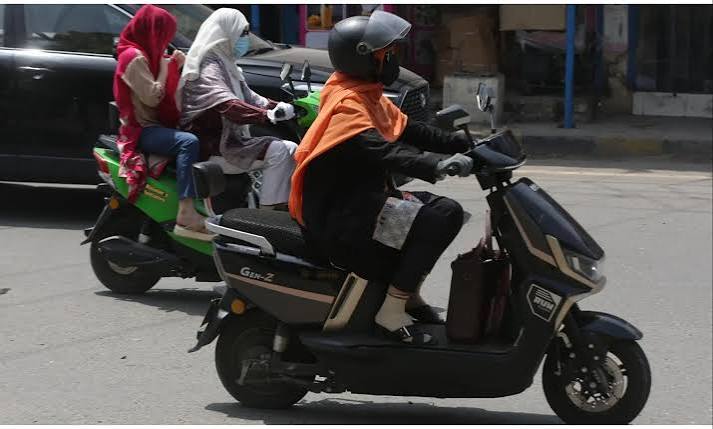
Moniba Iftikhar ISLAMABAD, Aug 30 (APP):The morning traffic is already beginning to swell when a woman pulls down her helmet, places both hands firmly on the handlebar of her scooty and joins the moving stream of vehicles. There is nothing unusual about a vehicle entering traffic, yet the scene carries a significance that goes beyond the road. A woman who once waited for someone else to drive …
Moniba Iftikhar
ISLAMABAD, Aug 30 (APP):The morning traffic is already beginning to swell when a woman pulls down her helmet, places both hands firmly on the handlebar of her scooty and joins the moving stream of vehicles. There is nothing unusual about a vehicle entering traffic, yet the scene carries a significance that goes beyond the road.
A woman who once waited for someone else to drive her is now choosing her own route, timing her own journey and deciding when she will return. Alia from Sialkot said one of the biggest challenges is the unnecessary
attention.
“You constantly feel watched and stared at. It honestly feels like you are being observed and judged everywhere you go,” she said.
For many women, the move from the passenger seat to the handlebar is not simply a change in transportation. It represents a gradual shift from dependence to confidence, from waiting for mobility to creating it
themselves.
For years, women travelling to schools, colleges, workplaces, markets or hospitals often had to depend on fathers, brothers, husbands or hired drivers.
Their journeys were shaped not only by distance, but by another person’s availability. Missing a ride could mean missing a class, delaying work or canceling an important task.

The growing presence of women on scooties
and motorcycles is changing that routine. Two wheels can shorten the distance between home and opportunity, but they can also give women something less visible and equally important: control over their own time.
A female student can leave for class without waiting for a family member. A working woman can reach her workplace according to her schedule. A daughter can accompany her mother to a hospital or market without having to arrange another driver.
In this sense, a scooter is more than a means of transport. For many women, it becomes a practical tool for independence.
Yet the road to independence is not always smooth. A woman rider has to negotiate traffic while also confronting social attitudes that have not changed as quickly as the roads themselves.
Unnecessary honking, prolonged staring, unwanted comments, deliberate following and reckless overtaking can turn an ordinary journey into an uncomfortable experience. What may be dismissed by others as a minor incident can leave a woman feeling exposed and cautious about travelling alone.
This creates a contradiction. Women are increasingly being encouraged to study, work and participate fully in society, yet some still face resistance simply because they choose to travel independently.
The real challenge, therefore, is not teaching women how to ride. It is creating an environment in which they can ride without being treated as an unusual sight or an easy target.
The government initiatives providing free, subsidized or interest-free scooters and electric bikes are helping address one of the most practical barriers: affordability.
For students and working women, such programmes can turn an aspiration for independent mobility into actual access to education, employment and essential services.
ASI Azra of the Islamabad Traffic Police (ITP) told APP that protecting women on the capital’s roads was a priority of Islamabad Police under the leadership of the Inspector General of Police.
She appreciated the Interior Ministry’s support for women-focused policing, saying women police personnel on patrol, increased road presence and Safe City cameras were strengthening security and helping women travel with greater confidence and dignity.
She urged women facing harassment, insecurity or any difficulty during their journey to immediately seek police assistance instead of remaining silent.
“No woman should feel alone or helpless on the road,” she said, adding that women could contact police at 15 or 1815 for timely assistance, while Safe City surveillance could help authorities monitor situations and respond more effectively.
Azra said the helpline operated 24/7, ensuring that help remained only a phone call away.
She said its integration with the AI-supported Women Police Station-on-Wheels, along with Safe City monitoring and field response was strengthening the protection network and reflecting the government and Islamabad Police’s commitment to making the capital safer for women.
For women learning to ride, family support can make the difference between hesitation and confidence. Rehana and Nighat, beauty experts told APP that their father and husband were among their strongest sources of encouragement when they decided to learn riding.
They believed that independent riding had become a necessity of modern life and supported the idea of learning the skill.
Nighat said that after learning to ride, her daily routine became considerably easier because she no longer had to wait for a bus or rely entirely on her husband for transportation. She can now travel independently and even take her mother along, reducing the difficulty and anxiety associated with arranging transport for both of them.
For many families, however, concerns about traffic and safety initially make them reluctant to allow women to ride. Confidence develops gradually through training, supervised practice and familiarity with roads. With every successful journey, fear begins to give way to self-reliance.
Rabia Sajid, another scooter rider, describes the less visible burden that accompanies this freedom. She recalled that when she and other women first began riding, people would stare at them in ways that made them uncomfortable. They chose to ignore the attention and continue with their routine, but the behavior sometimes became more
aggressive.
She said some men followed them, deliberately accelerated past them, honked without reason or attempted to intimidate them, while in some cases inappropriate comments and abusive language turned ordinary journeys into distressing experiences.
The problem becomes particularly serious when harassment begins to influence the route a woman chooses. Rabia said that because they usually travel within familiar areas, unfamiliar roads can create additional concern. On one or two occasions, when they felt someone was following them, they changed their route completely and avoided that road afterward.
Such experiences show that physical access to a road does not automatically mean freedom to use it. A road may be open to everyone, but fear can quietly place invisible boundaries around where a woman feels safe enough to travel.
Laher Mirza, Victim Support Officer at the Tahaffuz Center, Rawalpindi, Punjab Police said concerted efforts by law enforcement had helped create a safer environment for women and girls travelling on the roads.
She said many girls and women now felt much safer and appreciated the efforts being made by the Traffic
Police.

According to her, strict directions had been issued by the Inspector General of Police, while CPO Hassan Mushtaq Sukhera had also given clear instructions to ensure effective response to issues concerning women’ s
safety.
She said Chief Traffic Officer Farhan Aslam personally monitored the situation and received daily updates about patrolling, locations covered and issues reported by women and other road users.
“By the grace of Allah, there has been considerable improvement,” she said, adding that continued monitoring and patrolling had strengthened women’ s confidence while travelling.
But safety cannot depend only on police presence. It also requires responsible behaviour from every person sharing the road. A woman riding a scooter is not an invitation for attention, and travelling alone should never become a reason for harassment.
For Alishba Noor, a university student from Rawalpindi, independent mobility is part of a wider reality confronting young women today. The ability to travel without constantly depending on another person can affect access to universities, internships, workplaces and everyday responsibilities.
A social expert said women’ s independent mobility should be understood not merely as a transportation issue but as part of their wider participation in social and economic life.
Traditional expectations have often made dependence on male family members appear normal. The growing presence of women riders is gradually challenging those assumptions.
The deeper question is therefore not whether women should ride. It is why their decision to ride still requires explanation.
A man travelling alone is generally seen as simply going somewhere. A woman doing the same can still attract questions, looks and unsolicited opinions. The difference lies not in the road, the vehicle or the destination, but in a mindset that has historically placed limits on women’ s movement.
That mindset is now being challenged every time a woman starts an engine.
She is not merely covering a distance. She is reclaiming time, making choices and reaching places without waiting for someone else to make the journey possible.
The real transformation, however, will be complete only when society stops treating an independent woman rider as an exception. Scooters can provide mobility, families can provide encouragement, police can provide protection and government programmes can provide financial support but acceptance must come from society itself.
Women do not need a special road. They need the same road, the same respect and the same sense of security expected by every other road user.
The sound of an engine starting may last only a few seconds, but for a woman who once had to wait for a driver, it can mark the beginning of something much larger.
The handlebar is no longer merely where she places her hands to steer a scooter. It is becoming a symbol of choice.
And perhaps the most important change is not that more women are learning to ride. It is that society is being forced to reconsider what it means to see a woman on the road.
She is not lost. She is not seeking permission. She is not asking to be noticed.
She is simply going somewhere and she has chosen to get there herself.
The wheels are already turning. The next journey is for society to move beyond old assumptions and make sure that every woman who takes the handlebar can travel with dignity, confidence and freedom.

