

By Fakhar e Alam
PESHAWAR, Feb 24 (APP): As the sun dips below the horizon and the call to Magrib prayer echoes across Peshawar, the centuries-old lanes of Qissa Khwani Bazaar awaken with a familiar rhythm of Chappli Kabab with Qehwa.
From Iftar to Sehri, the aroma of sizzling chappli kabab mingles with the fragrance of traditional Peshawari Qehwa, while stories as old as the stones beneath flow freely among families and friends.
During Ramazan, this historic marketplace of Qissa Khwani transforms into more than a food street but a living museum of culture, memory, and taste.
Food shops, small hotels, and age-old Qehwa Khanas fill quickly as families and tourists gather for Iftar. Plates of crispy chappli kabab, steaming paye, mutton karahi, fried fish, Kabuli rice polao, and kulfi-falooda crowd the tables.
“I came with my family to enjoy chappli kabab and paye with the famous Qehwa,” says Sajid Khan from Nowshera, attending his second Iftar of the month here. “We will return again on the 29th fast for a grand gathering.”
For many, visiting Qissa Khwani during Ramazan is tradition — a ritual that binds generations.
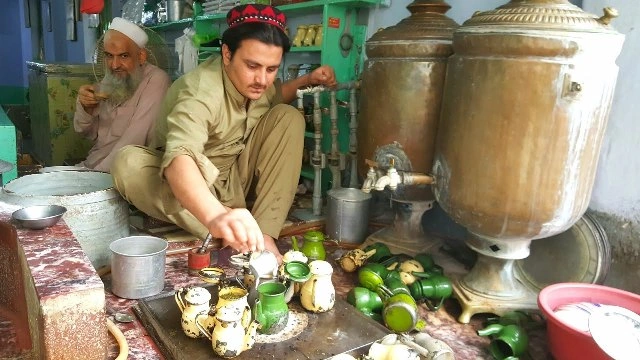
At Shah Wali Qatal Street, Fazlur Rehman of the famed Mohmand Qehwa carries forward a legacy inherited from his father in 1970 who was now joined by his own son.
“Making Qehwa is my passion,” he says, pouring steaming green tea into small cups. Most visitors prefer classic green Qehwa, while others request Sheen Da Payo — a green tea blended with milk, a cherished Ramazan specialty.
Here, he said conversations between visitors stretch deep into the night. Groups swap tales of culture, poetry, politics, and T20 world cup.
After Pakistan’s creation, these tea stalls became informal forums where locals debated historic moments from the Fatima Jinnah–Ayub Khan presidential contest to the 1965 war, the 1974 OIC Summit in Lahore, and even Pakistan’s 1992 Cricket World Cup triumph.
True to its name, the Storytellers’ Bazaar remains a place where narratives are shared as generously as tea.
Located near Ghanta Ghar and Bala Hisar Fort, and stretching toward ancient gates like Kabuli Gate, the Qisakhwani bazaar once hosted trade caravans arriving from Delhi, Amritsar, Lahore, Kabul, Dushanbe, Ashgabat, and Tashkent.
Merchants unloaded their goods, then sit in candlelit gatherings to exchange tales of love, architecture, music, and distant lands before crossing the legendary Khyber Pass.
According to Bakht Zada Khan of the Archaeology Department, excavations at Gor Khatri — one of the deepest urban digs in the world confirmed Peshawar’s history dating back to around 539 BC, earning it the title of South Asia’s oldest living city.
Through invasions and empires from Alexander the Great to Ahmad Shah Durrani, Qissa Khwani endured, absorbing each era into its layered identity.
The bazaar also carries cinematic nostalgia being home to Bollywood stars. Nearby stand ancestral homes linked to Bollywood legends Dilip Kumar (born Yousaf Khan) in Mohallah Khudadad,
Prithviraj Kapoor in Dhaki Nalbandi and
Shah Rukh Khan’s family residence at Shah Wali Katal.
“Peshawar’s Qissa Khwani and Dilip Kumar sahib are inseparable,” says Faud Ishaq, nephew of the late cinema icon Dilip Kumar. Kumar’s affection for his birthplace was so deep that he wished his ancestral home be used for the welfare of Peshawar’s people.
These homes continue to attract tourists and film enthusiasts from across borders. The bazaar has endured tragedy, including the 1930 Qissa Khwani massacre memorialized by a white marble monument at its centre.
“I have been selling chappli kabab here for 26 years,” says Waris Ali. “Even during the difficult years, we kept our fires burning.”
Today, visitors from Punjab, Swat, Chitral, Nowshera, Dir Upper, and beyond are returning as heritage of Qahwa still continue. Domestic tourism is reviving the night-time vibrancy of Ramazan.
In 2018, the Khyber Pakhtunkhwa government completed the Cultural Heritage Trail from Ghanta Ghar to Gor Khatri, restoring 85 historic buildings including the famed Sethi House. Proposals are now under consideration for further restoration to revive the bazaar’s centuries-old façade.
Traders’ representatives urge incentives for green tea cultivation in Malakand and Hazara to reduce costly imports and strengthen the local economy.
But beyond economics, preservation here means safeguarding identity of Qissa Khwani. As Aftar and Sehri approaches and the final cups of Qehwa are poured, conversations soften but never cease. In Qissa Khwani Bazaar, stories are not relics they are living companions, carried forward with every sip of tea. From Iftar to Sehri, the storytellers’ street still whispers its timeless tales.