By Dr. Muhammad Ali Zamir Bahawalpur, Aug 23 (APP):Where can history be found beyond the quiet shelves of books, the glass cases of museums and the folders of archives? Every so often, a place lets you feel the past practically standing in the street beside you. Bahawalpur is one such place, a city perched on the dunes of the Cholistan Desert where the past doesn't wait to be read; it …
Bahawalpur: Where the Sands preserve a kingdom of palaces and forts
By Dr. Muhammad Ali Zamir
Bahawalpur, Aug 23 (APP):Where can history be found beyond the quiet shelves of books, the glass cases of museums and the folders of archives? Every so often, a place lets you feel the past practically standing in the street beside you. Bahawalpur is one such place, a city perched on the dunes of the Cholistan Desert where the past doesn’t wait to be read; it simply shows itself.
It lives in the towering walls of Derawar Fort, in the graceful facade of Noor Mahal and in the vast expanses of Sadiq Garh, Gulzar Mahal and Darbar Mahal. It stretches through the old city gates, the historic schools, the corridors of Bahawal Victoria Hospital and the stacks of the Central Library.
Step out of the city toward Uch Sharif and the shrines there whisper of a spiritual and scholarly culture that predates the state itself.
The real story of Bahawalpur, though, is not the story of its royal homes alone. It is the story of all those homes together, the ones that kept trade routes in view, depended on water for survival, and were ruled by the Abbasi, or Daudputra, line.
The fort went up to protect the state; the palaces rose to declare its power; the schools, hospitals, libraries, and universities came to secure its future.
And then, in 1947, the state was folded into Pakistan, and in 1955 into West Pakistan. The political state came to an end. The architecture did not.
Today, Bahawalpur straddles two worlds. Modern roads cut across historic gates. Students fill schools founded by the Nawabs. Doctors and nurses work in hospitals that have stood for more than a century. Tourists photograph the palaces where princes, British officers, and nobles once moved. These relics are not frozen; they still shape the lives of the people around them.
The geography is where it all begins. Bahawalpur grew between the river and the desert and the desert was never empty space. For centuries, it was a hard but vital road for pilgrims, merchants and travelers. UNESCO’s records describe the forts strung along the caravan routes from Central Asia to the subcontinent, guarding both trade and pilgrimage.
To control those routes was to control movement; to control water was to control survival. The Daudputras had arrived in the region in the seventeenth century and when Nawab Bahawal Khan founded the state in 1748 later given firmer political form in 1802 Bahawalpur became its capital.
For the ordinary people who inhabited this land, history must have mattered less as dates and more as daily questions: Where would the water come from? Where could crops be grown? Was the road safe? Could a caravan cross the desert? Where would a sick man find treatment? Where could a child learn? That, more than royal titles, was the lasting work of the state.
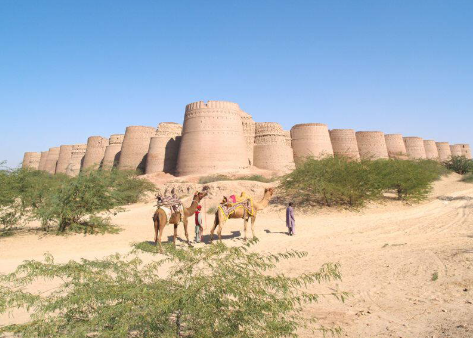
The people of Bahawalpur consider Derawar Fort their most impressive monument. In the harsh, near-impenetrable reaches of Cholistan, its forty great bastions rise like sentinels and from a distance, the fortress seems to float on the desert floor.
According to UNESCO’s tentative list, Derawar dates to the ninth century, raised by Rai Jajja Bhatti of the Bhatti clan. The Bahawalpur rulers captured it in 1733, lost it in 1747, and reclaimed it in 1804, after which it served as the Nawabs’ desert retreat. Its walls run 1,500 meters and climb as high as 30 meters, with forty bastions some 10 meters in circumference, decorated in intricate cut-brick patterns.
Derawar is far older than the state that later claimed it; the Nawabs inherited a strategic monument and folded it into their own political ambitions. Its walls were the frontier of Bahawalpur, while the city’s palaces formed its courtly heart.
In the shadow of those walls stands the Abbasi, or Derawar, Mosque, showcasing white marble and graceful curves that seem almost startling against the earth-toned fortress. Sources differ on its date 1835 or 1849 so it is safest to call it a nineteenth-century building. Where the fort speaks of military strength, the mosque speaks of faith and together they reveal a landscape where political power and religious identity have always shared ground.
Nearby, the royal cemetery turns the rulers once visited by embassies into mere names in stone, yet the fort outlasted them all and the desert remained.
Derawar was never alone. It belonged to a network: Mojgarh, Islamgarh, Marot, Mirgarh, Dingarh, Jamgarh, Nawan Kot, Bijnot, Khangarh and Khairgarh.
Some of these are ruined now, others survive only in fragments, and many are hard to reach. But viewed together, they record a far more connected landscape than today’s empty sands suggest. Caravans, pilgrims, merchants and soldiers all crossed it and the forts offered both protection and an assertion of authority.
The palaces are the other half of the story. Noor Mahal, built in 1872 in an Italian-inspired neoclassical style, blended European refinement with South Asian grandeur. It was never merely a home; it was the ruling family announcing itself to the world. Now it stands as a museum, elegant and oddly quiet; the courtiers are gone, the decisions long over, and only the rooms remain.
Darbar Mahal, raised around 1905, was where power was performed petitions heard, ceremonies held, government conducted and it still serves people today, now home to offices and the armed forces.
Gulzar Mahal, built in the Indo-Saracenic style between 1906 and 1909, humanizes all of it, reminding us that behind the plastered facades lived mothers, daughters wives, and children. A palace could be a home. Sadiq Garh, built between 1882 and 1891 at a grander scale, completes the picture.
After the state ended, its institutions carried the legacy forward. The school, the hospital, the library, and the university that grew from Jamia Abbasia all survived.
The mason who shaped a brick at Derawar never imagined tourists photographing it centuries later. The early teacher never knew how many children would pass through those gates. The nurse never dreamed of a 1,600-bed hospital. But all of them shared one inheritance: a history that outlived them.
The most fitting end is where we began, out in the desert. As the sun drops, Derawar’s walls turn color, the bastions fall into shadow, and the desert falls silent. The fort no longer looks like an instrument of war; it looks like a memory.
The state that built this world was gone by 1955, yet its story found its way into classrooms, hospital wards, library shelves and university corridors. It became tourism, scholarship and local memory a tale told to children wandering through an old palace.
Bahawalpur is not simply a city of palaces. It is a place of layers, where desert, river, fort, palace, school, hospital, faith, and scholarship converge. The state disappeared, but the memory remained, in walls and windows, domes and classrooms, hospital corridors and books, and above all in the people of Bahawalpur. That is the writing on the
sands.